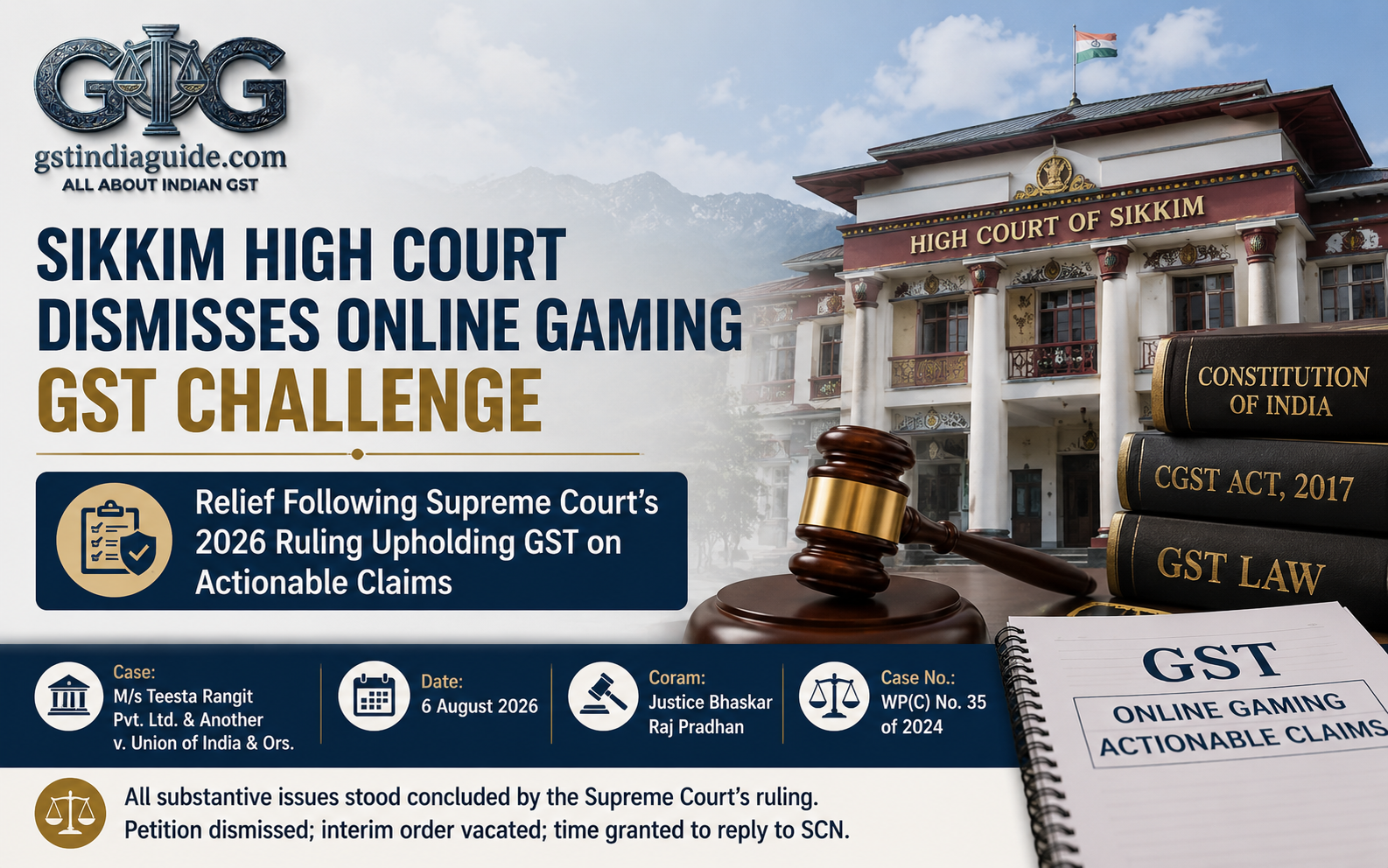
The Sikkim High Court has dismissed the writ petition filed by M/s Teesta Rangit Pvt. Ltd. & Another challenging GST proceedings relating to online gaming, after holding that the issues raised by the petitioners already stood concluded by the Supreme Court’s judgment dated 27 May 2026, reported as 2026 INSC 595. The High Court consequently vacated the interim protection granted earlier and directed the petitioners to respond to the pending show cause notice within the prescribed time.
Case Details
Case: M/s Teesta Rangit Pvt. Ltd. & Another v. Union of India and Others
Court: High Court of Sikkim, Gangtok
Case No.: WP(C) No. 35 of 2024
Date: 6 August 2026
Coram: Hon’ble Mr. Justice Bhaskar Raj Pradhan
The petitioners had raised several substantive challenges concerning the levy of GST on transactions associated with online gaming. During the proceedings, attention was drawn to the Supreme Court’s subsequent judgment resolving substantially identical constitutional and statutory questions. The Sikkim High Court observed that all five substantive prayers made in the writ petition involved issues that had already been considered and decided by the Supreme Court.
Supreme Court Principles Applied by the High Court
The Supreme Court had held that the essential element of betting and gambling lies in staking money or money’s worth on an uncertain outcome. Accordingly, even where a game involves substantial skill, participation involving monetary stakes on uncertain future outcomes can fall within betting and gambling for the purposes of the GST framework.
The Supreme Court further upheld the constitutional validity of the GST levy on actionable claims arising from betting and gambling. It sustained the relevant provisions of the CGST Act, including Sections 2(31), 2(52), 7, 9 and 15, holding that the levy is traceable to Parliament’s legislative competence under Article 246A of the Constitution. The constitutional challenges founded upon Articles 14, 19(1)(g), 21 and 265 were also rejected.
The Court additionally upheld the validity of Rules 31A, 31B and 31C of the CGST Rules. It held that the amendments introduced in 2023, including changes to Entry 6 of Schedule III and the insertion of Rules 31B and 31C, were clarificatory and explanatory and would operate retrospectively in the manner explained in the judgment.
In relation to online gaming, the Supreme Court held that organised gaming platforms involving pooled stakes create actionable-claim interests taxable under the GST law. Online gaming operators were held not to be merely intermediaries between players, but suppliers within the statutory framework. The taxable event arises upon placement and appropriation of stake amounts for participation in gameplay.
The Supreme Court also held that there was no statutory basis for deducting prize pools, winnings or payouts from the taxable value merely on that account. Pending show cause notices, adjudication proceedings and consequential demands relating to online gaming, fantasy sports and casino transactions were directed to be dealt with in accordance with Rules 31B and 31C, as applicable.
Sikkim High Court’s Decision
Applying the Supreme Court’s ruling, the Sikkim High Court found that no independent issue survived for consideration in the petition. The Court specifically recorded that the substantive contentions and prayers raised by the petitioners had already been adjudicated upon by the Supreme Court. The writ petition was therefore dismissed and disposed of in terms of the Supreme Court judgment, and the interim order earlier passed by the High Court was vacated.
Time Granted to Reply to Show Cause Notice
The petitioners requested the same procedural protection that had been granted by the Supreme Court in the connected matters. Accepting the request, the High Court directed the petitioners to submit their reply to the show cause notice within eight weeks from 6 August 2026.
The competent authority was further directed to consider the reply and pass an order in accordance with law and in light of the Supreme Court’s findings within twelve weeks thereafter.
Key Takeaway
The Sikkim High Court ruling reinforces the binding effect of the Supreme Court’s 2026 decision governing GST on online gaming, fantasy sports and betting-related actionable claims. Constitutional and statutory challenges to the levy no longer survived before the High Court, although taxpayers retain the opportunity to raise their factual and legally permissible submissions before the adjudicating authority in the pending GST proceedings.
The ruling is particularly relevant for online gaming operators and businesses facing pending show cause notices or adjudication proceedings, as those proceedings must now be decided in accordance with the valuation framework and principles laid down by the Supreme Court.