
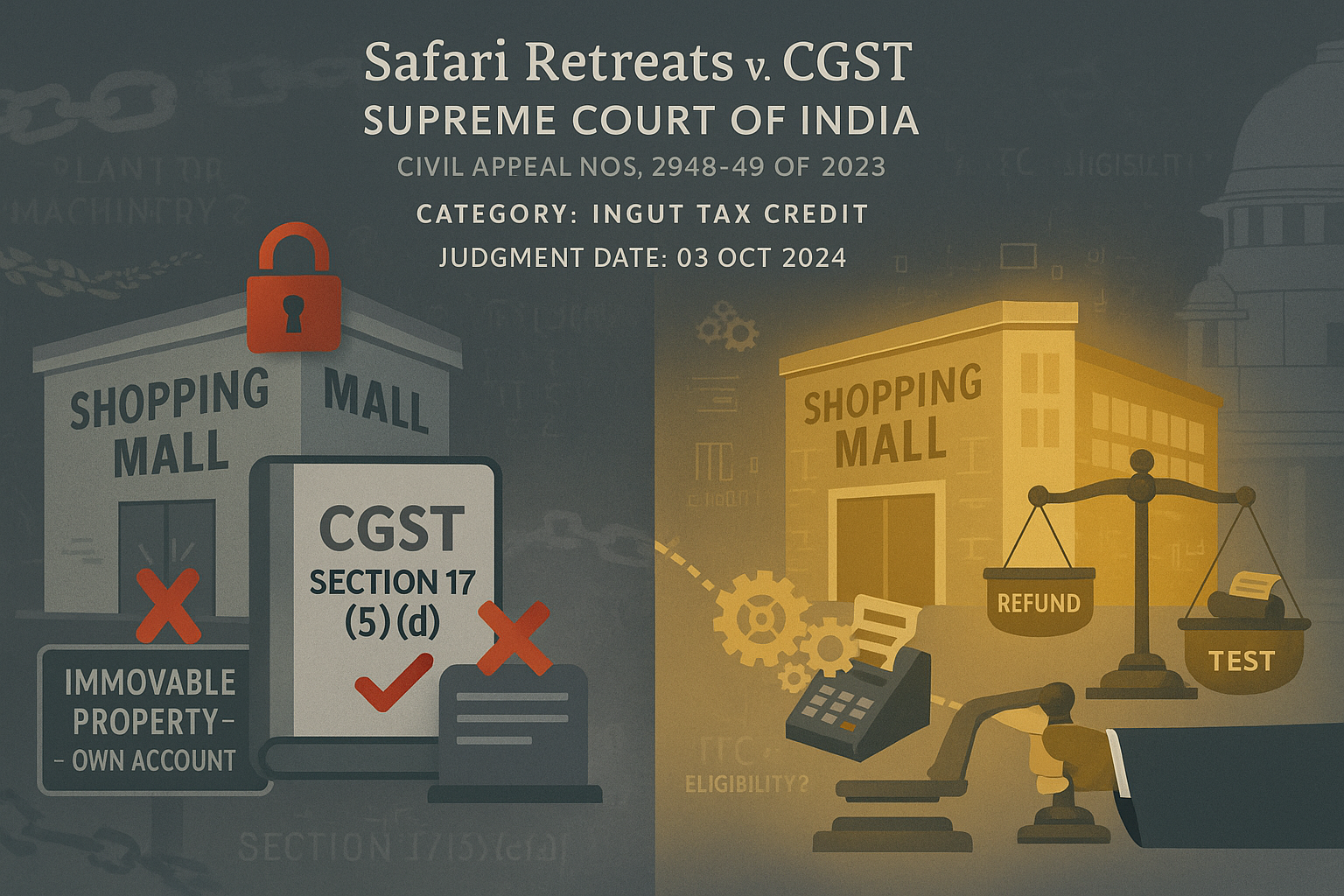
Case Title: Chief Commissioner of Central Goods and Services Tax v. Safari Retreats (P.) Ltd.
Court: Supreme Court of India
Petition Nos.: Civil Appeal Nos. 2948 and 2949 of 2023; WP(C) Nos. 804, 1030, 1036 of 2022; 90, 846 & 847 of 2023
Date of Judgment: 3rd October 2024
Relevant Section: Section 17(5)(c) & (d), Section 16(4), CGST Act, 2017
Category of Dispute: Input Tax Credit (ITC)
Facts of the Case
- The respondents, including Safari Retreats (P.) Ltd., constructed shopping malls intending to let out retail spaces and sought to avail Input Tax Credit (ITC) on goods and services used for the construction of such malls (¶2).
- Authorities denied the ITC by invoking Section 17(5)(d) of the CGST Act, asserting that ITC on immovable property constructed on “own account” is barred, regardless of its use for outward taxable supplies (¶2-3).
- The Orissa High Court read down Section 17(5)(d) to permit ITC in cases where rental income is generated, holding the denial to be contrary to the GST’s objectives (¶4).
- A series of writ petitions across the country also challenged the constitutionality of Section 17(5)(c) and (d), claiming that these provisions breach Articles 14, 19(1)(g), and 300A of the Constitution (¶5).
Questions in Consideration
- Whether Sections 17(5)(c) and 17(5)(d) of the CGST Act are constitutionally valid? (¶24(iii))
- Whether the expression “plant or machinery” under Section 17(5)(d) should be interpreted differently from “plant and machinery” defined in the explanation? (¶24(i))
- Whether malls or commercial buildings can qualify as “plant” for ITC eligibility under Section 17(5)(d)? (¶24(ii))
Observation of the Court
- On interpretation of “plant or machinery”: The Court noted that the legislature deliberately used the term “plant or machinery” (not “plant and machinery”) in Section 17(5)(d), implying a broader ambit and excluding application of the defined term “plant and machinery” under the explanation to Section 17(6) (¶44).
- Functionality test: The Court relied on judgments under income tax law (e.g., Taj Mahal Hotel, Karnataka Power Corp.) to hold that a building may qualify as a plant if it is specially designed and essential to the business’s functioning (¶52).
- Discrimination argument: The Court held that ITC is a statutory right, and classifications under Section 17(5)(c) and (d) are based on intelligible differentia with rational nexus to the object of the Act (¶58-60).
- Reading down rejected: Since no ambiguity or constitutional infirmity was found, there was no need to read down the provisions (¶64).
Judgment of the Court
- The Supreme Court upheld the constitutional validity of Sections 17(5)(c), 17(5)(d), and 16(4) of the CGST Act (¶65(a)).
- It clarified that “plant or machinery” in Section 17(5)(d) is not the same as “plant and machinery” under the explanation and must be interpreted independently (¶65(b)).
- The Court remanded the matter to the Orissa High Court to determine whether the shopping mall in question qualifies as a “plant” based on the functionality test (¶65(c), 66-67).
Between Fine Lines
- GST ITC can be denied for construction of immovable property used “on own account,” but there’s a carve-out for “plant or machinery.”
- Malls or commercial buildings may qualify for ITC if they are essential and integral to the taxable supply, applying the functionality test.
- The constitutional challenge to Sections 17(5)(c), (d), and 16(4) failed; ITC remains a statutory, not fundamental, right.
- The distinction between “plant and machinery” and “plant or machinery” is upheld; they are not interchangeable.
- The High Court must now determine factually whether specific constructions are “plant” eligible for ITC.
Summary of Referred Cases
| Case Name | Citation | Summary | Verdict |
| Taj Mahal Hotel v. CIT | [1971] 3 SCC 550 | Held sanitary fittings in hotels are “plant” under IT law based on essential use | Favoured broad interpretation of “plant” |
| Karnataka Power Corp. v. CIT | [2001] 247 ITR 268 (SC) | Power generating station building held as “plant” based on functional necessity | Allowed ITC treatment as plant |
| Anand Theatres v. CIT | [2000] 5 SCC 393 | Cinema/hotel buildings not plant; functional test not satisfied | Narrow interpretation; not applicable generally |
| Union of India v. VKC Footsteps India (P.) Ltd. | [2021] 130 taxmann.com 193 | ITC refund formula upheld; courts should not rewrite tax laws unless absurd results follow | Upheld legislative policy on refund limits |
| Solid & Correct Engg. Works v. CCE | [2010] 5 SCC 122 | Movability test used to decide whether an item qualifies as “goods” | Clarified test for immovable vs. movable property |
| Indore Development Authority v. Manoharlal | [2020] 8 SCC 129 | Clarified interpretative flexibility in statutory expressions like “or” and “and” | Accepted interpretive substitution in some cases |
| Dilworth v. Commr. of Stamps (UK) | [1899] AC 99 | Interpretation of “includes” in statutes | Explained legislative intent behind inclusive terms |