
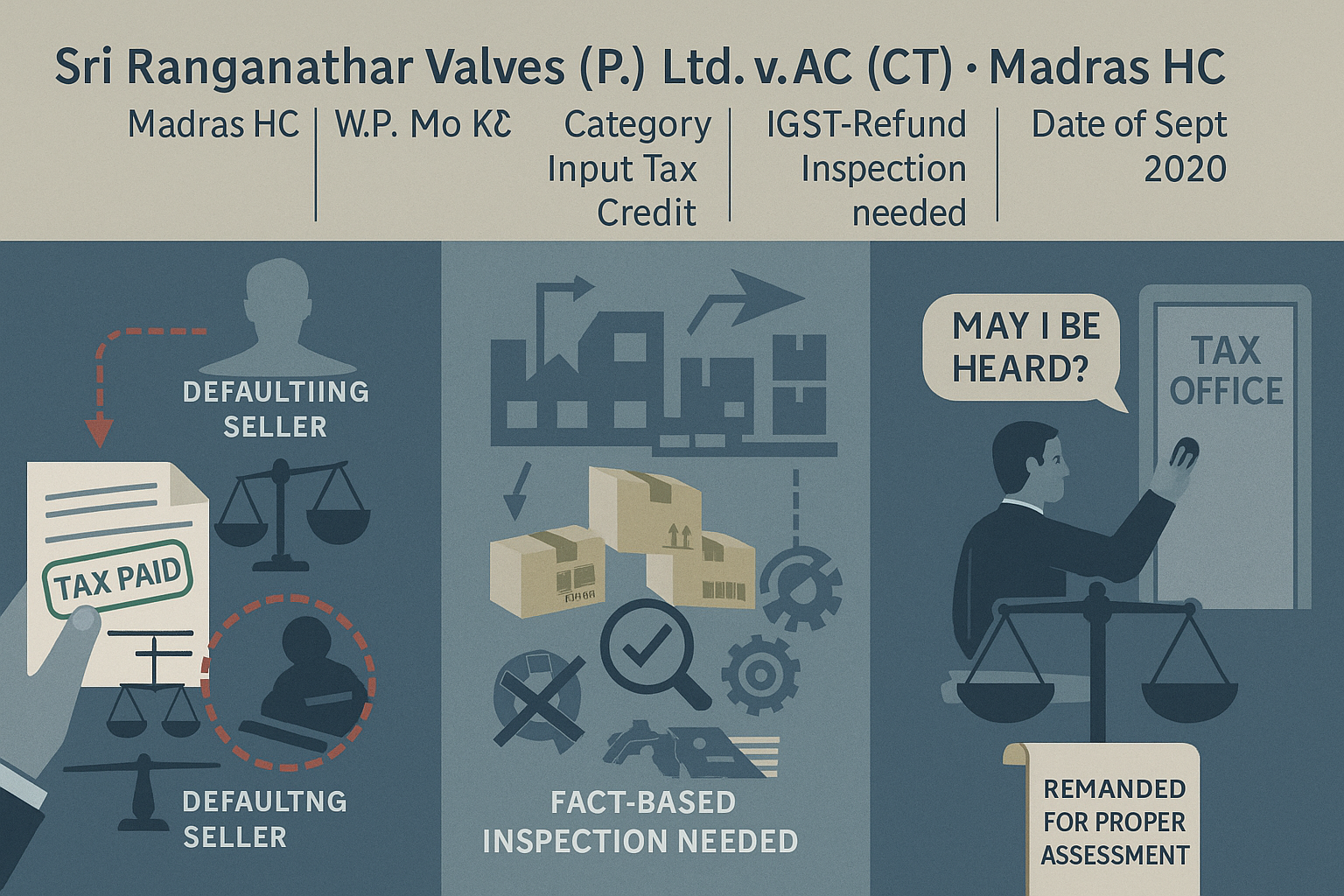
Case Title: Sri Ranganathar Valves (P.) Ltd. v. Assistant Commissioner (CT) (FAC)
Court Name: High Court of Madras
Petition Number: W.P. Nos. 38488 to 38493 of 2015
Category of Dispute: Input Tax Credit
Date of Judgement: September 2, 2020
Relevant Sections: Section 19(1), 19(9) of the Tamil Nadu Value Added Tax (VAT) Act, 2006
Facts of the Case:
- The petitioner challenged orders restricting Input Tax Credit (ITC) for December 2013 to May 2014. The restrictions were based on three grounds:
a) Taxes not paid by sellers;
b) Reversal of ITC due to wastage;
c) Ineligible claim of ITC on certain goods. [Para 2] - On the first ground, the department alleged that some sellers did not remit collected taxes to the government, even though they had invoiced the petitioner. [Para 3]
- Regarding reversal on wastage, the assessing officer applied uniform percentages (5% for invisible loss, 1% for visible loss) without assessing the actual loss incurred in manufacturing. [Para 4]
- On the third issue, the department disallowed ITC on the ground that the goods were not directly exported, although the petitioner claimed they were used in manufacturing export goods. [Para 5]
Question(s) in Consideration:
- Can ITC be disallowed solely on the ground that the selling dealer failed to remit tax to the government? [Para 3]
- Is it legally valid to apply uniform or ad hoc percentages for reversal of ITC on wastage without assessing actual loss? [Para 4]
- Should ITC be denied on goods not directly exported, though used in the manufacture of export goods, without giving the dealer a chance to explain? [Para 5]
Observation of Court:
- Citing Assistant Commissioner (CT) v. Infiniti Wholesale Ltd., the Court held that ITC cannot be denied if the purchaser has valid invoices and proof of tax charged, regardless of whether the seller remitted tax. [Para 3]
- Referring to its own prior judgment in Sri Ranganathar Valves (P.) Ltd. v. Assistant Commissioner (CT), the Court reiterated that assessing authorities cannot adopt arbitrary percentages for wastage loss. A fact-based assessment, including inspection of manufacturing processes, is mandatory. [Para 4]
- On ineligible ITC due to alleged non-export, the Court noted that the petitioner was not given any opportunity to present objections. [Para 5]
Judgement of the Court:
- The impugned orders were set aside. The matter concerning “prior sufferance of taxes” was remanded back to the Assessing Officer for reconsideration with personal hearing. [Para 7]
- On the issues of “ITC reversal on wastage” and “Ineligible ITC on goods”, the officer was granted liberty to issue fresh show cause notices, consider objections, and proceed per law. [Para 8]
- Writ Petitions were disposed of accordingly. [Para 9]
Between Fine Lines:
- A buyer cannot be penalized for a seller’s default in remitting tax if invoices are valid.
- Uniform percentages for ITC reversal on wastage are impermissible without assessing actual losses.
- Disallowing ITC without providing opportunity to object violates natural justice.
- Matter remanded to the assessing officer for proper reconsideration.
- Personal hearing is essential before passing final orders.
Summary of Referred Cases
| Name of Case | Citation | Summary | Verdict |
| Assistant Commissioner (CT) v. Infiniti Wholesale Ltd. | [2017] 99 VST 341 (Mad.) | ITC cannot be denied to buyer if tax was charged and invoices were issued, even if seller defaults | Buyer’s ITC claim cannot be denied |
| Interfit Techno Products Ltd. v. Principal Secretary and Commissioner of CT | [2015] 81 VST 389 | Assessing officers cannot apply uniform % for ITC reversal on wastage; detailed assessment is required | Set aside arbitrary reversals |
| Sri Ranganathar Valves (P.) Ltd. v. Assistant Commissioner (CT) | W.P. Nos. 41670–41680 of 2016 | Court disapproved of ad hoc wastage reversal; insisted on inspection-based assessment | Directions issued for fact-based review |