
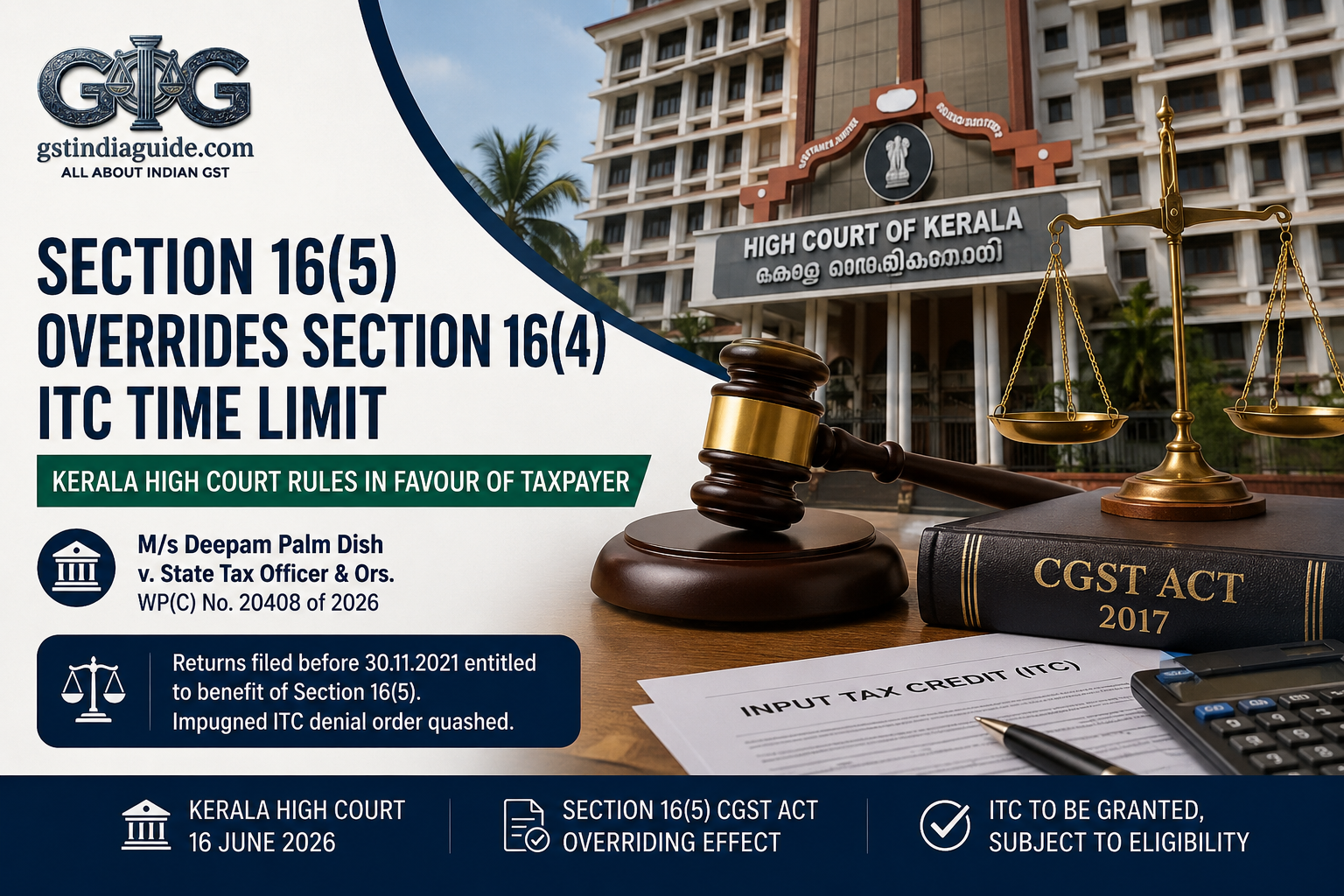
The Kerala High Court, in M/s Deepam Palm Dish v. State Tax Officer & Ors., has held that a registered taxpayer is entitled to the benefit of Section 16(5) of the Central Goods and Services Tax Act, 2017 where the relevant returns were furnished before the statutory cut-off date of 30 November 2021.
The judgment was delivered by Justice Ziyad Rahman A.A. on 16 June 2026 in WP(C) No. 20408 of 2026.
Background of the Case
The petitioner, M/s Deepam Palm Dish, is a registered taxpayer under the Central Goods and Services Tax Act and the Kerala State Goods and Services Tax Act.
The petitioner challenged an adjudication order passed under Section 73 of the CGST Act. Under the impugned order, the input tax credit claimed for April 2018 and March 2019 had been denied on the ground that the corresponding returns were not furnished within the time prescribed under Section 16(4) of the CGST Act.
The petitioner contended that it was entitled to the benefit of Section 16(5), as the returns relating to the relevant financial years had been furnished before 30 November 2021, which is the cut-off date prescribed under the provision.
Returns Filed Before the Section 16(5) Cut-Off Date
The High Court noted that the impugned order itself recorded the relevant dates of filing of the returns.
The return for April 2018 had been furnished on 15 February 2021, while the return for March 2019 had been furnished on 27 February 2021.
Both returns were therefore filed before the cut-off date of 30 November 2021 contemplated under Section 16(5) of the CGST Act.
Section 16(5) Contains a Non-Obstante Clause
The High Court observed that Section 16(5) contains a non-obstante clause in relation to Section 16(4).
Accordingly, once a taxpayer furnishes the relevant return within the cut-off date prescribed under Section 16(5), the limitation contained in Section 16(4) loses its significance for the periods covered by Section 16(5).
The Court found substance in the petitioner’s contention that the input tax credit could not be denied solely by relying on the earlier time restriction under Section 16(4), when the returns had admittedly been furnished within the extended statutory period recognised by Section 16(5).
Order of the Kerala High Court
The Kerala High Court quashed the adjudication order challenged in the writ petition.
The State Tax Officer was directed to reconsider the matter and grant the petitioner the benefit of Section 16(5) of the CGST Act, subject to the petitioner being otherwise eligible for the input tax credit.
Legal Principle Emerging from the Judgment
The judgment clarifies that the benefit introduced through Section 16(5) must be applied to eligible input tax credit claims relating to the financial years covered by the provision.
Where the relevant return was furnished on or before 30 November 2021, the claim cannot be rejected merely because it was beyond the original time limit prescribed under Section 16(4).
The non-obstante clause in Section 16(5) gives the provision overriding effect over the limitation contained in Section 16(4), subject to fulfilment of the remaining statutory conditions governing the availability of input tax credit.
Why This Judgment Is Important
The decision is relevant for taxpayers whose input tax credit for the earlier GST years was denied solely on account of delayed filing of returns under Section 16(4), despite the returns having been furnished within the cut-off date subsequently recognised under Section 16(5).
It also reinforces the obligation of adjudicating and appellate authorities to examine the effect of subsequent statutory provisions while deciding pending disputes concerning the time limit for availing input tax credit.
The ruling will be useful for advocates, Chartered Accountants, GST practitioners, tax consultants, businesses and corporate tax teams handling disputes involving Sections 16(4) and 16(5) of the CGST Act.



 overrides the ITC time limit under Section 16(4) where GST returns were filed before 30 November 2021.)