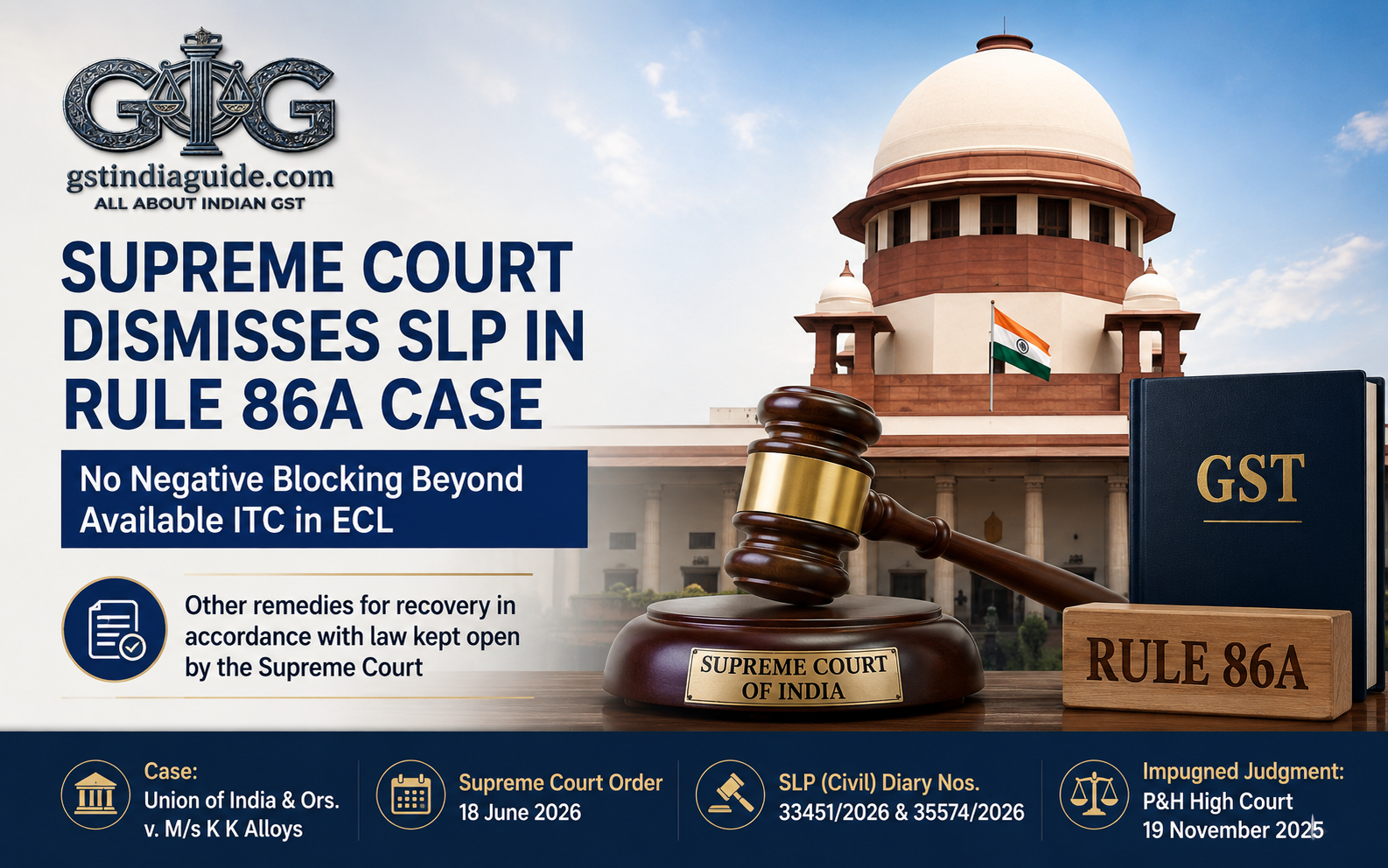
The Supreme Court has dismissed the Special Leave Petitions filed by the Union of India against the judgment of the Punjab and Haryana High Court in the case concerning negative blocking of the Electronic Credit Ledger under Rule 86A of the Central Goods and Services Tax Rules, 2017.
In Union of India & Ors. v. M/s K K Alloys, the Supreme Court found no case for interference under Article 136 of the Constitution. The Court, however, expressly kept open the authorities’ other remedies for recovery in accordance with law. The order was passed on 18 June 2026 by a Bench comprising Justice S.V.N. Bhatti and Justice Atul S. Chandurkar in Special Leave Petition (Civil) Diary Nos. 33451 of 2026 and 35574 of 2026.
Background of the Dispute
M/s K.K. Alloys had approached the Punjab and Haryana High Court challenging the action of the GST authorities in negatively blocking input tax credit in its Electronic Credit Ledger. The impugned entries were made on 27 August 2025 and 29 August 2025 under Rule 86A.
The principal question before the High Court was whether Rule 86A permits the Commissioner or an authorised officer to block a taxpayer’s Electronic Credit Ledger for an amount exceeding the credit actually available in the ledger on the date of the blocking order.
The taxpayer argued that Rule 86A only permits restriction of debit to the extent of input tax credit available in the Electronic Credit Ledger. According to the taxpayer, creation of an artificial negative balance would result in future credits being absorbed against that negative amount and would effectively operate as a recovery mechanism without following the statutory adjudication procedure.
Punjab and Haryana High Court’s Decision
The Punjab and Haryana High Court held that Rule 86A does not authorise negative blocking of the Electronic Credit Ledger beyond the credit available at the relevant time.
The High Court followed its earlier judgment in M/s Shyam Sunder Strips v. Union of India, in which it had endorsed the interpretation adopted by the Gujarat, Delhi, Telangana and Bombay High Courts.
The Court explained that availability of input tax credit in the Electronic Credit Ledger is a condition precedent for invoking Rule 86A. Where no credit is available, or where the credit has already been utilised, the power under Rule 86A cannot be exercised to create a negative balance.
Rule 86A is a provisional and preventive measure. It permits the proper officer to restrict debit from available credit where there are recorded reasons to believe that such credit has been fraudulently availed or is ineligible. It does not authorise the officer to make debit entries or undertake permanent recovery through the Electronic Credit Ledger.
The High Court accordingly set aside the impugned entries to the extent that they restricted debit beyond the input tax credit available in the taxpayer’s Electronic Credit Ledger when the action was taken.
Rule 86A Cannot Become a Recovery Mechanism
A significant principle emerging from the judgment is the distinction between provisional restriction and statutory recovery.
Rule 86A may be invoked before completion of assessment or determination of demand, but its operation is confined to credit actually available in the Electronic Credit Ledger. It cannot be used as a substitute for proceedings under Sections 73 or 74 of the CGST Act.
Where the department alleges that input tax credit has been wrongly availed or utilised, recovery must ordinarily be pursued through the adjudication provisions contained in the CGST Act. Depending upon the facts, the authorities may also consider other statutory remedies, including cancellation of registration under Section 29 or provisional attachment under Section 83.
The possibility that a taxpayer may continue to avail allegedly inadmissible credit does not permit the authorities to expand Rule 86A beyond its plain statutory language.
Supreme Court Dismisses the Special Leave Petitions
The Union of India challenged the High Court judgment before the Supreme Court. After condoning the delay, the Supreme Court held that no case for interference was made out in exercise of its jurisdiction under Article 136 and dismissed the Special Leave Petitions.
Importantly, the Court clarified that other remedies available to the petitioners for recovery in accordance with law would remain open. Therefore, while the relief granted against negative blocking remains undisturbed, the department is not prevented from initiating appropriate proceedings under the applicable statutory provisions.
The Supreme Court’s order does not contain an independent examination of Rule 86A. Nevertheless, the dismissal leaves the Punjab and Haryana High Court judgment operative between the parties.
Key Takeaway
GST authorities cannot create a negative balance in the Electronic Credit Ledger under Rule 86A by blocking an amount exceeding the credit actually available on the date of the order.
Rule 86A permits only a temporary restriction on utilisation of available credit. It does not authorise permanent debit, recovery of already utilised credit or adjustment of future input tax credit against an artificial negative balance.
Where the department seeks recovery of allegedly inadmissible input tax credit, it must adopt the remedies provided under the CGST Act and comply with the applicable adjudication procedure.