
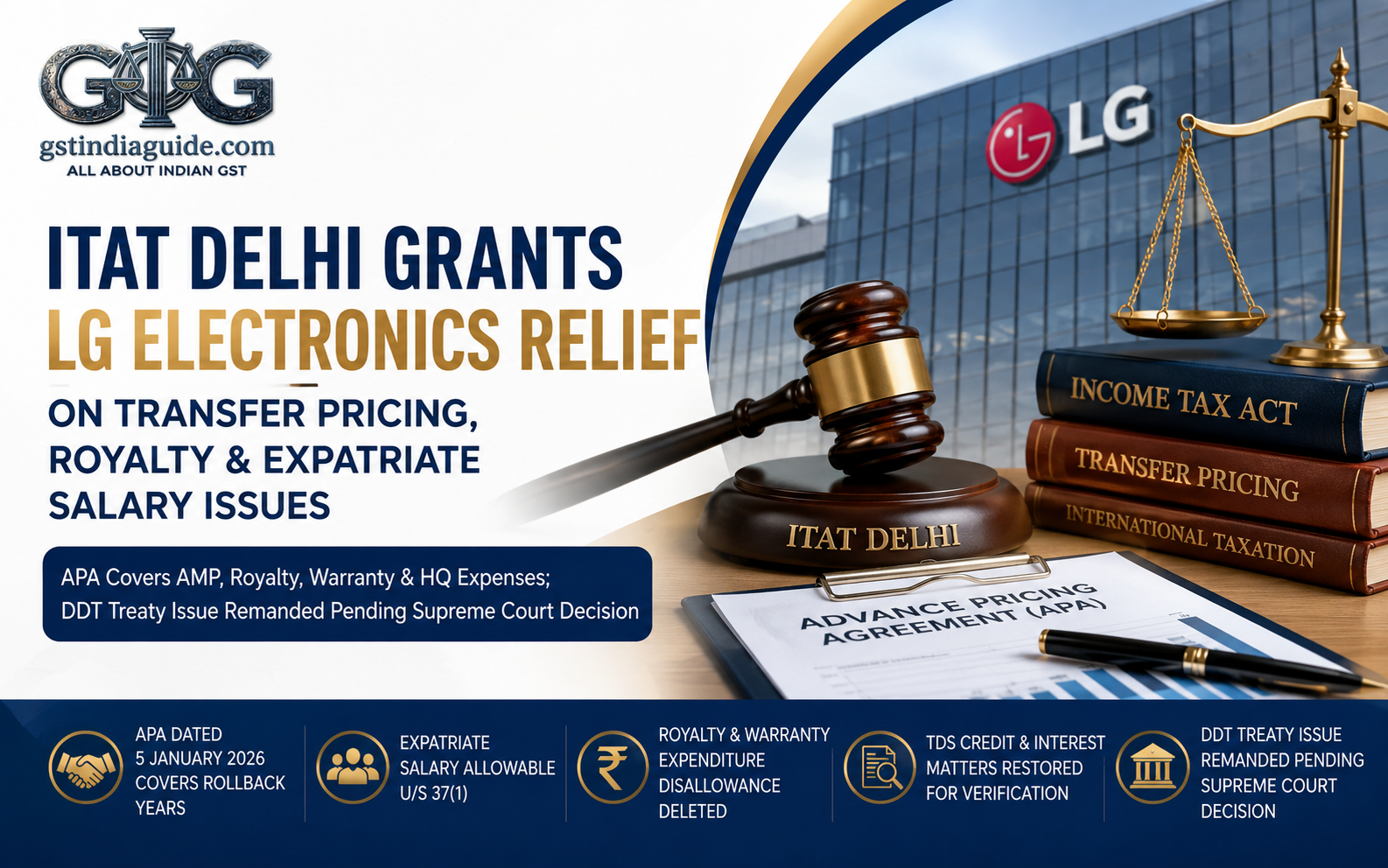
The Delhi Bench of the Income Tax Appellate Tribunal has partly allowed five appeals filed by L. G. Electronics India Pvt. Ltd., involving multiple transfer pricing and corporate tax issues across Assessment Years 2015-16, 2017-18, 2018-19, 2020-21 and 2022-23. A significant part of the dispute was resolved in light of an Advance Pricing Agreement (APA) dated 5 January 2026 entered into between the assessee and the Central Board of Direct Taxes under Section 92CC of the Income-tax Act, 1961.
Transfer Pricing Adjustments Covered by APA
The principal transfer pricing disputes concerned advertisement, marketing and promotion (AMP) expenditure, royalty payments, headquarters expenses and service warranty charges. During the pendency of the appeals, the assessee entered into an APA covering the relevant international transactions as well as rollback years. The agreement covered, among other transactions, royalty, imports and exports of goods and components, warranty charges, reimbursements, management fees and software services, and expressly included issues arising from AMP expenditure.
Under the APA, the covered assessment years included rollback years corresponding to Assessment Years 2015-16 to 2018-19 as well as APA years extending to Assessment Year 2023-24. The Tribunal recorded that the Revenue did not dispute this subsequent development. Accordingly, the transfer pricing issues were accepted for statistical purposes and the TPO/AO was directed to undertake consequential computation in accordance with the APA and law.
Expatriate Salary Allowable Under Section 37(1)
Another important issue concerned the disallowance of salary paid to expatriate employees on the ground that such employees were allegedly working under the direct control of LG Korea.
The Tribunal relied upon its earlier decision in the assessee’s own case for Assessment Year 2010-11. In that decision, it had found that the expatriates were employed for the assessee’s business, worked under its direct control and supervision, and were remunerated by the Indian company with applicable tax deducted at source.
Following judicial consistency, the Tribunal deleted the disallowance of expatriate salary under Section 37(1) for the relevant assessment years.
Royalty Expenditure: Disallowance Deleted
The tax authorities had also treated royalty paid by the assessee as capital expenditure. The Tribunal observed that the assessee had already succeeded on the same issue in earlier assessment years and that royalty transactions were also covered by the subsequently executed APA.
Accordingly, the Tribunal deleted the disallowance relating to royalty expenditure.
Provision for Service Warranty Allowed
For Assessment Year 2015-16, the assessee challenged disallowance of provision for service warranty, contending that the provision had been made on a scientific and rational basis.
The Tribunal noted that identical claims had previously been accepted in the assessee’s own cases for several assessment years. As the Revenue could not rebut that position, the Tribunal followed judicial consistency and deleted the service warranty provision disallowance.
TDS Credit Restored for Verification
In Assessment Year 2017-18, LG Electronics challenged restriction of TDS credit claimed through its revised return. The Tribunal considered the issue primarily one of reconciliation and factual verification rather than substantive adjudication.
The matter was therefore restored to the Assessing Officer for fresh determination in accordance with law.
Dividend Distribution Tax and India-Korea DTAA
A significant treaty issue arose regarding the assessee’s additional claim concerning Dividend Distribution Tax (DDT) and whether the rate could be governed by the India-Korea Double Taxation Avoidance Agreement instead of Section 115-O.
The Tribunal noted competing judicial developments, including the Bombay High Court decision in Colorcon Asia Pvt. Ltd. and the subsequent proceedings before the Supreme Court. The Supreme Court had admitted the Revenue’s Special Leave Petition on questions concerning the character of DDT and the applicability of treaty rates, while also directing High Courts to consider staying similar matters.
In view of the pending Supreme Court adjudication, the Tribunal remitted the DDT issue to the Assessing Officer with a direction to await the final decision of the Supreme Court.
Interest, Tax Credits and Consequential Issues
The Tribunal also restored the issue of Section 234A interest for Assessment Year 2020-21 for fresh examination, after the assessee contended that its return had been filed before the applicable due date.
Claims relating to credit for self-assessment tax and advance tax were similarly restored to the Assessing Officer for reconciliation and factual verification. Issues relating to interest under Sections 234B, 234C and 234D and certain penalty grounds were treated as consequential or premature.
The Assessing Officer was further directed to ensure that the correct tax rate is applied and that no double addition of transfer pricing adjustments is made while giving effect to the order.
Conclusion
The ruling is significant for multinational enterprises involved in prolonged transfer pricing litigation where an APA is concluded during the pendency of appeals. It illustrates how subsequent APA arrangements, including rollback provisions, can govern the consequential determination of transfer pricing adjustments for earlier assessment years.
The decision also reiterates the importance of judicial consistency in recurring disputes concerning expatriate remuneration, royalty expenditure and warranty provisions. At the same time, the Tribunal refrained from finally deciding the DDT treaty controversy because the issue is presently awaiting authoritative determination by the Supreme Court.
The five appeals filed by L. G. Electronics India Pvt. Ltd. were accordingly partly allowed.
[…] Click to view […]