, anti-profiteering, deemed dividend, Section 54EC and tax litigation.)
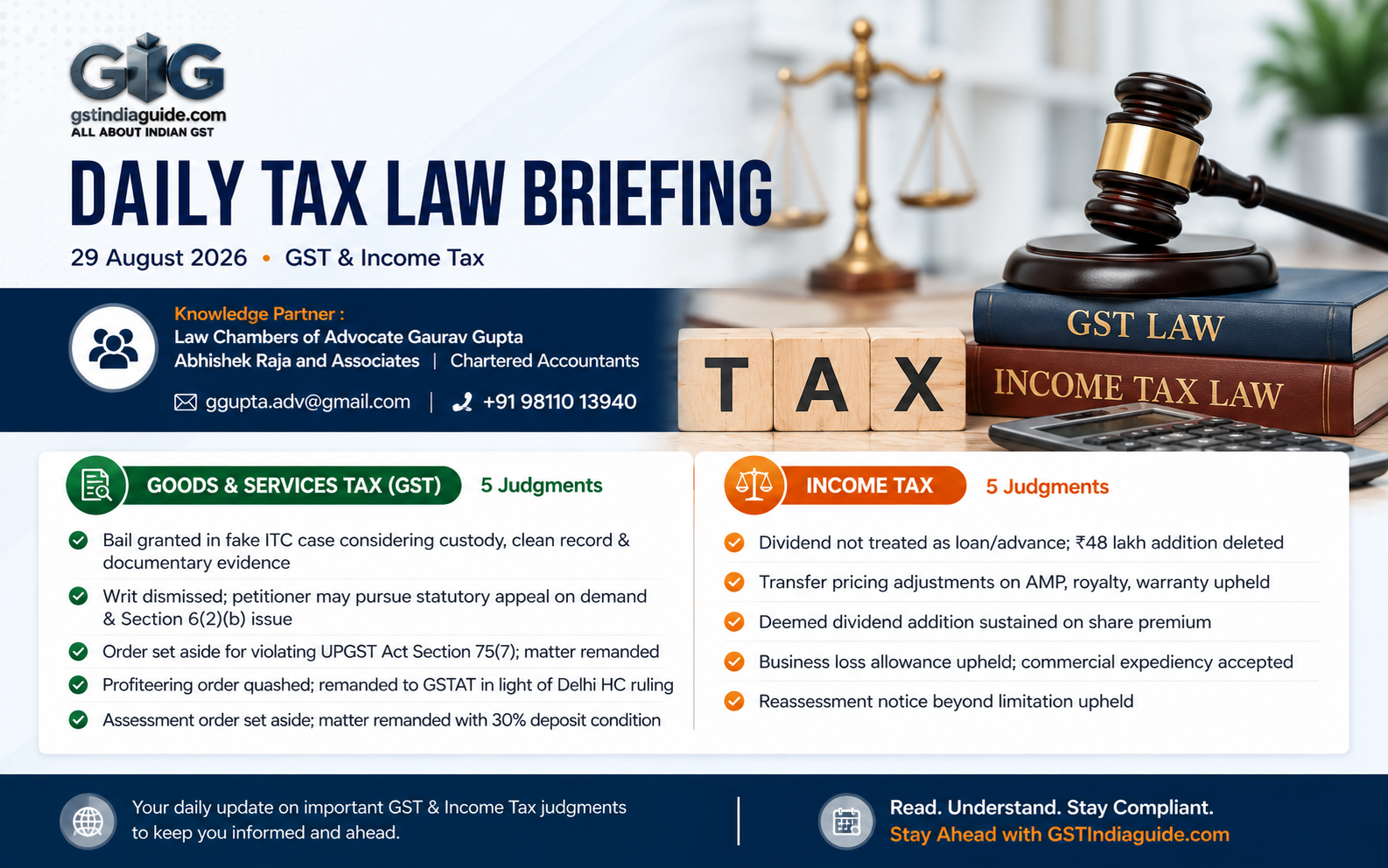
Daily Tax Law Briefing – GST & Income Tax | 29 August 2026
Goods & Services Tax (GST) (5 judgments)
| TITLE | BRIEF FACTS | RATIO |
| Karan Kochhar Versus Inspector (Anti-Evasion) of CGST Commissionerate
CRM-M No.37441 of 2026 (O&M)
Punjab and Haryana High Court
|
The petitioner sought regular bail under Section 483 of the Bharatiya Nagarik Suraksha Sanhita, 2023 in a complaint alleging offences under Sections 132(1)(b), (c) and (i) of the CGST Act read with Section 20 of the IGST Act. The Department alleged fraudulent availment and utilisation of ITC of ₹13.09 crore on fake invoices having taxable value of ₹72.76 crore. The petitioner was formally arrested on 29 April 2026 and had remained in custody for approximately four months. | The Court held that the petitioner was entitled to bail considering his approximately four months’ custody, clean antecedents, maximum prescribed imprisonment of five years, documentary nature of evidence, unlikely early conclusion of trial, and absence of material showing likelihood of tampering with evidence, influencing witnesses or non-cooperation with trial. Without commenting on merits, the Court directed his release on personal and surety bonds, subject to conditions including non-interference with witnesses, disclosure of address and not leaving India without prior permission of the Trial Court. Petition Allowed; Bail Granted. |
| M S Liberty General Insurance Limited v. The Additional Commissioner of CGST Delhi South Commissionerate & Anr.
W.P.(C) 4526/2026 and CM APPL. 22031/2026
Delhi High Court
|
The petitioner challenged the Order-in-Original dated 3 December 2025, principally alleging violation of Section 6(2)(b) of the CGST Act. State GST authorities had earlier initiated proceedings for FY 2020-21 alleging excess ITC of ₹2,44,97,609 and dropped them on 22 February 2025. Meanwhile, Central GST authorities issued an SCN dated 26 May 2025 under Section 74 covering FY 2018-19 to FY 2023-24, culminating in a demand of ₹4,80,26,753 along with penalty. | The Court held that Section 6(2)(b) seeks to prevent parallel Central and State proceedings on the “same subject matter”, but determining sameness requires comparison of the periods, allegations, transactions, ITC, computations and underlying material. Since this involved factual examination and the petitioner had an efficacious statutory appellate remedy, writ interference was declined. The Court left all contentions, including Section 6(2)(b), limitation under Section 74, ITC demand and penalties, open for determination by the Appellate Authority. An application under Section 14 of the Limitation Act for exclusion of time spent in the writ proceedings may also be considered on merits. Petition Disposed Of; Liberty to Avail Statutory Appeal. |
| M/S Dell International Services India Private Limited Versus State of U.P. and Another
WRIT TAX No. 3409 of 2026
Allahabad High Court
|
The petitioner challenged the adjudication order dated 13 July 2026 passed under Section 73 of the UPGST Act, 2017 for FY 2021-22 after an earlier remand by the High Court. A single show cause notice dated 24 February 2026 alleged GSTR-3B/GSTR-2B discrepancy of ₹54,63,216.28 and discrepancy in outward supplies of ₹15,09,56,460.22. The adjudication order, however, confirmed demands of ₹2,15,11,596 and ₹18,32,31,808 respectively. | The Court held that the confirmed demands far exceeded the amounts proposed in the show cause notice, constituting a clear violation of Section 75(7) of the UPGST Act, which mandates that the amount of tax, interest and penalty demanded cannot exceed the amount specified in the notice. The defect was fundamental and incurable. The Court declined to permit the State another opportunity to issue a fresh notice, observing that this would give the revenue authorities a second or third innings to improve their case. The impugned order dated 13 July 2026 was set aside and the matter remitted to the adjudicating authority for a fresh order. Order Set Aside; Matter Remanded. |
| Sanghvi Premises Pvt. Ltd. Versus Union of India and ors.
Writ Petition No. 3107 of 2023
Bombay High Court
|
The petitioner, a real estate company, challenged orders of the National Anti-Profiteering Authority, including the order dated 26 July 2022, determining alleged profiteering, and questioned the valuation methodology adopted for such computation. It also challenged the constitutional validity of Section 171 of the CGST Act, 2017 and Rules 122, 124, 126, 127, 129, 133 and 134 of the CGST Rules, 2017. | The Court noted that the Delhi High Court had held the methodology adopted by NAA/DGAP for computing profiteering in the real estate sector to be flawed because turnover and input tax credit do not directly correlate throughout a project’s life cycle. As the respondents had no objection to reconsideration, the impugned order dated 26 July 2022 was quashed and the matter remanded to GSTAT for fresh consideration in light of the Delhi High Court decision. The challenge to the vires of Section 171 and the Rules was left open pending the Supreme Court proceedings. Petition Allowed; Matter Remanded. |
| Sri Bramaramba Mallikarjuna District Tribal Rural Development Society v. The State of Andhra Pradesh & Ors.
Writ Petition No. 22624 of 2026
Andhra Pradesh High Court
|
The petitioner challenged the assessment proceedings, including Form GST DRC-07 and consequential recovery proceedings, principally on the ground that the assessment order did not bear the signature of the Assessing Officer. The respondents opposed the petition on the ground of inordinate delay and contended that uploading the order on the GST portal constituted valid service under Section 169(1)(d) of the GST Act. The petitioner also faced consequential attachment and recovery proceedings. | The Court held that absence of the Assessing Officer’s signature constitutes an inherent defect rendering the assessment order invalid, following its earlier Division Bench decisions holding that Sections 160 and 169 of the CGST Act cannot cure such defect. Considering the delayed challenge and practical difficulties under the online GST regime, relief was made conditional upon deposit of 30% of the disputed tax within six weeks. The assessment order was set aside and remanded for fresh adjudication after due opportunity of hearing; coercive recovery and attachment would stand revoked upon the stipulated payment. Order Set Aside; Matter Remanded subject to 30% deposit. |
Income Tax (5 judgments)
| TITLE | BRIEF FACTS | RATIO |
| Deepak Varandmal Wadhwa Vs. Assessing Officer, Circle 27(1), Mumbai
ITA No. 4843/Mum/2026
Income Tax Appellate Tribunal, Mumbai
|
The assessee, holding 85% shares and being a director of M/s Dhanraj Global Corporation Pvt. Ltd., received ₹48 lakh from the company on 23 May 2019. The AO treated it as deemed dividend under Section 2(22)(e). The assessee contended that the company was already indebted to him under a running account, which had an opening credit balance of ₹42,03,475 and never became debit. Although the CIT(A) accepted these factual aspects, the addition was sustained. | The Tribunal held that Section 2(22)(e) does not cover every payment made by a closely held company to a substantial shareholder; the payment must possess the character of a “loan or advance”. Where the company already owes money to the shareholder and makes payment against the shareholder’s existing credit balance without the account becoming debit, such payment merely discharges the company’s liability and cannot constitute a loan or advance. Here, the account ultimately showed a credit balance of ₹68,91,536 in the assessee’s favour. Accordingly, the ₹48 lakh addition under Section 2(22)(e) was directed to be deleted. Appeal Allowed. |
| L. G. Electronics India Pvt. Ltd. Vs Assistant/Joint/Additional Commissioner of Income Tax/Income Tax Officer, National e-Assessment Centre, Delhi / Deputy Commissioner of Income Tax, Circle-13(1), Delhi
ITA Nos. 490/Del/2021, 2493/Del/2022, 1036/Del/2023, 4397/Del/2024 & 187/Del/2026
Income Tax Appellate Tribunal, Delhi
|
The assessee filed five appeals for AYs 2015-16, 2017-18, 2018-19, 2020-21 and 2022-23 arising from assessments under Section 143(3) read with Section 144C(13). Principal disputes concerned transfer-pricing adjustments relating to AMP expenses, royalty, headquarters expenses and service warranty charges. During pendency, the assessee and CBDT entered into an Advance Pricing Agreement under Section 92CC on 5 January 2026 covering relevant international transactions and rollback years. Other issues included expatriate salaries, royalty expenditure, warranty provision, TDS/tax credits and DDT. | The Tribunal accepted that the APA governed the covered transfer-pricing transactions and directed the TPO/AO to make consequential computations accordingly. Following earlier orders in the assessee’s own cases, it deleted disallowances relating to expatriate salaries, royalty expenditure and service-warranty provision. TDS and other tax-credit issues were restored for verification. The DDT claim under the India-Korea DTAA was remitted to the AO to await the Supreme Court’s final adjudication of the pending issue. Consequential interest, penalty, correct tax-rate and double-addition matters were directed to be dealt with accordingly. Five Appeals Partly Allowed. |
| Nikhat Fatma Vs. PCIT Central, Patna
ITA No. 303/PAT/2026
Income Tax Appellate Tribunal, Patna
|
The assessee filed her return declaring income of ₹59,66,520. Following a search under Section 132, the AO examined ₹94 lakh paid in cash over and above ₹75 lakh stated consideration for jointly purchased shops and added ₹94 lakh as undisclosed investment, assessing income at ₹1,53,66,520. The PCIT invoked Section 263 because the AO neither specified the applicable provision nor applied Section 115BBE and had initiated penalty under Section 271AAB(1A)(a) instead of Section 271AAC. | The Tribunal held that failure to invoke the correct provision for the addition, resulting in non-application of the special tax rate under Section 115BBE, constituted incorrect application of law and caused loss of lawful revenue. Initiation of penalty under an incorrect provision also reflected non-application of mind and could adversely affect subsequent penalty proceedings. The assessment order was therefore erroneous insofar as prejudicial to Revenue. The PCIT was within his powers under Section 263 in setting aside the assessment and directing necessary inquiries and application of the correct provisions. Appeal Dismissed; PCIT’s Revision Order Upheld. |
| Shiv Kumar Agarwal Vs. ITO, Ward 37(4), Kolkata
ITA No. 1103/KOL/2026
Income Tax Appellate Tribunal, Kolkata
|
The assessee, a food-grain trader operating as M/s Sarita Traders, sold a property on 29 December 2012 and earned long-term capital gains. For exemption under Section 54EC, he invested ₹50 lakh in specified bonds on 28 March 2013 and another ₹50 lakh on 28 June 2013, both within six months of transfer but in two different financial years. The CIT(A) restricted the exemption to ₹50 lakh, leading to the present appeal. | The Tribunal held that, for AY 2013-14, Section 54EC prescribed two distinct conditions: investment within six months of transfer and a ceiling of ₹50 lakh for investment during each financial year. Where the six-month period extended over two financial years, an assessee could invest ₹50 lakh in each financial year and claim exemption of ₹1 crore. The subsequent amendment restricting the aggregate investment to ₹50 lakh, effective from AY 2015-16, was prospective. Accordingly, the orders of the AO/CIT(A) on this issue were set aside and the ₹50 lakh addition was deleted. Appeal Allowed. |
| Vithalrao Ranganathrao Ambarwadikar Vs. ACIT, Circle-3, Aurangabad presently ACIT, Circle-1, Aurangabad
ITA No. 1963/PUN/2025
Income Tax Appellate Tribunal, Pune
|
The assessee challenged addition of ₹9,92,38,664 as long-term capital gain on sale of land at Hamalwadi, Aurangabad, contending that it was agricultural land and hence not a capital asset. He also challenged interest disallowance of ₹6,50,110. The land was sold to Deogiri Nagari Sahakari Bank Ltd. by sale deed dated 10 April 2012. The assessee had ₹17,12,65,921 of available funds against advances of ₹1,42,56,800. | The Tribunal held that the land was not agricultural land: it had been purchased from Maharashtra Housing and Area Development Authority, no evidence established its agricultural character, no agricultural activity had been undertaken, and it was adjacent to Aurangabad Railway Station. The capital gain was therefore taxable in AY 2013-14 and the ₹9,92,38,664 addition was sustained. However, since sufficient own funds substantially exceeded the advances, such advances were presumed to have been made from own funds; consequently, the ₹6,50,110 interest disallowance was deleted. Appeal Partly Allowed. |