
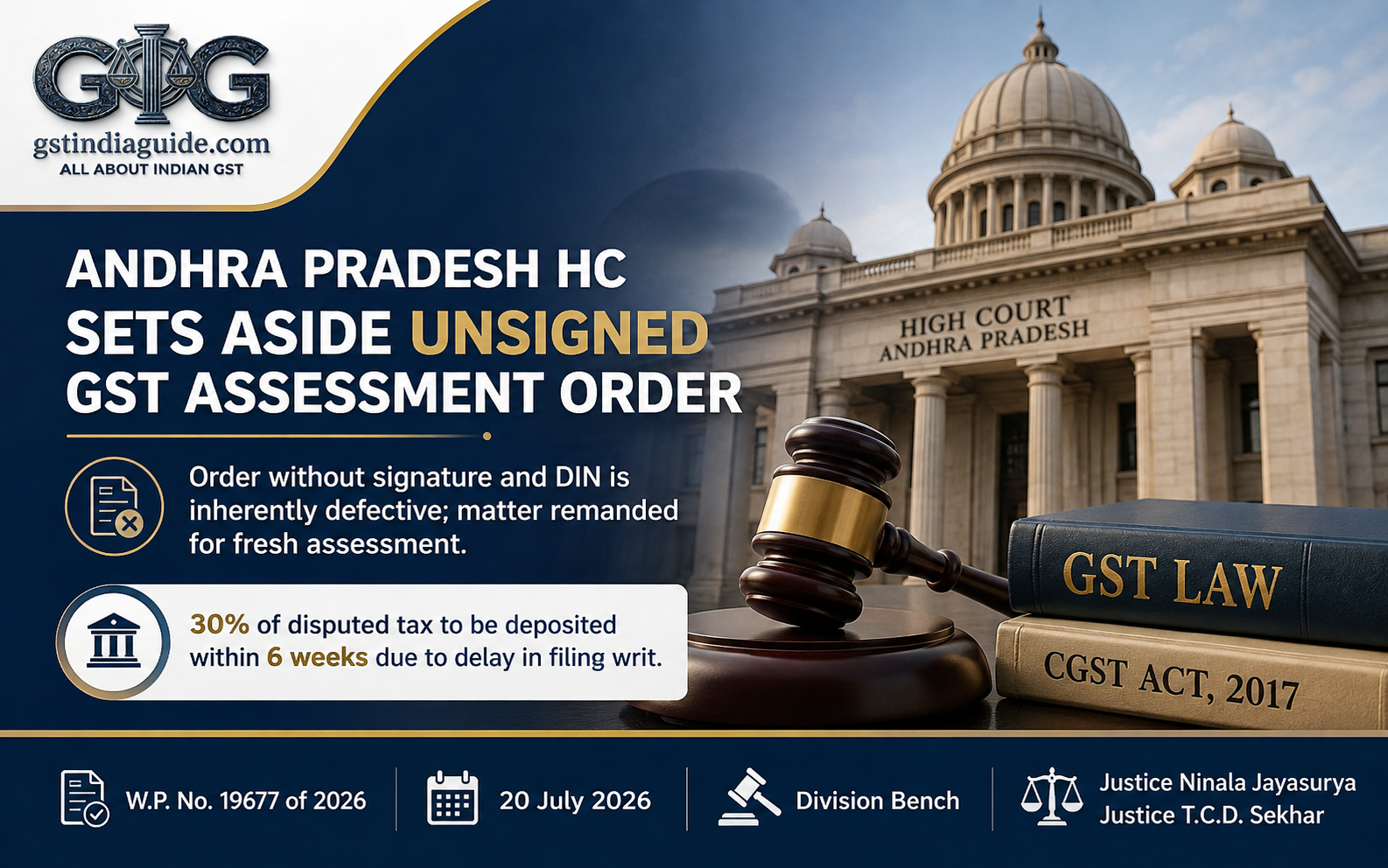
The Andhra Pradesh High Court, in M/s Modern Engineers and Contractors v. The Deputy Assistant Commissioner (ST) & Ors., has set aside a GST assessment order suffering from the inherent defect of absence of the assessing officer’s signature. The Court remanded the matter to the Assessing Officer for fresh consideration after providing due opportunity of hearing to the taxpayer, while imposing a condition of depositing 30% of the disputed tax because the writ petition had been filed after considerable delay.
The judgment was delivered by a Division Bench comprising Justice Ninala Jayasurya and Justice T.C.D. Sekhar on 20 July 2026 in Writ Petition No. 19677 of 2026, reported as 2026:APHC:28506.
The petitioner challenged the summary assessment order in Form GST DRC-07 dated 29 November 2023, contending that it did not contain the signature of the assessing officer or a Document Identification Number (DIN). The petitioner also challenged the subsequent demand notice dated 2 May 2026 issued under Section 79 of the CGST/APGST Act. The demand involved tax, interest and late fee aggregating to ₹1,13,154.
Absence of Signature Makes GST Order Invalid
The High Court referred to its earlier decisions in A.V. Bhanoji Row v. Assistant Commissioner (ST), M/s SRK Enterprises v. Assistant Commissioner, and M/s SRS Traders v. Assistant Commissioner ST & Ors. The Court reiterated the principle that the signature of the assessing officer on an assessment order cannot be dispensed with and that Sections 160 and 169 of the CGST Act do not cure such a defect.
The Court noted that its earlier precedents had consistently treated an assessment order without the signature of the assessing officer as invalid. It also referred to earlier decisions holding that absence of DIN can invalidate an order.
Delay in Approaching High Court and Portal Service
The Revenue opposed the writ petition on the ground of inordinate delay. It argued that uploading an order on the GST portal constitutes valid service under Section 169(1)(d) of the GST enactment.
The petitioner, however, submitted that the assessment order had not been served through conventional means and that the Department was relying on its uploading on the GST portal as sufficient service.
The High Court acknowledged that registered taxpayers ordinarily cannot rely upon ignorance of law or inability to access the GST portal as sufficient justification for delay. At the same time, the Court took note of practical difficulties arising from the online GST administration system, particularly where the impugned orders suffer from patent irregularities.
30% Deposit to Balance Taxpayer Hardship and Revenue Interest
The Court observed that, in cases where registered persons approach the High Court belatedly against orders containing patent irregularities, an appropriate balance could be achieved by requiring payment of 30% of the disputed tax.
Applying this principle, the Court held that the assessment order suffered from an inherent defect because it lacked the signature of the assessing officer. The impugned order was consequently set aside and the assessment was remanded to the Assessing Officer.
The relief was made subject to the petitioner depositing 30% of the disputed tax within six weeks. Any payments already made after the date of the assessment order were directed to be adjusted towards the stipulated 30% deposit. The deposit would ultimately abide by the result of the fresh assessment proceedings.
Fresh Assessment After Opportunity of Hearing
The Assessing Officer was directed to pass fresh orders after providing the petitioner the opportunity of hearing available under the GST Act. The Court further directed that the period from the date of filing of the writ petition until receipt of the High Court’s order by the Assessing Officer would be excluded for the purpose of limitation.
Importantly, all substantive issues were expressly left open for the petitioner to raise before the Assessing Officer in the fresh proceedings.
Key Takeaway
The judgment reinforces the Andhra Pradesh High Court’s consistent position that an assessment order lacking the assessing officer’s signature suffers from a fundamental defect and cannot be sustained merely by invoking curative or service-related provisions of the GST law. However, where the taxpayer approaches the writ court after substantial delay, relief against such a defective order may be made conditional upon payment of a portion of the disputed tax.