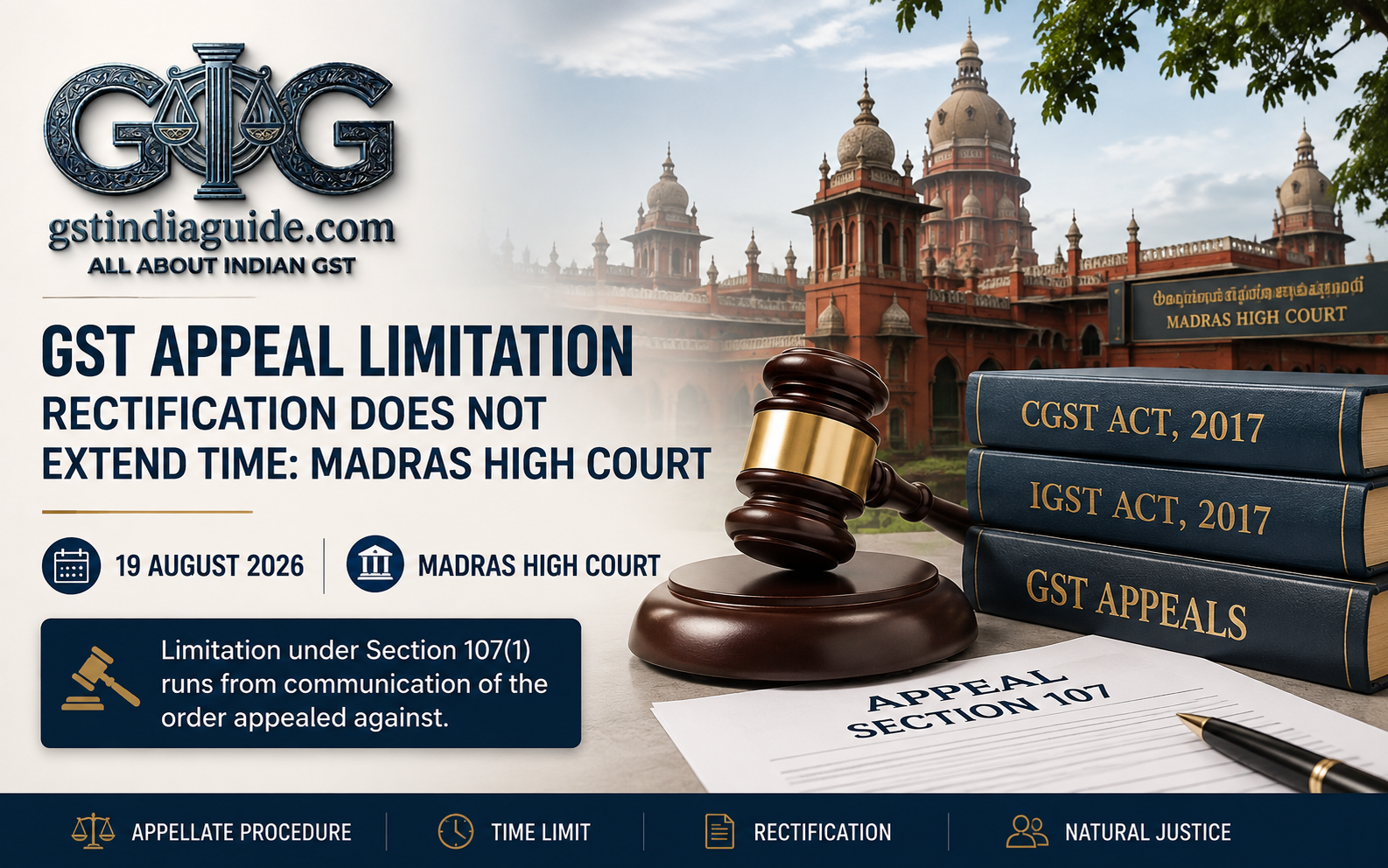
The Madras High Court, in M/s. Star Blue Metal v. The Appellate Deputy Commissioner (GST – Appeals), State Taxes, considered whether the limitation period for filing an appeal under Section 107(1) of the GST enactments could be reckoned from the communication of a rectification order instead of the original adjudication order. The common order was passed by Justice Senthilkumar Ramamoorthy on 19 August 2026 in W.P. Nos. 31621 and 31623 of 2026.
The petitioner had challenged two appellate orders whereby its statutory appeals against the original orders were rejected as being filed beyond the permissible period of limitation. The petitioner relied upon an alleged contradiction between the original orders. One order dated 31 December 2025 proceeded on the basis that supplies of Rs. 9,12,200 were taxable, whereas another order dated 20 December 2025 treated supplies of the same amount as exempt.
The petitioner contended that, in view of the rectification proceedings, the period prescribed under Section 107(1) should be calculated from the date of communication of the rectification order. Reliance was placed on the Madras High Court decision in M/s. SPK and Co. v. State Tax Officer and the Gujarat High Court decision in New Kailash Suppliers v. State of Gujarat & Ors.
Limitation Under Section 107(1)
The High Court noted that Section 107(1) permits an appeal against a decision or order within three months from the date of its communication. Referring to its earlier decision in the batch led by E2E Supply Chain Solutions Ltd. v. Deputy Commissioner of Income Tax, the Court reiterated that principles underlying Section 14 of the Limitation Act, 1963 can be invoked only where the requirements of that provision are satisfied.
Significantly, the Court recorded that the earlier decision in SPK and Co. had not dealt with the language of Section 107 or the principles laid down by the Supreme Court in the authorities considered in E2E Supply Chain Solutions Ltd. The Court therefore reiterated the observation that SPK and Co. did not qualify as good law on this issue.
Rectification Application Did Not Save the Appeals
On examining the record, the Court found that both appeals had been filed beyond the condonable period. It also found that the rectification applications merely reiterated the reply that had already been submitted to the show-cause notice. Consequently, there was no proper basis for seeking rectification on the grounds mentioned in those applications.
The Court accordingly found no infirmity in the appellate authority’s orders rejecting the appeals as time-barred. It declined to interfere with those appellate orders while expressly leaving it open to the petitioner to challenge the original orders in accordance with law. The connected miscellaneous petitions were closed without any order as to costs.
Key Takeaway
The judgment reinforces that the statutory limitation under Section 107(1) is ordinarily reckoned from the communication of the order sought to be appealed against. Filing a rectification application does not, by itself, restart or extend the limitation period. Where an assessee seeks exclusion of time on principles analogous to Section 14 of the Limitation Act, the applicable statutory requirements must be independently satisfied.
The ruling is particularly relevant for GST practitioners handling appellate matters where rectification proceedings are initiated after adjudication. Taxpayers should carefully monitor the statutory appeal period because pursuing rectification cannot automatically preserve an otherwise time-barred appeal.