
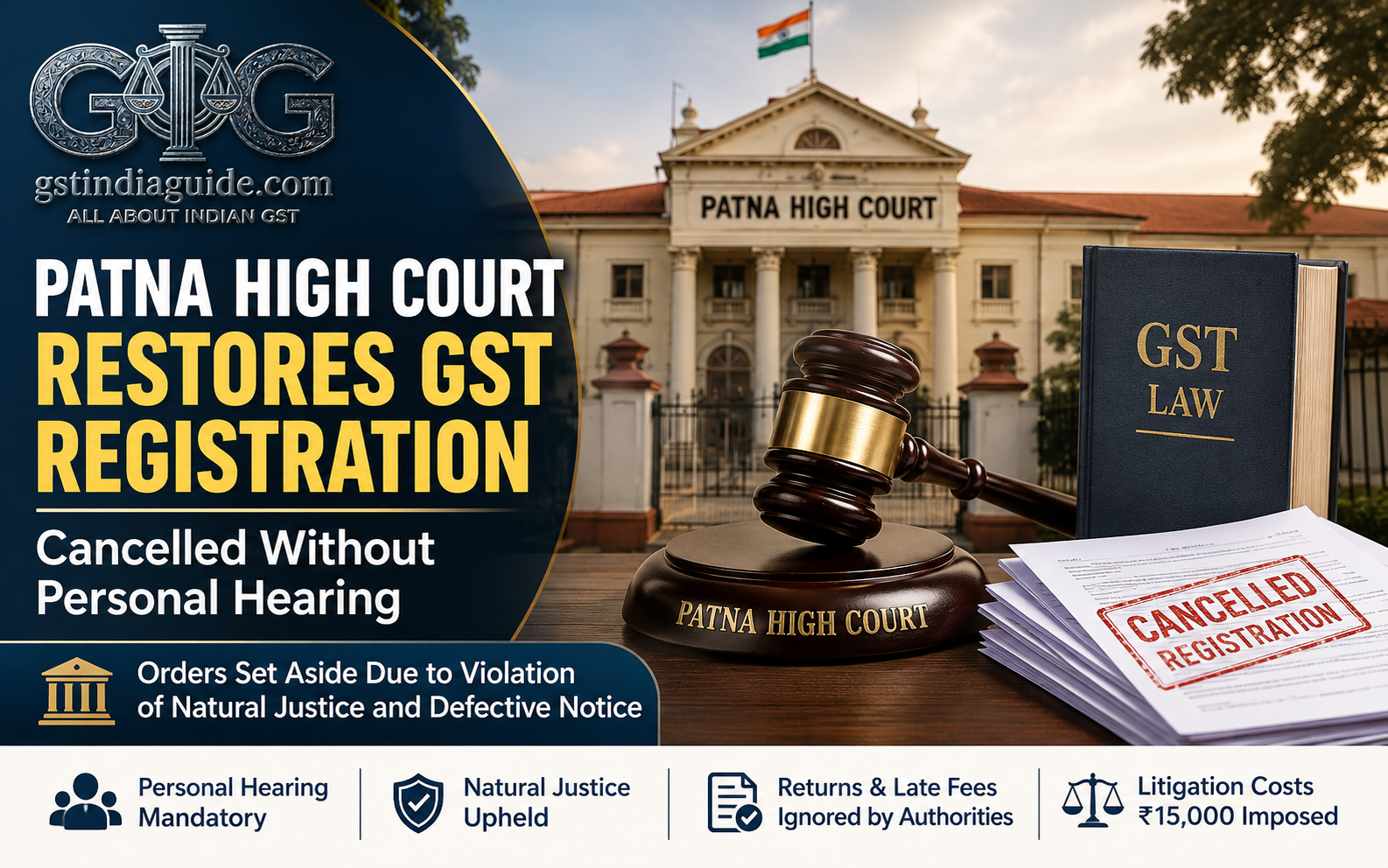
The Patna High Court, in M/s Munna Chaudhary v. The Union of India & Others, has set aside the cancellation of the petitioner’s GST registration, the rejection of its revocation application and the subsequent appellate orders. The Court held that the authorities acted without proper application of mind and failed to provide the personal hearing required under Section 75(4) of the Central Goods and Services Tax Act and the Bihar Goods and Services Tax Act.
The judgment was delivered on 17 July 2026 by a Division Bench comprising Justice Rajeev Ranjan Prasad and Justice Sunil Dutta Mishra in Civil Writ Jurisdiction Case No. 4593 of 2026.
Background of the Dispute
The petitioner was engaged in contractual work for various government organisations. A show-cause notice dated 3 February 2023 was issued on the allegation that the petitioner had failed to file GST returns continuously for six months.
According to the petitioner, the returns could not be filed within time because the accountant was suffering from dengue and the petitioner was dealing with the murder of his son. Since no response was submitted to the show-cause notice, the GST registration was cancelled by an order dated 26 June 2023.
The petitioner subsequently filed an application for revocation of cancellation. The petitioner asserted that the pending returns for the preceding six months had already been filed on 14 July 2023 after payment of the applicable late fees. However, the revocation application was rejected on 2 February 2024. The appeals filed by the petitioner were also dismissed on the ground of limitation.
Failure to Grant Personal Hearing
The Department admitted before the High Court that no separate notice fixing a date for personal hearing was issued before cancellation of the registration. Apart from the original show-cause notice, the petitioner was not granted any opportunity of personal hearing.
The High Court held that Section 75(4) casts a statutory duty upon the GST authorities to provide an opportunity of personal hearing where an adverse decision is contemplated. The Court observed that the settled procedure required the authorities to fix at least three dates for personal hearing.
Since no such opportunity was provided, the cancellation order and the order rejecting revocation were held to be contrary to the principles of natural justice embodied in the GST law.
Returns and Late Fees Were Not Considered
The Court found that the petitioner had filed the updated returns and paid the required late fees on 14 July 2023, much before the show-cause notice proposing rejection of the revocation application was issued on 22 January 2024.
The respondents did not specifically controvert the petitioner’s assertion regarding the filing of returns. The Court noted that the authorities could have verified the returns from the GST portal but failed to consider the information available on the portal.
The petitioner had also submitted a written explanation referring to the illness of the accountant, the petitioner’s own illness and the murder of his son. The Court observed that the Superintendent ignored this communication and proceeded in undue haste without examining the materials available on record.
Defective Notice and Absence of DIN
The Court further noticed that the show-cause notice issued in connection with the revocation proceedings did not disclose the name or designation of the issuing authority. It also did not bear a Document Identification Number, although quoting a DIN was mandatory at the relevant time.
The Department relied upon CBIC Circular No. 249/06/2025-GST dated 9 June 2025, under which the requirement of mentioning DIN was dispensed with for communications generated through the GST common portal carrying a valid and verifiable Reference Number.
The High Court rejected the attempt to rely retrospectively upon the 2025 circular. It held that the subsequent circular could not validate an earlier defective notice by giving the circular retrospective effect.
Limitation Could Not Protect Jurisdictionally Defective Orders
Although the appellate authority had dismissed the petitioner’s appeal on the ground of limitation, the High Court held that the underlying proceedings suffered from jurisdictional errors.
The cancellation adversely affected the petitioner’s livelihood, and the authorities had proceeded in violation of statutory safeguards and natural justice. Consequently, the Court held that the appellate orders were also required to be set aside.
Decision of the Patna High Court
The Patna High Court set aside the order cancelling the GST registration, the order rejecting the revocation application and the subsequent appellate orders.
The respondents were directed to restore the petitioner’s GST registration forthwith.
The Court also imposed litigation costs of ₹15,000 upon the respondent authorities. The amount was directed to be paid to the petitioner within one month from the date of the judgment.
Significance of the Judgment
The ruling reiterates that cancellation of GST registration cannot be treated as a routine administrative exercise. Where an adverse decision is contemplated, the statutory requirement of personal hearing must be meaningfully followed.
The judgment also emphasises that GST authorities must consider returns, payments and explanations already available on the GST portal before rejecting an application for revocation. A subsequent administrative circular cannot ordinarily be relied upon retrospectively to cure defects in a notice issued when different procedural requirements were applicable.
The decision is relevant for taxpayers, advocates, Chartered Accountants, GST practitioners and businesses dealing with cancellation and restoration of GST registration, rejection of revocation applications, defective notices, DIN requirements and denial of personal hearing.