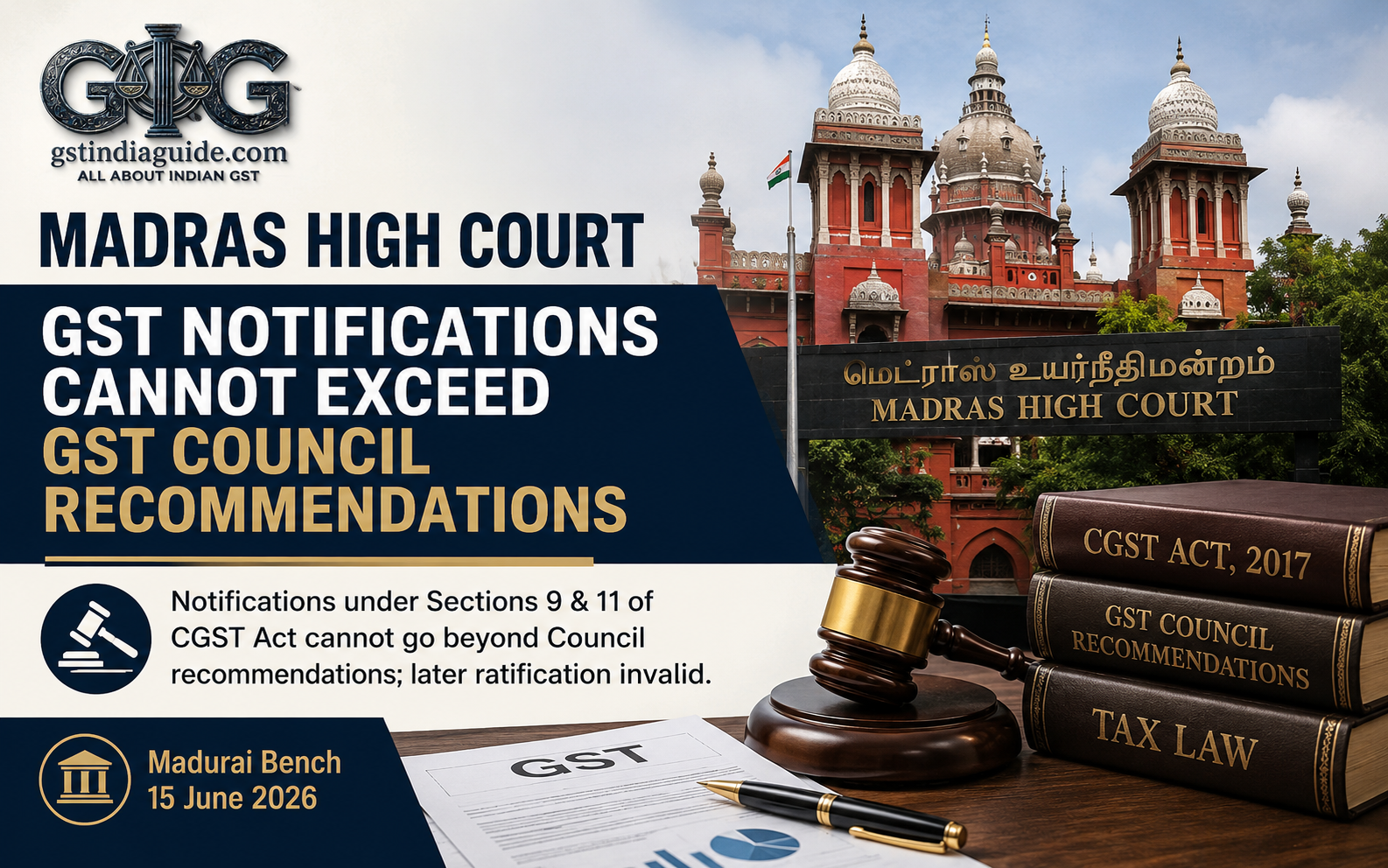
The Madurai Bench of the Madras High Court has delivered an important judgment on the relationship between GST Council recommendations and statutory notifications issued by the Central and State Governments. In M/s. Guru and Co. v. Union of India & Others, along with connected writ petitions, the Division Bench examined whether notifications issued under Sections 9 and 11 of the Central Goods and Services Tax Act, 2017 could contain provisions not supported by a prior recommendation of the GST Council.
The batch of writ petitions was decided by a Bench comprising Justice G.R. Swaminathan and Justice R. Kalaimathi on 15 June 2026. The proceedings arose from W.P.(MD) Nos.14115, 14116, 14117, 14118, 14119, 14120, 14208, 18602 and 26403 of 2022.
Background of the Dispute
The petitioners were suppliers of pulses such as moong dal and toor dal. They sold their products in unit containers under brand names that were not registered under the Trade Marks Act, 1999 or the Copyright Act, 1957.
Under the initial GST rate notifications issued on 28 June 2017, dried leguminous vegetables put up in unit containers attracted GST when they bore a registered brand name. Goods sold under unregistered brand names were therefore outside the taxable entry.
The Government subsequently issued Notification Nos.27/2017 and 28/2017 dated 22 September 2017. Corresponding State notifications were also issued by the Government of Tamil Nadu. These amendments expanded the scope of the levy to products bearing a brand name in respect of which an “actionable claim or enforceable right in a court of law” was available, unless such rights had been voluntarily foregone in accordance with the prescribed procedure.
Show cause notices were thereafter issued to the petitioners. They challenged both the amended notifications and the consequential notices, principally on the ground that the notifications travelled beyond the recommendations actually made by the GST Council.
Issues Before the High Court
The Court considered two principal questions. First, whether notifications issued by the Central Government under Sections 9 and 11 of the CGST Act could go beyond the recommendations of the GST Council. Second, whether the GST Council possessed the power to ratify a notification already issued by the Government.
GST Council Recommendations Bind the Government While Issuing Notifications
The Court distinguished between primary legislation enacted by Parliament or State Legislatures and subordinate legislation framed by the Government.
Relying on the Supreme Court’s decision in Union of India v. Mohit Minerals Private Limited, the High Court observed that while GST Council recommendations are not binding on legislatures when enacting primary legislation, the Government is bound by those recommendations when exercising delegated rule-making powers.
The Bench held that statutory notifications issued under Sections 9 and 11 stand on the same footing as rules framed under Section 164. Both constitute subordinate legislation and are required to be placed before Parliament. Consequently, when Sections 9 and 11 authorise the Government to act “on the recommendations of the Council,” the relevant recommendation must precede and support the notification.
The Government may decline to implement a recommendation, but it cannot introduce additional substantive conditions that were never recommended by the GST Council.
“Actionable Claim” and “Enforceable Right” Are Not Synonymous
The GST Council had approved a proposal covering a mark or name in respect of which an actionable claim was available. However, the impugned notifications also introduced the wider expression “enforceable right in a court of law.”
The High Court held that these two expressions were not synonymous. An actionable claim may constitute an enforceable right, but every enforceable right is not necessarily an actionable claim. The words “enforceable right in a court of law” therefore represented a substantive addition made by the Government beyond the Council’s recommendation.
The Court accordingly declared the Central and State notifications ultra vires the parent legislation only to the extent that they incorporated the expression “enforceable right in a court of law.” After removing that expression, the remaining portions of the notifications were held to be valid.
GST Council Has No Power of Retrospective Ratification
The Central Government argued that the notifications had subsequently been ratified by the GST Council at its 22nd meeting.
The High Court rejected this submission. Article 279A empowers the GST Council to make recommendations, but it does not confer any express or implied power to ratify an unauthorised action already taken by the Government.
The Bench relied on settled principles governing statutory authorities, under which an act performed without statutory authority is void from inception and cannot be cured by subsequent ratification. The Court also referred to the Telangana High Court’s ruling in Brunda Infra (P) Ltd. v. Commissioner of Central Tax, which held that later ratification cannot be equated with a prior recommendation and cannot revive an invalid notification.
The Court therefore held that the ratification recorded during the 22nd GST Council meeting was without jurisdiction.
Show Cause Notices Set Aside
Since the impugned show cause notices had been issued on the basis of the invalid portion of the notifications, the High Court set them aside.
However, the department was granted liberty to issue fresh show cause notices where legally permissible, based only on those portions of the notifications that continued to remain valid after the Court’s ruling.
The writ petitions were accordingly allowed, with no order as to costs.
Significance of the Judgment
The decision reinforces the statutory discipline governing delegated legislation under the GST framework. Although the GST Council’s recommendations may not bind Parliament or State Legislatures while making primary law, notifications issued under the charging and exemption provisions of the GST statutes must remain within the scope of the Council’s prior recommendations.
The judgment is also significant for holding that a constitutional or statutory body cannot retrospectively validate an action through ratification unless the power of ratification has been expressly conferred or necessarily implied.
For taxpayers and GST practitioners, the ruling provides an important ground to examine whether a rate, exemption or classification notification faithfully implements the recommendation of the GST Council or introduces additional conditions unsupported by the Council’s decision.