
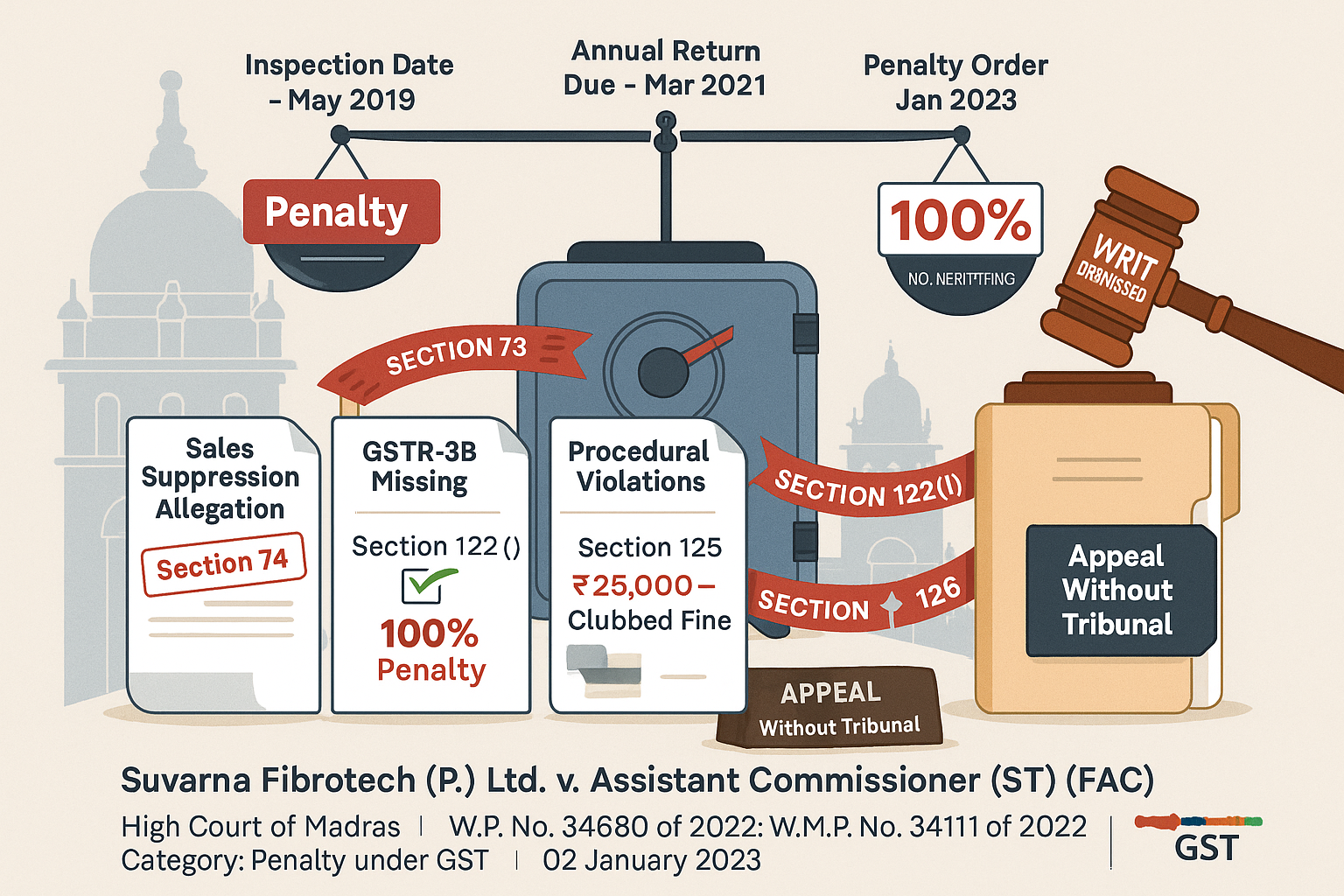
Case Title: Suvarna Fibrotech (P.) Ltd. v. Assistant Commissioner (ST) (FAC)
Court: High Court of Madras
Petition No.: W.P. No. 34680 of 2022; W.M.P. No. 34111 of 2022
Category of Dispute: Penalty under GST for Sales Suppression, Non-compliance of Statutory Provisions, and Tax Collection without Remittance
Date of Judgment: 02 January 2023
Relevant Sections: Sections 44, 73, 74, 122(1), 125, 126 of CGST/TNGST Acts; Rule 56 of CGST/TNGST Rules
Takeaway: Procedure vs. Penalty – When Compliance Timing Saves You from Suppression but Not from Liability
Facts of the Case
[Para 5]
Suvarna Fibrotech (P.) Ltd., engaged in manufacturing fibre glass composite products, was inspected by Enforcement Wing Officials during FY 2019–20. Three key issues emerged:
- (a) Alleged sales suppression;
- (b) Contraventions including non-maintenance of supplier/customer records and production data (Rule 56 violations);
- (c) Filing of GSTR-1 but failure to file GSTR-3B, hence tax collected was not paid.
The Original Authority imposed:
- 100% penalty for sales suppression,
- ₹25,000 for three procedural contraventions under Section 125, and
- 100% penalty under Section 122(1) for non-remittance of collected tax.
[Para 6]
The petitioner appealed, arguing all issues in detail, but the Appellate Authority confirmed the original penalties without specific analysis of grounds.
Questions in Consideration
- Whether the penalty under Section 74 was justifiable for alleged suppression when annual return reconciliation time had not lapsed? [Para 7]
- Whether multiple procedural contraventions could be clubbed under a single penalty, and if Section 126 applied for treating them as minor breaches? [Para 10]
- Whether the imposition of 100% penalty under Section 122(1) was appropriate or whether a lenient view under Section 126 was warranted? [Para 11]
Observations of the Court
On Point (a) – Suppression & Section 74
[Paras 7–9]
- The Court observed that reconciliation of annual return was due by 31.03.2021, and inspection occurred in April-May 2019.
- Therefore, invoking Section 74 for “suppression of facts to evade tax” was not appropriate; rather, Section 73 was applicable.
- However, shifting to Section 73 made the petitioner worse off as the minimum penalty under Section 73(9) would be ₹10,000 against the ₹3,890 originally imposed.
- Hence, though interference was declined, the Court clarified that Section 74 is not applicable.
On Point (b) – Statutory Non-compliances
[Para 10]
- Although the Original Authority could have levied ₹75,000 (₹25,000 for each of the 3 contraventions), only ₹25,000 was levied in total.
- Since facts were undisputed and Section 125 was a residuary penalty provision, no interference was warranted.
On Point (c) – Tax Collected but Not Paid (Section 122(1))
[Para 11]
- Section 126 did not apply here since the infraction involved a fixed percentage penalty and was not a minor breach or rectifiable documentation error.
- Hence, 100% penalty under Section 122(1)(iii) was justified.
Judgment of the Court
[Paras 12–13]
- All three challenges failed.
- The writ petition and connected miscellaneous petition were dismissed without costs.
- The Court clarified that the finding of suppression under Section 74 is not sustained and only Section 73 applies.
Between Fine Lines
- The Court clarified that procedural timelines matter when assessing the nature of suppression.
- Section 74 could not be invoked prematurely, but Section 73 still makes the petitioner liable.
- Procedural contraventions without factual disputes warrant penalties under Section 125.
- Failure to remit collected tax rightly attracted fixed penalties under Section 122(1).
- Filing a writ instead of waiting for the Tribunal (not yet constituted) proved disadvantageous.
Summary of Referred Cases
| Name of Case | Citation | Summary | Verdict |
| None Explicitly Referred | — | No precedents were cited in the judgment text. The ruling relied solely on statutory interpretation. | — |