, analysing Section 129 penalty for expired e-way bill, application of Section 126, and remand for fresh consideration.)
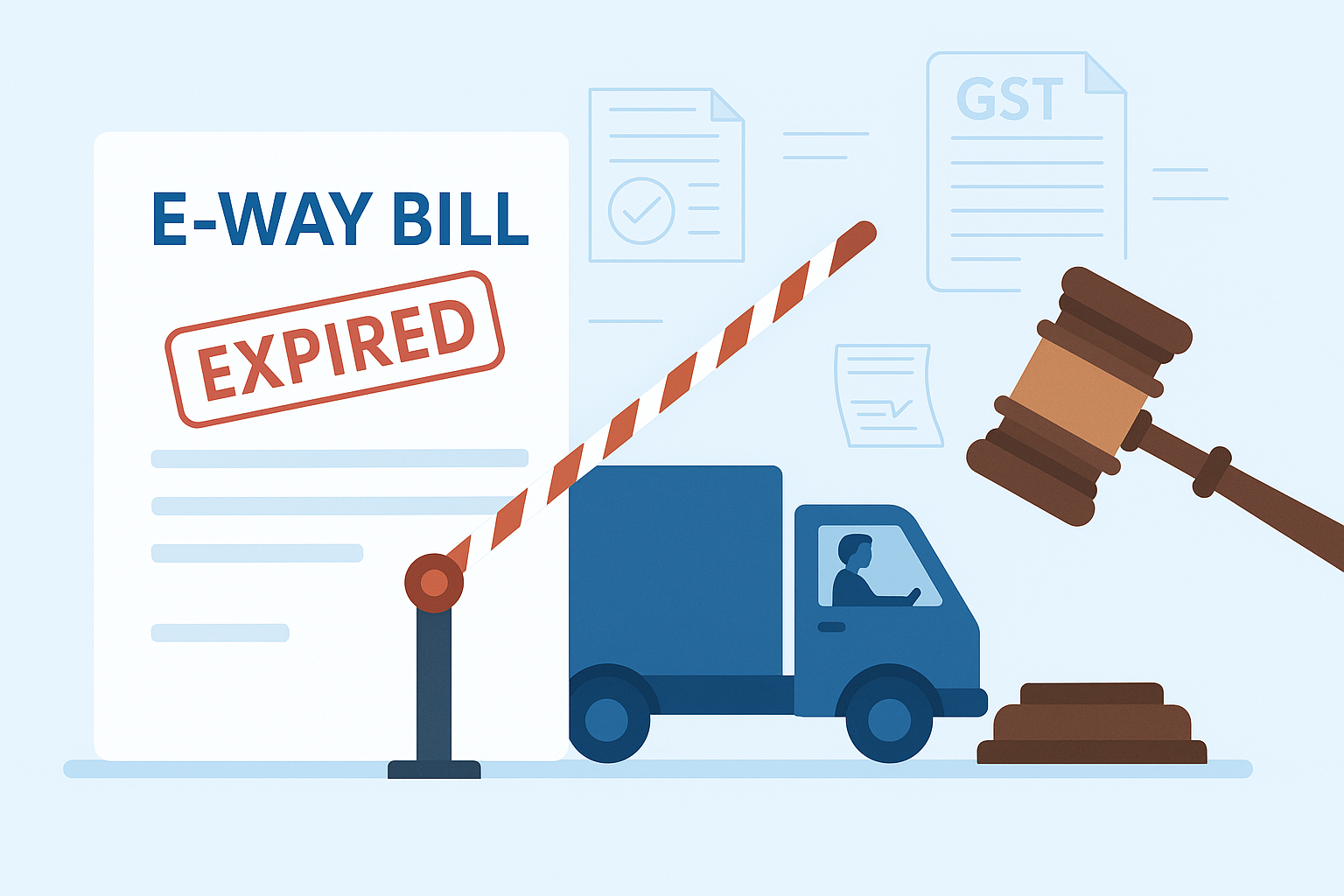
Nirmal Kumar Mahaveer Kumar v. Commissioner of CGST & Another
W.P.(C) 8585/2022 — Delhi High Court
Date of Judgment: 23.08.2022
Category: Detention & Penalty under Section 129 — Expired E-Way Bill
Facts of the Case (Paras 1–15)
The petitioner challenged the appellate order dated 31.12.2021 sustaining a demand of ₹2,33,100 tax and an equivalent penalty, levied under Section 129(3) of the CGST Act on grounds that the goods were transported with an expired e-way bill. The goods originated from Guwahati and were en route to New Delhi. The e-way bill was valid only till 28.09.2020, whereas the interception occurred on 29.09.2020 at 3:40 AM (paras 5–8).
Two e-way bills were on record (Annexures P-1 and P-3), and the vehicle had changed due to mechanical breakdown (para 9.1). The petitioner had not sought extension of validity on the GST portal. A Form GST MOV-07 notice dated 30.09.2020 was issued alleging that the goods were “not covered by valid documents” (paras 11–12). The petitioner paid the entire demand on the same day to secure release of goods (para 13.1), but did not pursue a reply on merits (para 14). Tax on goods was undisputedly paid (para 15).
Questions / Issues Before the Court
-
Whether mere expiry of e-way bill, without any intention to evade tax, justified levy of 100% penalty under Section 129(3).
-
Whether the petitioner should be granted an opportunity to demonstrate genuine reasons for delay in completion of transit.
-
Whether Section 126 CGST Act (for condonable and easily rectifiable mistakes) applies to cases of e-way bill expiry.
Court’s Observations (Paras 16–19.1)
The Court recorded that this was not a case of tax evasion, since tax on the goods had already been paid and the only lapse was the expiry of e-way bill (para 15–16). The petitioner’s explanation regarding vehicle breakdown warranted consideration.
The Court emphasised that the petitioner must be afforded a fresh opportunity to show bona fide reasons for delay (para 17). Importantly, the Bench expressly directed the authority to keep in mind Section 126, which deals with minor breaches or omissions that are easily rectifiable and do not warrant penal consequences (para 19.1). This provision becomes relevant where the lapse is purely procedural and not fraudulent.
Judgment / Verdict (Paras 18–21)
The High Court set aside the appellate order dated 31.12.2021 and remanded the matter to the Appellate Authority (Respondent No. 2). The authority was directed to:
-
Reconsider the case afresh;
-
Grant the petitioner full opportunity to produce evidence justifying delay;
-
Examine applicability of Section 126 CGST Act;
-
Issue a written notice fixing hearing date and time.
The writ petition was disposed of accordingly.
Statutory Provisions Considered
-
Section 129(3), CGST Act – Penalty for transporting goods without valid documents.
-
Section 126, CGST Act – Minor breaches, omission or mistakes that are easily rectifiable and should not attract penalty.
-
Rule 138(10), CGST Rules (contextual) – Validity and extension mechanism for e-way bill.
Case Classification under GST Act
Detention, Seizure and Release of Goods — Section 129 (Expired E-way Bill / Penalty)
Cases Referred (None cited in judgment)
The judgment does not expressly cite precedents. Hence, table is provided only for completeness.
| Case Name | Court | Citation | Principle / Verdict |
|---|---|---|---|
| No cases were cited in this judgment | — | — | — |
Between the Fine Lines — Practical Takeaways for Industry
This judgment reiterates that procedural lapses such as e-way bill expiry, when unaccompanied by any tax-evasion intent, cannot ipso facto justify the harsh 100% penalty under Section 129. Transporters and suppliers should document genuine transit delays (breakdowns, natural causes, obstruction of route) and may rely on Section 126 to argue that such lapses are minor, rectifiable, and not penal in nature. Authorities are duty-bound to accord a fair hearing and cannot mechanically sustain penalties solely based on expiry of e-way bill.
Disclaimer – “The above summary is for academic purpose only; not formal legal opinion. Seek professional opinion before application. Author or publisher or website shall not be responsible for any usage in any form.”