(c) mandatory: ITC cannot be claimed where the supplier has not actually paid GST to the Government.)
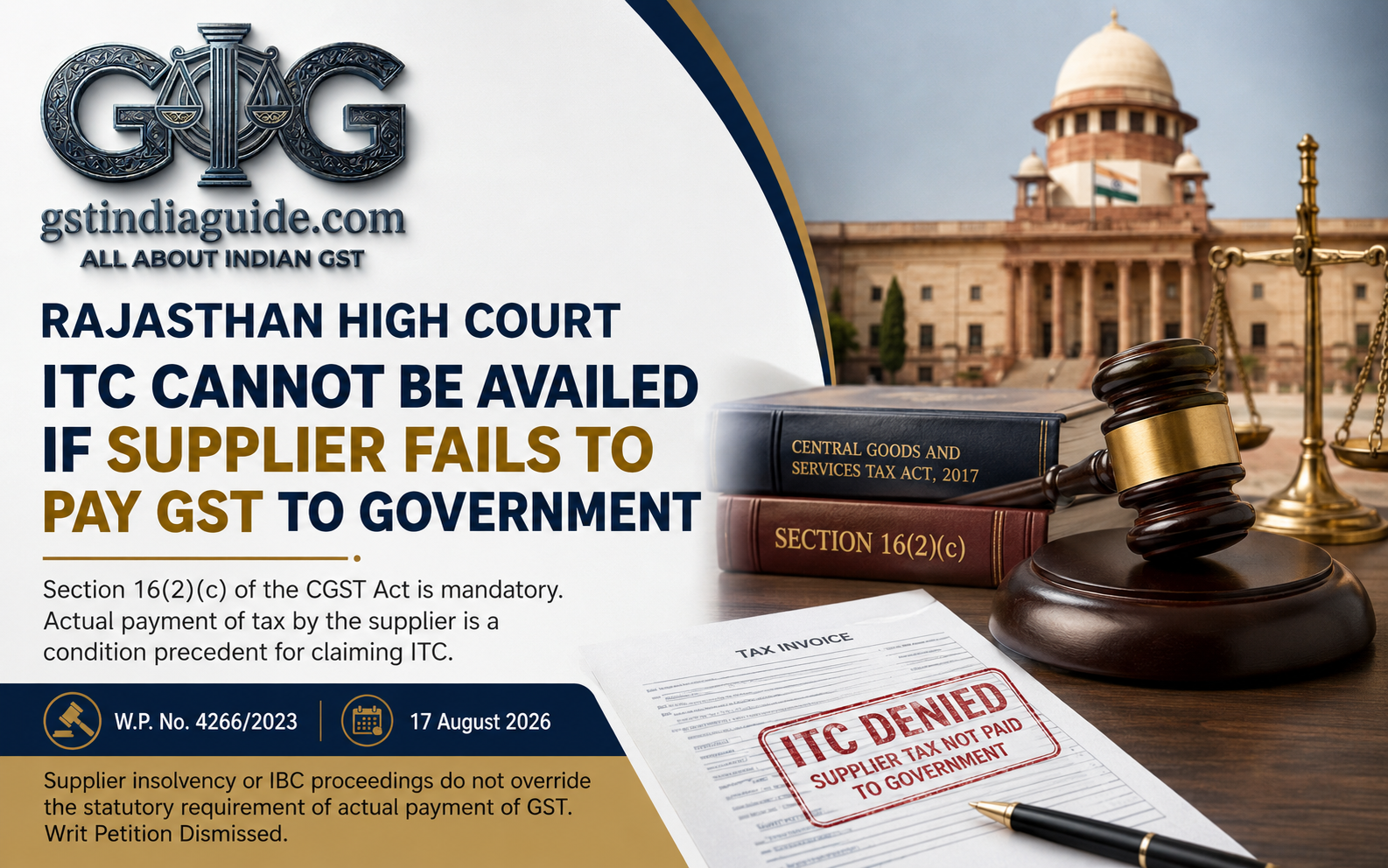
The Rajasthan High Court has held that the condition prescribed under Section 16(2)(c) of the Central Goods and Services Tax Act, 2017 is mandatory and that a recipient cannot claim Input Tax Credit where the tax charged by the supplier has not actually been paid to the Government. The Court consequently declined to interfere with the GST demand raised against the purchasing dealer and dismissed the writ petition.
The dispute arose after M/s Shree Karni Electrovision purchased electronic goods from M/s Techno Kart India Limited during December 2017 to January 2018. According to the judgment, the purchases amounted to approximately Rs. 59.42 lakh and involved GST of Rs. 13 lakh, comprising Rs. 6.50 lakh each towards CGST and RGST. The petitioner had availed ITC in respect of the tax charged by the supplier.
The supplier subsequently became insolvent and proceedings were initiated under the Insolvency and Bankruptcy Code, 2016. According to the petitioner, the tax authorities failed to pursue their tax claim against the supplier during the insolvency proceedings. The petitioner therefore argued that it could not subsequently be made liable merely because the supplier had failed to deposit the GST collected from it.
Challenge to Section 16(2)(c) of the CGST Act
The petitioner challenged the validity of Section 16(2)(c), contending that the provision effectively requires a purchasing dealer to ensure that the supplier deposits tax with the Government even though the purchaser has no practical mechanism to compel such payment. Alternatively, the petitioner sought reading down of the provision by relying upon the principle lex non cogit ad impossibilia—the law does not compel a person to perform an impossibility.
The petitioner also relied upon the Supreme Court judgment in Ghanashyam Mishra & Sons (P.) Ltd. v. Edelweiss Asset Reconstruction Co. Ltd., concerning the effect of approval of a resolution plan under the Insolvency and Bankruptcy Code.
Section 16(2)(c) Is a Mandatory ITC Condition
The Rajasthan High Court rejected the challenge. It held that Section 16(2)(c), subject to Section 41 of the CGST/RGST Acts, expressly requires that the tax charged in respect of a supply must actually be paid to the Government.
The Court observed that unless this statutory requirement is fulfilled, availment of ITC is prohibited. Where a purchaser avails credit despite the supplier not having discharged the corresponding tax liability, recovery of such ITC is permissible in accordance with law.
The Court further relied upon the Gujarat High Court decision in Maruti Enterprise through its authorised partner, Jigneshbhai Bharatbhai Tarpara v. Union of India & Ors., which had considered the constitutional challenge to Section 16(2)(c), its interplay with Sections 41 and 155 of the CGST Act and Rule 37A of the CGST Rules.
The Rajasthan High Court endorsed the principle that the various conditions contained in Section 16(2) have to be satisfied conjointly and cannot be treated as independent requirements. Consequently, possession of an invoice and receipt of goods or services alone would not establish entitlement to ITC if the condition relating to actual payment of tax to the Government remains unsatisfied.
Burden of Establishing ITC Eligibility
The judgment also reinforces the relevance of Section 155 of the CGST Act, under which the burden of proving eligibility for ITC lies upon the person claiming the credit.
Accordingly, a registered person claiming ITC must establish compliance with the applicable statutory conditions. The Court did not accept the proposition that the Revenue must stop its enquiry once receipt of goods or services under Section 16(2)(b) is established.
Supplier’s Insolvency Does Not Override Section 16(2)(c)
The Rajasthan High Court also rejected the petitioner’s reliance on the Supreme Court’s decision in Ghanashyam Mishra & Sons.
The Court held that the Supreme Court judgment concerns the consequences arising after approval of a resolution plan under the IBC. It does not dispense with the statutory conditions governing the purchasing dealer’s independent entitlement to ITC under Section 16(2)(c) of the CGST Act.
Thus, the insolvency of the supplier and the consequences flowing from the resolution process were held insufficient to override the statutory requirement that the tax relating to the supply must actually have been paid to the Government.
Conclusion
The Rajasthan High Court held that Section 16(2)(c) is a mandatory condition for availment of Input Tax Credit. Where the supplier has not paid the tax charged on the underlying supply to the Government, the recipient cannot claim an unconditional right to retain the corresponding ITC.
Finding no ground to interfere with the order dated 24 November 2022, the Division Bench dismissed the writ petition.
The ruling assumes significance for GST recipients dealing with supplier defaults, particularly where the supplier subsequently enters insolvency proceedings. It reiterates that entitlement to ITC remains governed by the statutory conditions prescribed under Section 16, read with Section 41 and the burden of proof contemplated under Section 155 of the CGST Act.