(xi) of the Income-tax Act.)
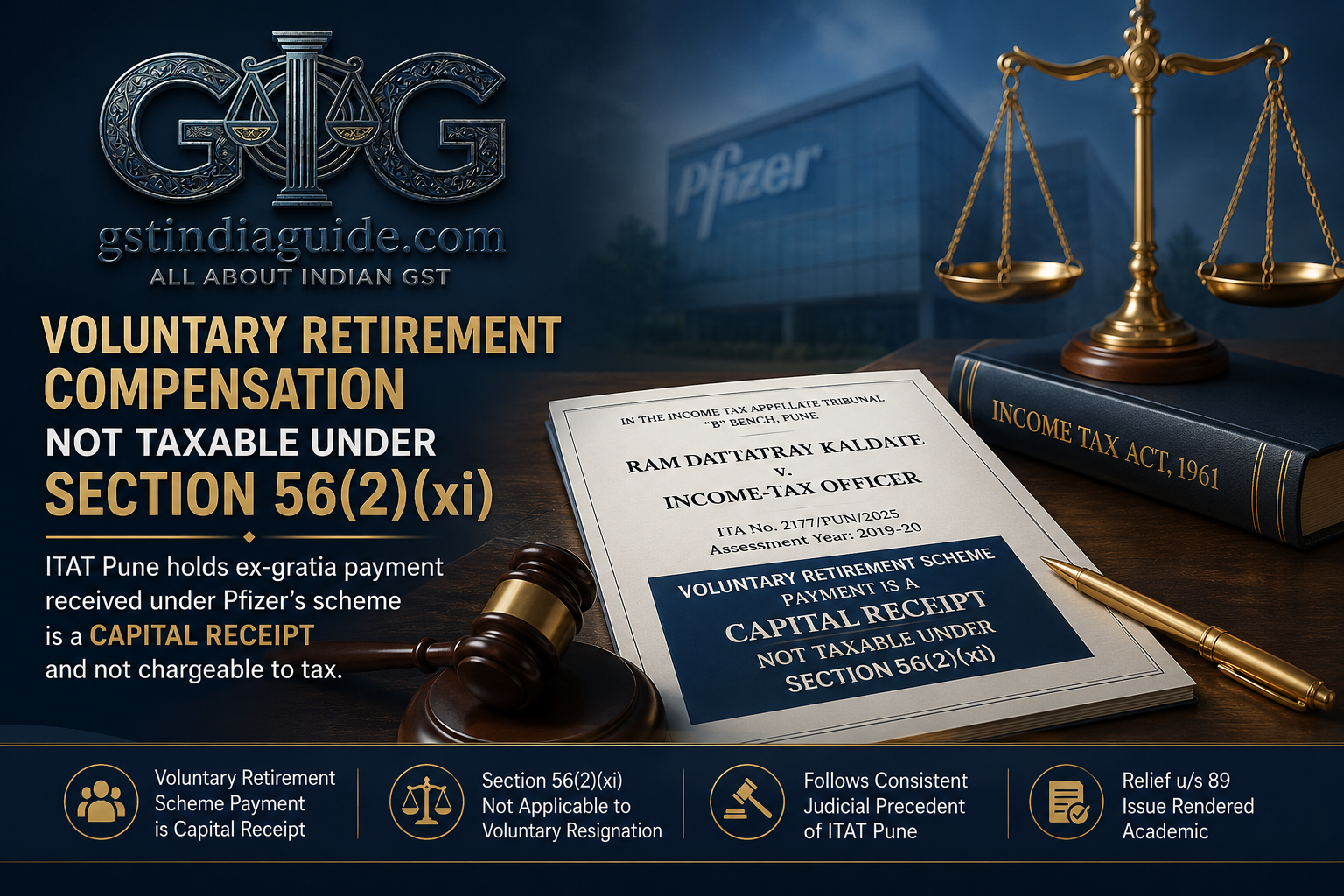
The Pune Bench of the Income Tax Appellate Tribunal (ITAT) has delivered an important ruling in Ram Dattatray Kaldate v. Income-tax Officer, dealing with the taxability of compensation received under a voluntary retirement scheme introduced by Pfizer Healthcare India Pvt. Ltd. The Tribunal examined whether the ex-gratia payment received by an employee upon opting for voluntary retirement could be taxed as “Income from Other Sources” under Section 56(2)(xi) of the Income-tax Act, 1961, or whether it retained the character of a non-taxable capital receipt.
The assessee, a former employee of Pfizer Healthcare India Pvt. Ltd., received approximately ₹54.64 lakh under the company’s financial scheme following the closure of its Aurangabad manufacturing facility. Initially, relief under Section 89 was claimed, but during assessment proceedings the assessee alternatively contended that the payment constituted a capital receipt. While the Commissioner (Appeals) held that the amount was taxable under Section 56(2)(xi) as income from other sources, the matter ultimately reached the Tribunal.
The Tribunal noted that identical issues involving similarly placed Pfizer employees had repeatedly been decided in favour of the taxpayers. It observed that the payments were made under a voluntary retirement scheme and that the scheme itself specifically clarified that employees resigned voluntarily and that such separation did not constitute retrenchment or termination of employment by the company. Consequently, the Tribunal held that the provisions of Section 56(2)(xi), which apply to payments received in connection with termination of employment, were not attracted to the facts of the case.
The ITAT further relied upon its earlier decisions in Ashok Raghunathrao Kulkarni, Prasad Vijaykumar Kulkarni, Atul Shashikant Garbhe, Parna Vasudevaiah, and other cases involving employees covered under the same Pfizer scheme. Emphasising the principle of judicial consistency, the Tribunal held that the ex-gratia compensation received under the scheme was voluntary in nature, represented a capital receipt, and was not liable to tax either as salary or as income from other sources. The order of the Commissioner (Appeals) was accordingly set aside, and the Assessing Officer was directed to modify the assessment in favour of the assessee.
This ruling is significant for employees who receive voluntary retirement or separation payments under employer-sponsored financial schemes, particularly where the scheme expressly characterises the separation as voluntary resignation rather than termination of employment. The decision also highlights the importance of maintaining consistency in tax administration where identical facts have already been judicially settled.
Why You Should Read This Judgment
This decision is highly relevant for Chartered Accountants, tax professionals, advocates, corporate employers, and employees dealing with voluntary retirement schemes, severance packages, or ex-gratia payments. It provides important guidance on the interpretation of Section 56(2)(xi), the distinction between voluntary retirement and termination of employment, and the tax treatment of compensation received upon cessation of employment.