
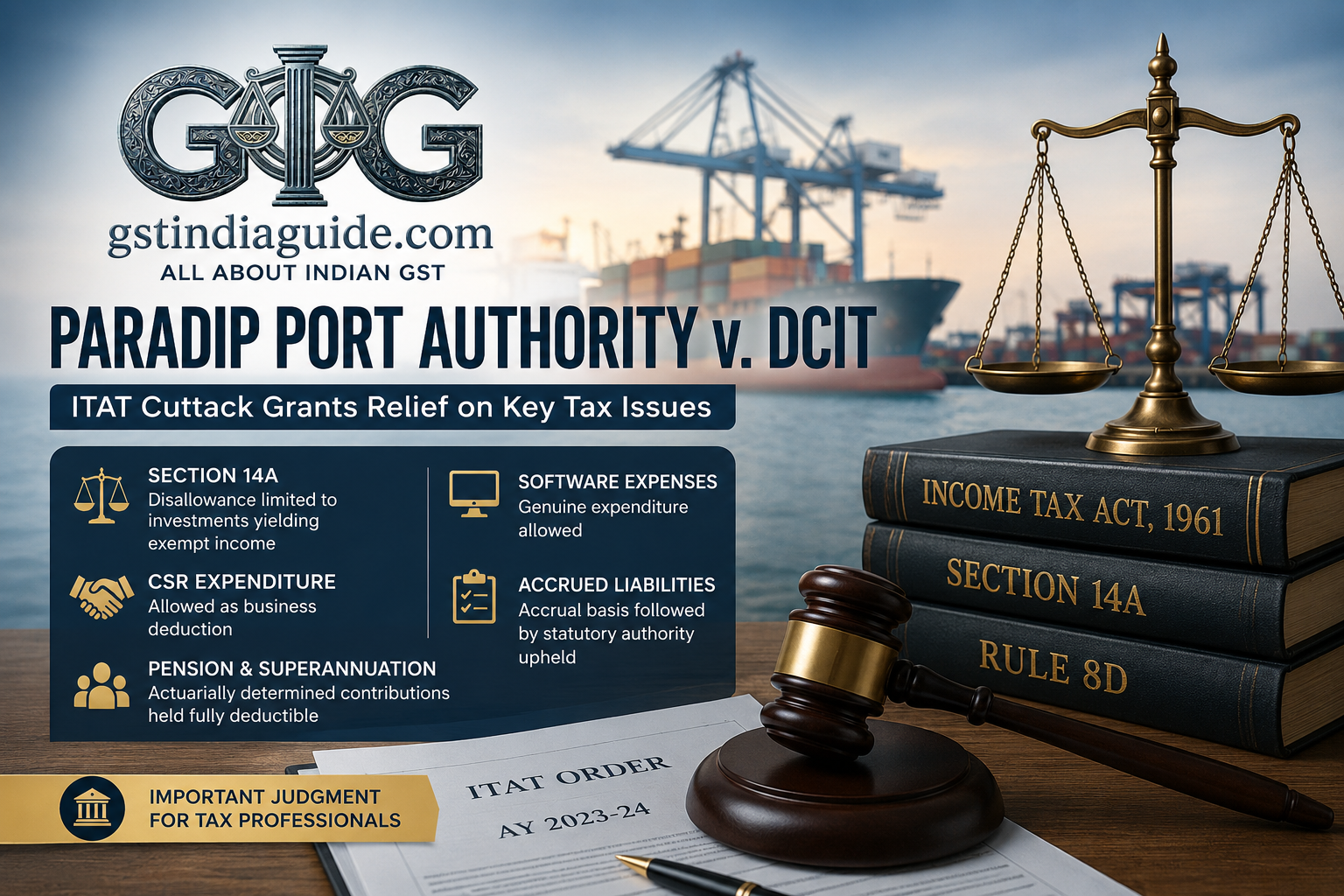
The Income Tax Appellate Tribunal (ITAT), Cuttack Bench, in Paradip Port Authority v. Deputy Commissioner of Income-tax, delivered an important ruling concerning the scope of disallowance under Section 14A, deductibility of Corporate Social Responsibility (CSR) expenditure, employer contributions to pension and superannuation funds, allowability of software development expenses, and recognition of accrued liabilities. The Tribunal examined multiple additions made during assessment and granted substantial relief to the assessee by applying settled judicial principles and the statutory framework governing port authorities.
The appeal arose from the assessment for AY 2023-24 where the Assessing Officer had made several additions relating to exempt income, CSR expenditure, pension contributions, software development payments and accrued liabilities. The Tribunal partly allowed the appeal on the Section 14A issue and allowed the remaining major grounds in favour of the assessee.
Key Highlights of the Judgment
The Tribunal held that while the Assessing Officer had recorded the necessary satisfaction for invoking Section 14A, the computation of disallowance under Rule 8D cannot extend to all investments. Only those investments which actually yielded exempt income during the relevant year can be considered for determining the disallowance. Consequently, the disallowance was substantially reduced by restricting it to investments that generated exempt income.
The Tribunal further held that the CSR expenditure incurred by Paradip Port Authority was allowable as a business deduction. Since the assessee is a statutory authority constituted under the Major Port Trust legislation and not a company governed by Section 135 of the Companies Act, 2013, the restriction contained in Explanation 2 to Section 37(1) was held to be inapplicable. The Tribunal also noted that similar expenditure had been accepted in earlier years and applied the principle of consistency.
On the issue of employer contributions towards pension and superannuation funds, the Tribunal ruled that Rule 87 of the Income-tax Rules limits only ordinary annual contributions. Contributions made to bridge an actuarially certified deficit in the pension fund constitute exceptional payments and therefore fall outside the statutory ceiling. Such actuarially determined contributions were held to be fully deductible.
The Tribunal also deleted the addition relating to payments made for customised software development and annual maintenance services. It observed that the assessee had produced invoices, banking records and evidence of TDS deduction. The mere fact that the vendor had not filed its income tax return or had subsequently been struck off could not justify disallowance once the genuineness of the expenditure stood established.
In addition, the Tribunal allowed deductions relating to accrued expenses, salary provisions and provident fund provisions. It recognised that Paradip Port Authority is statutorily required to maintain accounts on an accrual basis under the accounting framework approved by the Ministry of Shipping and that the liabilities represented genuine ascertained obligations rather than contingent liabilities.
Why This Judgment is Important
This decision provides valuable guidance on several recurring issues under the Income-tax Act. It reiterates that Section 14A disallowance must be linked only to investments generating exempt income, clarifies the treatment of CSR expenditure incurred by statutory authorities outside the Companies Act framework, recognises deductibility of actuarially certified pension fund contributions, and reinforces that genuine business expenditure cannot be disallowed merely because the recipient fails to comply with its own tax obligations. The ruling also strengthens the principle that statutory entities following mandated accrual accounting standards are entitled to deduction of genuine accrued liabilities.