
Preamble
The 56th GST Council Meeting held in September 2025 marked a watershed moment in the trajectory of indirect tax reforms. The Council introduced sweeping changes in service tax rates, effective from 22nd September 2025, thereby redefining the contours of multiple service sectors including hospitality, transportation, insurance, and health care. These amendments are not mere numerical adjustments but bear significant legal, commercial, and compliance ramifications. In this article, we examine the statutory foundations of these changes, their transitional intricacies under Section 14 of the CGST Act, 2017, and their broader implications on businesses and consumers alike.
- Statutory framework for rate changes under GST
The power to levy and alter GST rates emanates from Section 9 of the CGST Act, 2017, which provides for the levy and collection of tax on intra-State supplies. Further, Section 11 empowers the Government to grant exemptions through notifications issued on the recommendations of the Council. Notifications under Section 9(1) read with Section 15 prescribe the actual rate applicable to services.
For transitional provisions, Section 14 of the CGST Act assumes prominence. It prescribes rules where there is a change in rate of tax in respect of supply of services. The section delineates scenarios based on timing of supply, receipt of payment, and issuance of invoice. For example, Section 14(a)(i) clarifies that if services are supplied before the change in rate but the invoice is issued after such change and payment is also received post-change, the liability is determined with reference to the date of payment or invoice, whichever is earlier.
Thus, the Council’s decision is backed by statutory architecture, and its enforceability stems from notifications issued under Section 11(1) of the Act, which stand automatically mirrored under State GST Acts by virtue of Section 11(4) of SGST statutes.
- Major changes in service rate structure
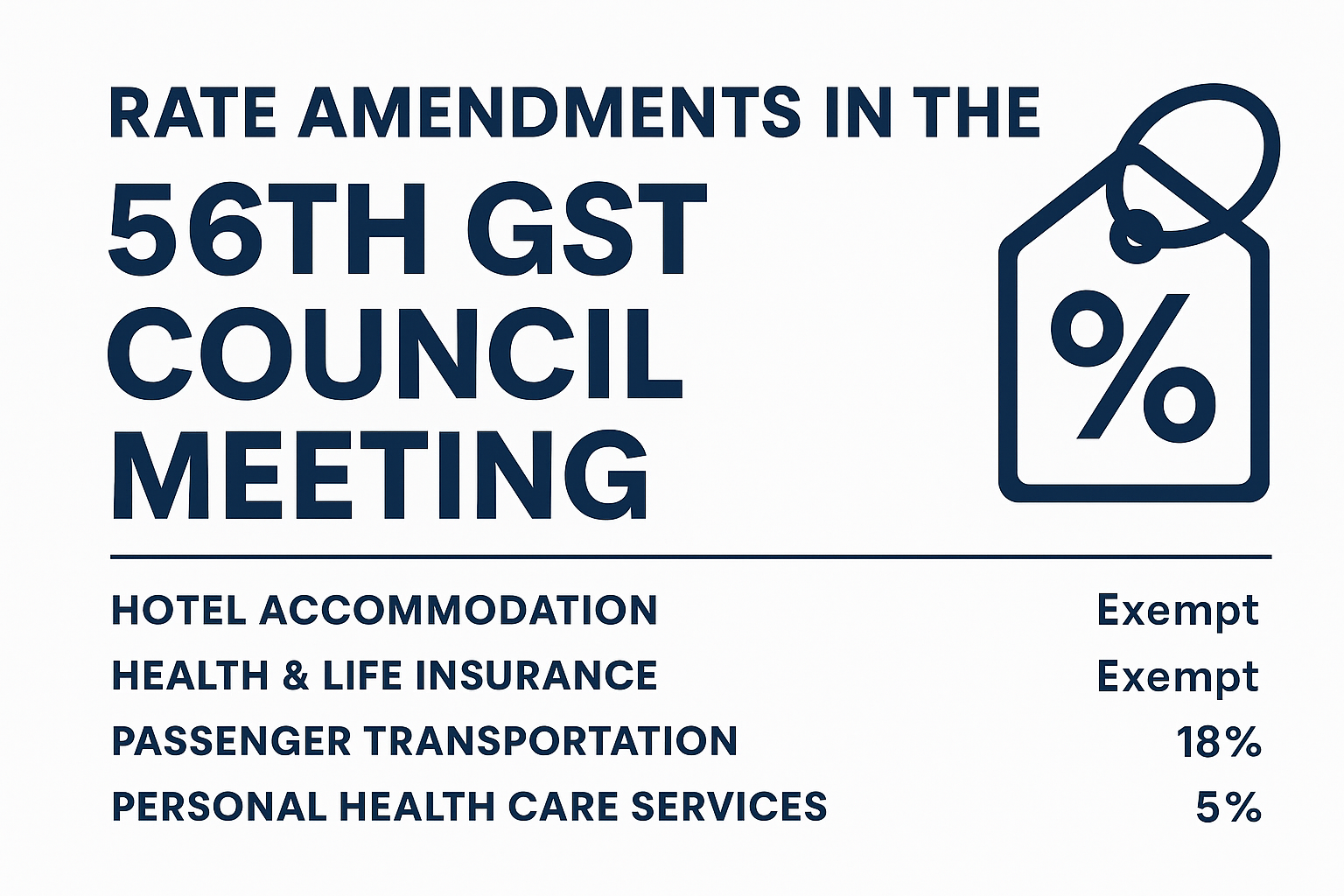
The amendments notified after the 56th GST Council Meeting are intended to simplify structure while broadening the revenue base. The following sectors witnessed substantial change:
- Hotel accommodation – Accommodation up to ₹7,500 per day now attracts exemption when provided without ITC benefit. Earlier taxable at 5%, the Council has opted for a relief-oriented approach to support domestic tourism.
- Health and life insurance – Except for group insurance policies, individual policies are brought under exemption. This alleviates cost burden on households but also creates complexities for insurers in segregating taxable from exempt business.
- Passenger transportation – Earlier taxable at 12%, this now attracts 18%, thereby aligning it with other premium service segments.
- Personal health care services – Services such as wellness, spa, and physical well-being offered without ITC condition continue to remain under concessional 5%.
These changes, though numerically simple, ripple across supply chains as ITC eligibility, pricing structure, and contractual re-negotiations stand redefined.
- Transitional issues – time of supply and credit notes
One of the most delicate aspects of rate amendments is transition. Section 14 of the CGST Act provides for determination of liability depending on the sequence of supply, invoice, and payment. For instance:
- If supply was made before 22.09.2025, but invoice issued and payment received after, the applicable rate shall be the new rate.
- If supply was made after 22.09.2025 but invoice was raised before, the rate on invoice date will govern.
The Council has specifically cautioned that ongoing contracts, especially in government tenders, may face financial strain unless renegotiated, as suppliers cannot retrospectively alter their bid prices.
Further, credit notes for supplies made before the rate change must reflect the old rate, even if issued later. For example, in the illustration cited, transportation services rendered on 20.09.2025 at 12% GST attracted a credit note on 30.09.2025; the applicable rate remains 12% and not 18%. This ensures parity with Section 34 of the CGST Act dealing with debit/credit notes.
- Sector-wise implications of amendments
(a) Hospitality and accommodation sector
The exemption for hotels with tariff below ₹7,500 per day (without ITC) is poised to make budget hotels more competitive. However, such entities lose ITC entitlement, thereby raising their input costs. Businesses must carefully weigh whether to opt for exemption or standard taxation to claim ITC.
(b) Insurance sector
Exempting health and life insurance outside group schemes appears citizen-centric, but insurers face challenges in proportionate reversal of ITC under Rule 42 of CGST Rules, 2017. As ITC on common inputs becomes partly ineligible, insurers must undertake monthly and annual reversals, complicating compliance.
(c) Transportation services
Moving passenger transportation to 18% may initially increase cost burden on commuters, but the rationale lies in harmonisation with global norms and revenue augmentation. Service providers engaged in long-term contracts must either absorb the cost or renegotiate with government authorities.
(d) Healthcare and wellness services
By continuing concessional 5% without ITC, the Council seeks to promote wellness and personal care. Yet, this segment remains divided, as premium establishments may prefer standard rate to avail ITC.
- Anti-profiteering and consumer benefit
Section 171 of the CGST Act mandates that any reduction in rate of tax or benefit of ITC must be passed on to consumers by way of commensurate reduction in price. Businesses must therefore re-calibrate pricing in light of exemptions or reductions. Failure to pass benefits could invite investigation by the Directorate General of Anti-Profiteering.
This reinforces consumer interest and prevents enterprises from unjust enrichment, echoing the principle earlier elaborated in Article 2 of this series on anti-profiteering.
- Compliance and contract management
The Council has also underscored that where exemption or no-ITC condition applies, the ITC already availed does not lapse but becomes unusable unless taxable outward supply exists. Taxpayers must carefully monitor ITC balances to prevent accumulation.
Moreover, government contractors working under fixed-price tenders are at risk of margin erosion. Unless tender terms provide for tax variation clauses, contractors may bear the incremental GST burden. Renegotiation, though administratively cumbersome, becomes inevitable.
- Practical illustrations of transitional application
- Case I – A hotel provided stay from 18.09.2025 to 24.09.2025, invoicing the customer on 24.09.2025. Here, since supply was continuous and invoice raised post-change, Section 14 dictates application of the new rate/exemption on services post 22.09.2025.
- Case II – An insurance company issued annual policies on 01.09.2025 for full year and received premium in advance. Even if exemption begins from 22.09.2025, liability continues for premium already collected, as supply was effected on receipt of payment.
Such illustrations highlight why meticulous examination of timing provisions is indispensable.
Conclusion
The 56th GST Council Meeting has once again demonstrated that GST is not a static levy but an evolving ecosystem, constantly adapting to socio-economic priorities. By restructuring rates in key service sectors, the Council has sought to balance revenue considerations with citizen welfare. Yet, the onus lies heavily on businesses to navigate transitional challenges, recalibrate ITC positions, and ensure compliance with anti-profiteering obligations. Ultimately, while these reforms appear to ease consumer burden in certain spheres, their real test will be in the manner of implementation and industry adaptation.
Disclaimer – This article is solely for educational purposes and does not constitute professional advice. Readers are advised to consult a qualified professional before acting upon the matters discussed herein.