
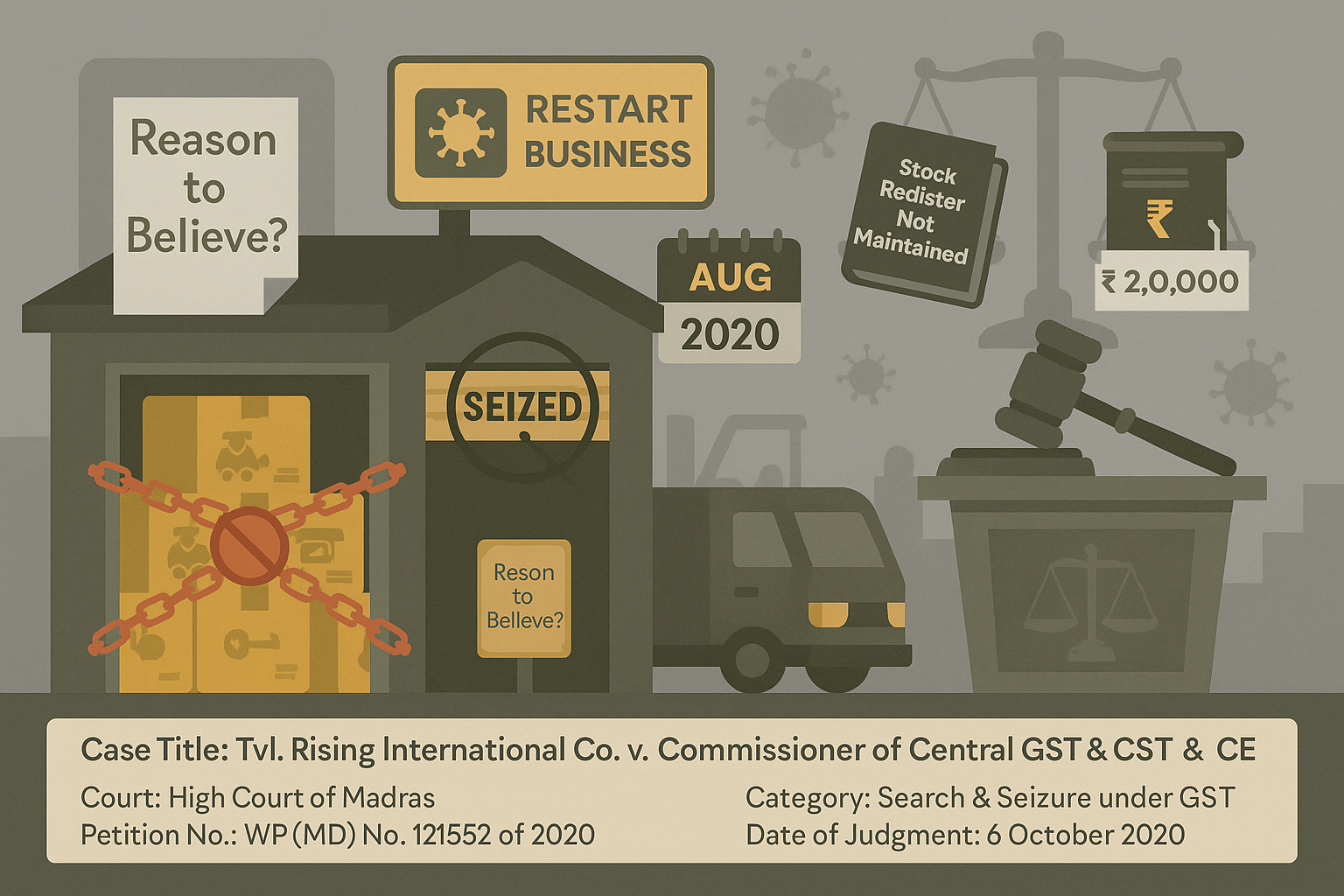
Case Title: Tvl. Rising International Co. vs. Commissioner of Central GST & Central Excise
Court: High Court of Madras
Petition No.: WP (MD) No. 12152 of 2020, WMP (MD) No. 10459 of 2020
Category of Dispute: Search and Seizure – Power of Inspection & Confiscation
Date of Judgement: 6 October 2020
Relevant Sections: Section 67(1), 67(2), 67(6), 35(1) of CGST Act, 2017; Rule 56 of CGST Rules, 2017
Facts of the Case
- The petitioner, M/s Rising International Co., a GST-registered dealer based in Madurai, imported toys from China and procured goods from Delhi. Due to the COVID-19 lockdown, the business was shut from April 2020 and later resumed in August 2020 [Para 1].
- On 21.08.2020, a search was conducted by CGST officers under Section 67(2) and goods/documents were seized on the grounds that there were reasons to believe the goods were liable for confiscation [Para 1].
- The petitioner challenged the seizure and prohibition order, arguing there was no suppression or contravention of GST provisions and the action was based on a fishing enquiry [Para 2].
- The petitioner contended that mere non-maintenance of stock registers could not justify seizure and the action was detrimental as business had just restarted after lockdown [Para 2].
Questions in Consideration
- Whether the seizure and prohibition order issued under Section 67(2) of CGST Act was validly passed?
- Whether the petitioner’s non-maintenance of stock register was a justifiable ground for seizure?
- Whether the High Court can interfere with the ‘reasonable belief’ formed by the proper officer under Section 67?
[Para 2, 4, 6, 9]
Observations of the Court
- The Court reaffirmed that the expression “reason to believe” under Section 67(1) must be held in good faith and not be a pretence. The belief must be based on material facts that bear a rational connection with the action taken [Para 8].
- The Revenue failed to produce any intelligence report or specific material before the Court that formed the basis of the “reasonable belief” for seizure, which undermined the justification for the seizure [Para 9].
- However, since stock records were not maintained and the search had already been conducted, the Court declined to quash the seizure entirely but found the continuing prohibition to be harsh [Para 9].
- Emphasizing economic recovery in pandemic times, the Court ordered provisional release under Section 67(6) upon a personal bond and deposit of ₹2 lakhs, noting that delay in adjudication harms businesses and affects tax recovery as well [Para 10–11].
Judgement of the Court
- The seizure order dated 21.08.2020 was upheld, but the prohibition order restraining the petitioner from dealing with goods was modified [Para 11].
- The Court directed provisional release of goods upon furnishing a personal bond and deposit of ₹2,00,000 [Para 11].
- The respondents were given liberty to proceed with adjudication under CGST Act without being affected by this writ decision [Para 11].
- Writ petition was partly allowed. No costs imposed [Para 13].
Between Fine Lines
- The Court acknowledged procedural flaws in forming “reason to believe” for seizure under Section 67.
- However, in view of statutory obligations and incomplete records, it upheld seizure but eased prohibition.
- The judgement emphasized balancing tax enforcement with post-COVID business revival.
- Businesses must strictly maintain stock records as per CGST law to avoid such penal consequences.
- Authorities were reminded not to delay adjudication or withhold goods arbitrarily without final determination.
Summary of Referred Cases
| Name of Case | Citation | Summary | Verdict Applied |
| Income Tax Officer v. Lakhmani Mewal Das | [1976] 103 ITR 437 (SC) | Defined “reason to believe” as requiring good faith, rational connection with facts | Relied Upon |
| State of Gujarat v. Mohanlal Jitamalji | 1987 taxmann.com 612 (SC) | Search should not be interfered with unless mala fide is clear | Relied Upon |
| Indru Ramchand Bharvani v. Union of India | 1988 taxmann.com 601 | Legitimacy of seizure upheld when based on statutory compliance | Relied Upon |
| Bhagwan R. Daswani v. CCE | 2002 taxmann.com 455 (Mad.) | Courts cannot sit in appeal over officers’ subjective satisfaction if formed on reasonable grounds | Relied Upon |