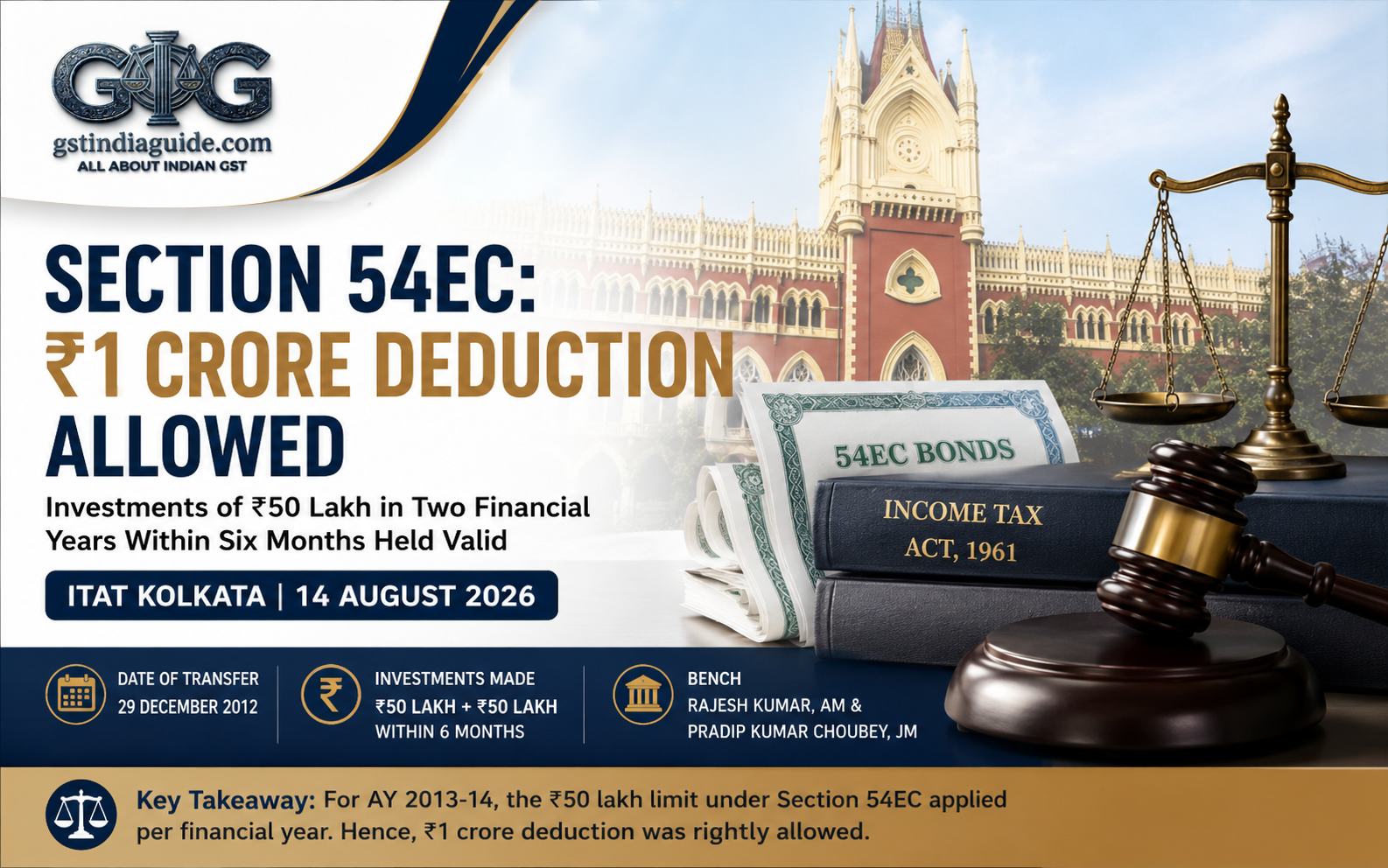
The Income Tax Appellate Tribunal, Kolkata has held that, for Assessment Year 2013-14, an assessee was entitled to claim deduction of ₹1 crore under Section 54EC of the Income-tax Act, 1961 where ₹50 lakh each was invested in specified bonds in two different financial years, provided both investments were made within six months from the date of transfer of the long-term capital asset.
The assessee, Shiv Kumar Agarwal, had sold a property on 29 December 2012 and earned long-term capital gains. For claiming exemption under Section 54EC, he invested ₹50 lakh on 28 March 2013 and another ₹50 lakh on 28 June 2013. Both investments were admittedly made within the statutory period of six months from the date of transfer.
During assessment, the Assessing Officer had, among other adjustments, restricted the assessee’s claim under Section 54EC to ₹50 lakh. In appeal, the CIT(A) granted relief in respect of the assessee’s claims under Sections 57 and 54F but continued to restrict the Section 54EC deduction to ₹50 lakh. The assessee therefore approached the ITAT on the limited dispute concerning the balance ₹50 lakh deduction under Section 54EC.
The Tribunal examined the language of Section 54EC as it applied to Assessment Year 2013-14. It observed that the provision imposed two distinct requirements: the investment had to be made within six months from the date of transfer, while the first proviso restricted investment in specified assets to ₹50 lakh during a financial year. Accordingly, where the six-month investment period overlapped two financial years, the statutory limit, as it then stood, operated separately for each financial year.
The Kolkata Bench relied upon its earlier decision in Sweta Sonthalia v. ITO, where the issue had been considered with reference to judicial precedents including the decisions concerning Section 54EC. The Tribunal noted that the subsequent second proviso restricting the aggregate investment arising from transfer of one or more original assets to ₹50 lakh across the financial year of transfer and the subsequent financial year was introduced only with effect from 1 April 2015. Therefore, that restriction did not govern Assessment Year 2013-14.
The Tribunal consequently held that the assessee was entitled to the benefit of Section 54EC in respect of the entire ₹1 crore investment. Since ₹50 lakh had been invested in each of two financial years and both investments were within six months of the transfer, the remaining addition of ₹50 lakh sustained by the CIT(A) was deleted.
The order of the Assessing Officer, as confirmed by the CIT(A) on this issue, was therefore set aside and the assessee’s appeal was allowed.
Key Takeaway
For Assessment Year 2013-14, the ₹50 lakh ceiling under the then applicable first proviso to Section 54EC operated with reference to each financial year. Thus, where the six-month period from the date of transfer extended into two financial years, investment of ₹50 lakh in each financial year could qualify for exemption, resulting in an aggregate deduction of ₹1 crore. The later restriction introduced with effect from 1 April 2015 could not be applied to the earlier assessment year.