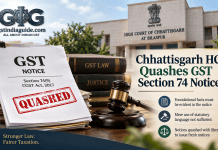
The Supreme Court, in M/s G.R. Infra Projects Limited Ratlam v. The State of Madhya Pradesh & Ors., has set aside a GST show cause notice issued for the assessment year 2018-19, holding that the extended limitation available under Section 74 of the Central Goods and Services Tax Act, 2017 cannot be invoked merely by mechanically referring to “fraud” or “concealment of facts”. The allegations and circumstances supporting fraud, wilful misstatement or suppression of facts must emerge from the show cause notice itself.
The decision was delivered on 19 August 2026 by a Bench comprising Justice J.B. Pardiwala and Justice K. Vinod Chandran in Civil Appeal No. 11277 of 2026, arising out of Special Leave Petition (C) No. 33594 of 2025.
Background of the Case
The dispute arose from a show cause notice dated 13 June 2025 issued by the Madhya Pradesh GST authorities for the assessment year 2018-19. The principal question before the Supreme Court was whether the notice could validly be treated as having been issued under Section 74 of the CGST Act read with the Madhya Pradesh Goods and Services Tax Act, 2017.
G.R. Infra Projects contended that proceedings under Section 74 could be initiated only where the notice itself contained allegations establishing fraud, wilful misstatement or suppression of facts. According to the assessee, the notice was otherwise beyond the limitation applicable to proceedings under Section 73.
The State sought to rely upon its counter-affidavit before the Court to demonstrate circumstances which, according to it, established fraud and suppression and justified invocation of Section 74.
Validity of Notice Must Be Judged From the Notice Itself
The Supreme Court declined to rely upon the allegations contained in the counter-affidavit.
The Court reiterated the settled principle that where the validity of a notice or an order is challenged, the legal requirements necessary to sustain it must be found in the notice or order itself. Deficiencies in the original notice cannot subsequently be supplied or cured through a counter-affidavit filed before the Court.
Accordingly, whether the requirements for invoking Section 74 existed had to be determined from the show cause notice itself.
Show Cause Notice Was Beyond Limitation Under Section 73
The Supreme Court examined the limitation applicable to the assessment year 2018-19.
The Court noted that the time for furnishing the annual return for the relevant year was eventually extended up to 31 December 2020. On that basis, the limitation relevant to proceedings under Section 73 would ordinarily expire on 31 December 2023.
The Court further considered the exclusion of limitation granted during the COVID-19 pandemic in Re: Cognizance for Extension of Limitation. After accounting for the excluded period, the Court held that the extended limitation expired on 28 February 2025.
Since the impugned show cause notice was issued only on 13 June 2025, the Supreme Court held that it was clearly barred by limitation if governed by Section 73.
The decisive question, therefore, was whether the Department could validly invoke Section 74.
Mere Use of Words “Fraud” or “Concealment” Is Not Enough
On examining the notice, the Supreme Court found that, except for what it described as a “bland statement” of fraud or concealment of facts, the notice did not explain how fraud had been inferred or how concealment had been detected.
The Court observed that the notice itself did not disclose the factual aspects which persuaded the assessing officer to conclude that the assessee had employed fraud, wilful misstatement or suppression of facts.
According to the Supreme Court, the extended period cannot be attracted by the mechanical use of statutory expressions such as “fraud, wilful misstatement or suppression of facts.” The show cause notice must disclose the allegations and factual circumstances which lead the authority to such a conclusion.
The Court also noticed the manner in which the expression “fraud or concealment of facts” had been used and observed that it indicated uncertainty on the part of the assessing officer as to the precise basis on which the proceedings were sought to be initiated.
Supreme Court Sets Aside SCN
The Supreme Court found no justification for sustaining the impugned show cause notice and held that the Madhya Pradesh High Court had erred in upholding it.
The Court consequently:
- set aside the High Court’s impugned order;
- set aside the show cause notice dated 13 June 2025; and
- directed the State authorities to desist from taking any further proceedings pursuant to that notice.
The Civil Appeal was accordingly allowed.
Key Legal Principle
The judgment reinforces an important distinction between proceedings under Sections 73 and 74 of the CGST Act. The Department cannot invoke the longer limitation available in cases involving fraud, wilful misstatement or suppression merely by reproducing those statutory expressions in a notice.
Where Section 74 is invoked, the show cause notice itself must disclose the factual allegations forming the basis for alleging fraud, wilful misstatement or suppression of facts. Such foundational requirements cannot subsequently be supplied through pleadings or affidavits before a court.
The ruling is particularly significant where the normal limitation period under Section 73 has already expired and Section 74 is sought to be invoked for the purpose of sustaining otherwise time-barred proceedings.