
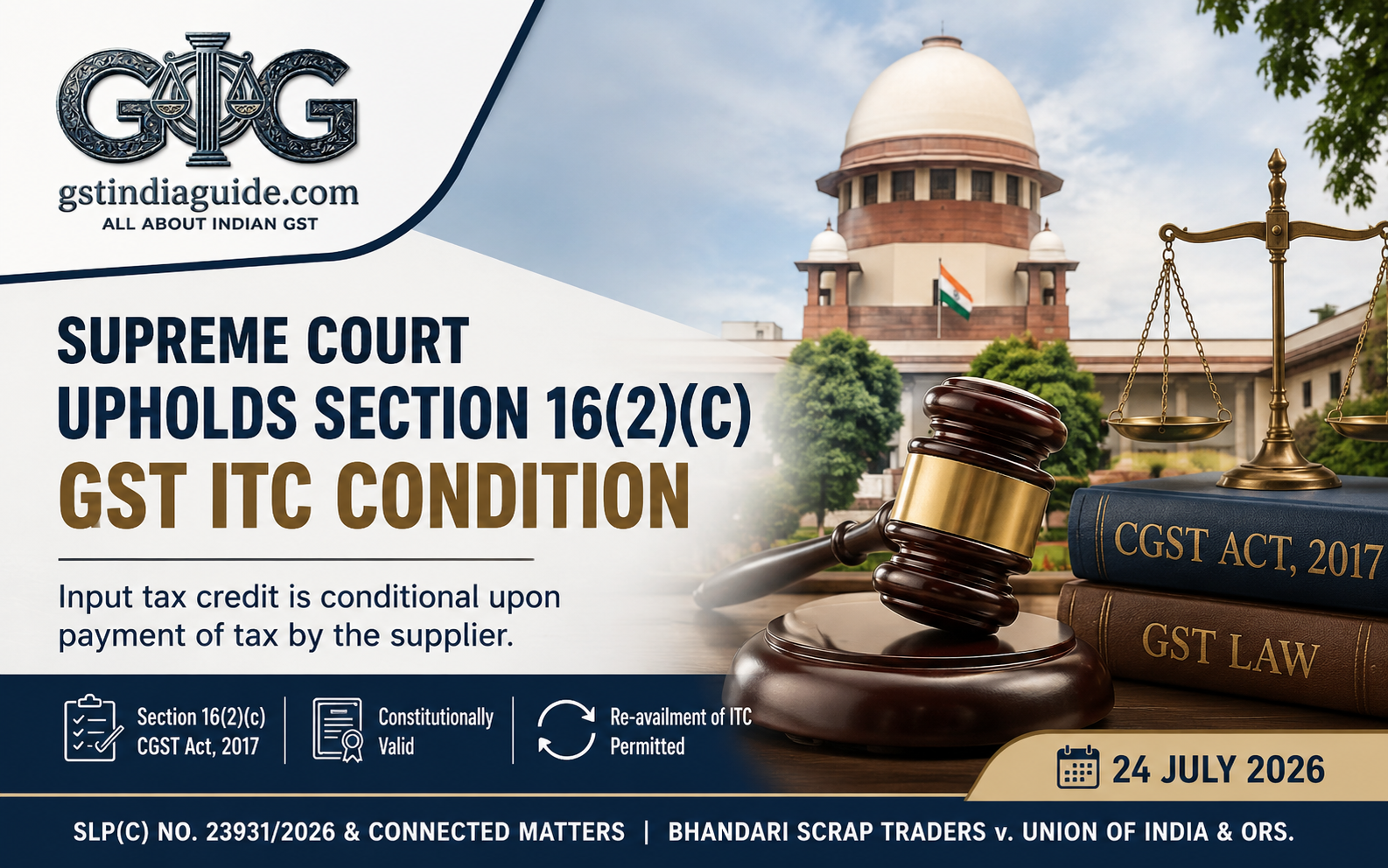
The Supreme Court, in Bhandari Scrap Traders v. Union of India & Others, has upheld the Gujarat High Court’s judgment affirming the constitutional validity of Section 16(2)(c) of the Central Goods and Services Tax Act, 2017. The provision makes the recipient’s entitlement to input tax credit subject to the condition that the tax charged on the supply has actually been paid to the Government.
The order was passed on 24 July 2026 by a Bench comprising Justice Sanjay Kumar and Justice Sanjeev Sachdeva in SLP(C) No. 23931 of 2026 and connected matters. The special leave petitions arose from the Gujarat High Court’s judgment dated 1 May 2026 in Special Civil Application No. 749 of 2025.
Background of the Dispute
The principal challenge concerned the validity and interpretation of Section 16(2)(c) of the CGST Act. The purchasing dealers sought protection against the denial or reversal of input tax credit where the corresponding supplier had failed to deposit the tax collected on the transaction with the Government.
The petitioners relied upon principles developed under the Delhi Value Added Tax Act, 2004, particularly those concerning bona fide purchasing dealers. They contended that a genuine recipient should not be denied input tax credit merely because of a default committed by the supplier.
No Parity Between Delhi VAT and GST Provisions
The Supreme Court rejected the attempt to draw parity between the Delhi VAT framework and the GST regime.
The Court noted that the Gujarat High Court had undertaken a detailed comparison of the Delhi VAT Act and the CGST Act. That analysis demonstrated material differences between the statutory provisions, the structure of input tax credit and the mechanisms governing its availment under the two enactments.
Accordingly, a purchasing dealer governed by the CGST Act could not be placed on the same footing as a purported bona fide purchasing dealer under the Delhi VAT Act where the supplier had failed to pay the requisite tax.
The entitlement to input tax credit under GST must therefore be determined according to the specific statutory scheme contained in the CGST Act rather than principles evolved under a differently structured State VAT enactment.
Section 16(2)(c) Held Constitutionally Valid
Section 16(2)(c) provides that input tax credit can be availed only where the tax charged in respect of the relevant supply has actually been paid to the Government, either in cash or through utilisation of admissible input tax credit.
The Supreme Court agreed with the Gujarat High Court that no grounds had been established for declaring this condition unconstitutional. The Court also declined to read down the provision.
The judgment confirms that the payment of tax by the supplier is a statutory condition attached to the recipient’s entitlement to input tax credit. The recipient’s bona fides, by themselves, do not remove or dilute this legislative requirement.
Re-availment of Reversed Input Tax Credit
An important aspect of the Gujarat High Court’s reasoning, specifically noticed by the Supreme Court, concerned the recipient’s ability to re-avail input tax credit after the supplier discharges the corresponding tax liability.
The High Court had examined Section 41 as well as Sections 73 and 74 of the CGST Act. These provisions form part of the statutory mechanism for reversal, recovery and subsequent re-availment of input tax credit.
The Supreme Court observed that the purchasing dealer may become entitled to re-avail the reversed credit once the supplier is made to discharge the relevant tax liability. This aspect was considered significant while assessing the constitutional challenge to Section 16(2)(c).
Reference to the Tripura High Court Decision
The petitioners referred to the decision of the Tripura High Court in Sahil Enterprises v. Union of India & Others and informed the Supreme Court that a special leave petition concerning that judgment had been entertained.
However, the Supreme Court found that the detailed statutory comparison undertaken by the Gujarat High Court had not been carried out in the Tripura High Court decision. The existence of proceedings arising from that judgment therefore did not persuade the Court to interfere with the Gujarat High Court’s analysis.
Supreme Court’s Decision
The Supreme Court expressed complete and respectful agreement with the views of the Gujarat High Court. It affirmed and upheld the impugned judgment and dismissed all the special leave petitions.
Pending applications, if any, were also disposed of.
Significance of the Judgment
The ruling has important consequences for businesses and GST practitioners dealing with input tax credit disputes arising from supplier defaults.
It confirms that input tax credit is a statutory benefit governed by the conditions prescribed under Section 16 of the CGST Act. A recipient cannot claim an unconditional right to credit merely on the basis of possession of tax invoices, receipt of goods or services and payment of consideration where the statutory requirement concerning payment of tax to the Government remains unfulfilled.
At the same time, the recognition of the recipient’s ability to re-avail reversed credit after recovery of tax from the supplier is relevant in proceedings involving temporary reversal, supplier compliance and departmental recovery action.
Taxpayers should therefore maintain effective vendor-compliance systems, reconcile purchase records with GST returns and promptly address mismatches indicating non-payment or non-reporting of tax by suppliers.
Case Details
Case: Bhandari Scrap Traders v. Union of India & Others
Court: Supreme Court of India
Bench: Justice Sanjay Kumar and Justice Sanjeev Sachdeva
Case Number: SLP(C) No. 23931 of 2026 with connected matters
Date of Order: 24 July 2026
Impugned Judgment: Gujarat High Court judgment dated 1 May 2026 in SCA No. 749 of 2025
Decision: Special leave petitions dismissed; Gujarat High Court judgment affirmed
Legal Provision: Section 16(2)(c) of the CGST Act, 2017

(c) of the CGST Act and rules that GST input tax credit depends on payment of tax by the supplier.)