Case Details
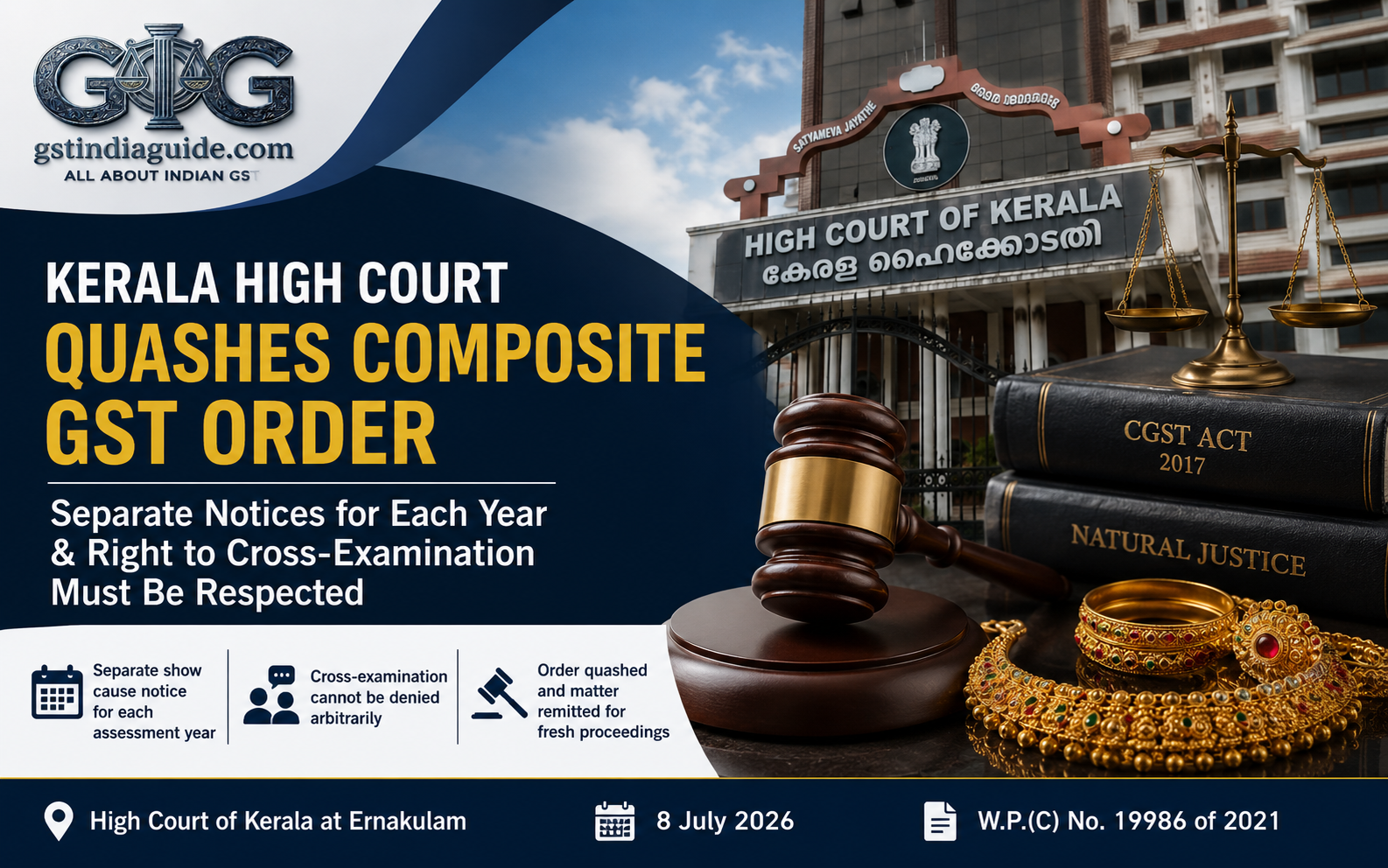
Case: EMAS Gold and Diamonds LLP & Others v. The Joint Commissioner, Central GST and Central Excise & Another
Court: High Court of Kerala at Ernakulam
Coram: Hon’ble Mr. Justice Ziyad Rahman A.A.
Case Number: W.P.(C) No. 19986 of 2021
Date of Judgment: 8 July 2026
Neutral Citation: 2026:KER:50129
Introduction
The Kerala High Court has set aside a GST adjudication order passed against EMAS Gold and Diamonds LLP after finding serious defects in the manner in which the proceedings were conducted. The Court held that a composite adjudication covering several financial years under Section 74 of the Central Goods and Services Tax Act, 2017, was not legally sustainable.
The Court also examined the denial of the taxpayer’s request to cross-examine persons whose statements had been relied upon by the adjudicating authority. It held that cross-examination could not be rejected on speculative or legally irrelevant grounds when the statements formed an important basis of the demand.
Background of the Case
EMAS Gold and Diamonds LLP is engaged in the wholesale jewellery business. Its business premises were searched by the GST Department on 11 December 2019. During the search, gold ornaments, gold pieces, books, documents, computer systems and other devices were seized under Section 67(2) of the CGST Act.
The statement of the firm’s Chairman was recorded, and he was arrested on 16 December 2019. According to the petitioners, statements of several employees were thereafter recorded while the Chairman remained in detention.
A show cause notice dated 19 October 2020 was issued proposing tax and other liabilities. The firm submitted replies disputing the allegations and specifically requested permission to cross-examine the persons whose statements had been relied upon in the notice.
The adjudicating authority, however, proceeded to pass the final order without first deciding the request for cross-examination. The order imposed liability under Section 74 and directed confiscation of the seized gold under Section 130 of the CGST Act. Penalties were also imposed on certain employees and other noticees for alleged aiding and abetting.
Composite GST Proceedings for Multiple Years Held Invalid
A principal challenge raised by the petitioners was that the adjudication had been conducted as a block assessment for the financial years 2017-18, 2018-19 and 2019-20.
The Kerala High Court observed that assessments under Section 74 must be undertaken with reference to the relevant tax period. Relying on its earlier decisions, the Court reiterated that a composite notice and adjudication order covering multiple assessment years is not legally sustainable.
The impugned order was therefore liable to be set aside on this ground alone. The Department was directed to initiate fresh proceedings by issuing separate notices for each assessment year.
Cross-Examination Is Essential Where Statements Are Relied Upon
The adjudicating authority had rejected the request for cross-examination on the ground that the persons concerned had not retracted their statements. It was also stated that the statements were supported by documents and that the witnesses, being employees of the taxpayer, could have been influenced over time.
The High Court found these reasons unconvincing.
The Court explained that the purpose of cross-examination is to test the truthfulness and reliability of a witness’s statement. The fact that the witness has not retracted the statement does not prevent the noticee from challenging its correctness through cross-examination.
Where statements are relied upon as evidence and contribute to the final conclusion, the affected person must ordinarily be given a fair opportunity to test such statements. The adjudicating authority cannot presume in advance that cross-examination would be biased or would serve no useful purpose.
The Court followed the principle recognised by the Supreme Court in Andaman Timber Industries v. Commissioner of Central Excise, under which denial of cross-examination may amount to a serious violation of natural justice when witness statements form the basis of an adverse order.
Documents Were Treated Only as Corroborative Evidence
The Department argued that the demand was also supported by documents recovered during the investigation and therefore did not depend entirely upon witness statements.
The High Court rejected this contention after examining the adjudication order. It found that the recovered documents had not been independently evaluated. Instead, they had been treated as corroborative material supporting the statements recorded from the persons concerned.
This established a direct link between the statements and the documents. Since the statements continued to form an important part of the evidentiary foundation, the request for cross-examination could not have been rejected on the ground that other material was available.
No Right to Cross-Examine Co-Noticees
The Court nevertheless clarified that the right to cross-examination was not unlimited.
Some of the persons whom the taxpayer sought to cross-examine were themselves co-noticees against whom penalties had been imposed for allegedly aiding or abetting the taxpayer. The Court held that the taxpayer could not insist on cross-examining such co-noticees, as this could effectively require them to depose against themselves.
The right to seek cross-examination was therefore confined to persons who were not co-noticees in the proceedings.
Pocket Diaries Could Not Be Relied Upon Without Proper Proof
The adjudicating authority had also relied upon pocket diaries allegedly maintained by goldsmiths associated with the firm.
The Court observed that a document may be treated as relevant evidence only when it is produced or proved through the person who authored it or was responsible for maintaining it. The statements of the goldsmiths who allegedly maintained the diaries had not been recorded.
The Court therefore held that the petitioners would be entitled to summon such persons during the fresh proceedings, if necessary, so that the documents could be properly proved and tested.
Final Decision of the Kerala High Court
The Kerala High Court quashed the impugned adjudication order and directed the authorities to commence fresh proceedings.
The Department was directed to:
Issue separate show cause notices for each assessment year.
Provide the petitioners with an opportunity of personal hearing.
Properly consider the request for examination or cross-examination of witnesses.
Avoid rejecting cross-examination on the grounds mentioned in the earlier order.
Permit the petitioners to seek appropriate relief before the adjudicating authority in light of the Court’s observations.
The Court further directed that, while calculating the limitation period for completing the fresh proceedings, the period from the issuance of the original notice until receipt of the certified copy of the judgment would be excluded because the writ petition had remained pending since 2021.
Significance of the Judgment
The judgment reinforces two important safeguards applicable to GST adjudication.
First, tax liability under Section 74 must be determined separately for each legally recognised tax period. Authorities cannot combine several financial years into a single block proceeding merely for administrative convenience.
Second, where witness statements are relied upon to establish tax evasion or suppression, the adjudicating authority must fairly consider a request for cross-examination. Such a request cannot be rejected merely because the witness has not retracted the statement, because the witness is an employee of the taxpayer, or because the authority assumes that the witness may subsequently support the taxpayer.
The decision is particularly relevant in GST investigations involving searches, employee statements, seized records, private diaries and allegations of unaccounted transactions. It confirms that procedural fairness and proper proof of evidence remain essential even in proceedings alleging fraud or wilful suppression.