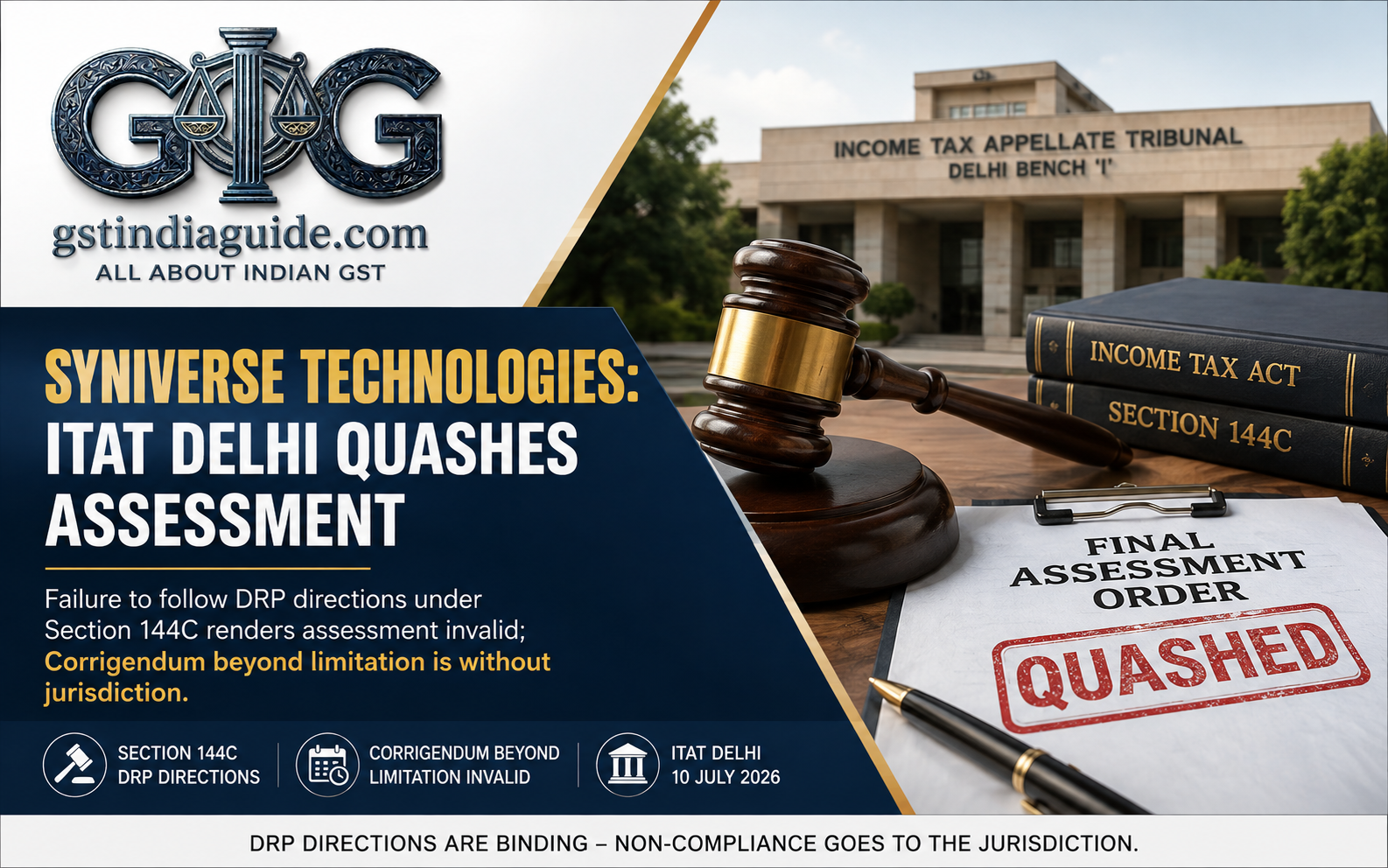
The Income Tax Appellate Tribunal, Delhi Bench, in Syniverse Technologies Services India P. Ltd. v. ACIT, Circle 3(1), Gurgaon, has examined an important procedural issue concerning the mandatory nature of directions issued by the Dispute Resolution Panel under Section 144C of the Income-tax Act, 1961. By order pronounced on 10 July 2026, the Tribunal held that a final assessment order passed without incorporating the binding directions of the DRP could not subsequently be validated through a corrigendum issued beyond the permissible period. The appeal of the assessee for Assessment Year 2018-19 was accordingly allowed.
Income Tax
The dispute arose from a final assessment order dated 30 June 2022 passed under Section 143(3) read with Section 144C(13). The DRP had earlier issued its directions on 25 April 2022, and the Transfer Pricing Officer subsequently passed an order giving effect to those directions on 17 June 2022. However, while passing the final assessment order, the Assessing Officer did not incorporate the effect of the DRP directions and substantially retained the position reflected in the draft assessment order.
The assessee contended that the statutory time available for completion of the assessment expired on 30 June 2022. Although the Assessing Officer passed the final assessment order on that date, the mandatory directions of the DRP were not implemented. A corrigendum was thereafter issued on 27 July 2022 seeking to address the deficiency. According to the assessee, once the limitation period had expired, the Assessing Officer had no jurisdiction to cure the defective final assessment order through a later corrigendum.
The Tribunal observed that the Assessing Officer had received the TPO’s order giving effect to the DRP directions before the final assessment was completed. Therefore, the final assessment order ought to have incorporated those directions within the limitation prescribed under Section 144C. The Tribunal found that although the final assessment order had formally been passed within time, it did not comply with the mandatory directions of the DRP. The subsequent corrigendum was viewed as an attempt to cure that statutory failure after expiry of the relevant period.
In reaching its conclusion, the Delhi Bench relied particularly on the Bombay High Court ruling in Pr. CIT v. Lionbridge Technologies Pvt. Ltd. and the decision of the Mumbai Bench of the Tribunal in I.A.R. System Aktiebolag Deloitte v. DCIT. The Tribunal noted the principle that failure to comply with the procedure mandated by Section 144C goes to the jurisdiction of the assessment itself. A defect of this nature cannot be overcome by a corrigendum issued after the competent authority has exhausted its statutory jurisdiction.
The Tribunal consequently held that non-compliance with the DRP directions rendered the final assessment order bad in law. The corrigendum issued on 27 July 2022 was held to be beyond jurisdiction and incapable of validating the assessment. The assessment order was therefore quashed, and the legal ground raised by Syniverse Technologies Services India P. Ltd. was allowed. Since the appeal was decided on the jurisdictional issue, the remaining grounds were kept open.
The decision reinforces the statutory importance of the DRP mechanism under Section 144C. Once directions are issued by the DRP, the Assessing Officer is required to complete the final assessment in conformity with those directions. Passing a final order within limitation is not sufficient where the order itself disregards the binding DRP directions, and a subsequent correction after expiry of jurisdiction cannot ordinarily cure such a fundamental procedural defect.
Why Read This Briefing?
This judgment is significant for Advocates, Chartered Accountants, Company Secretaries, Tax Consultants, Corporate Tax Teams, businesses and professionals dealing with transfer pricing and DRP proceedings. It highlights the consequences of non-compliance with Section 144C(13), the limits of the Assessing Officer’s jurisdiction after expiry of the statutory period, and the distinction between a curable error and a fundamental defect affecting the validity of the assessment proceedings.