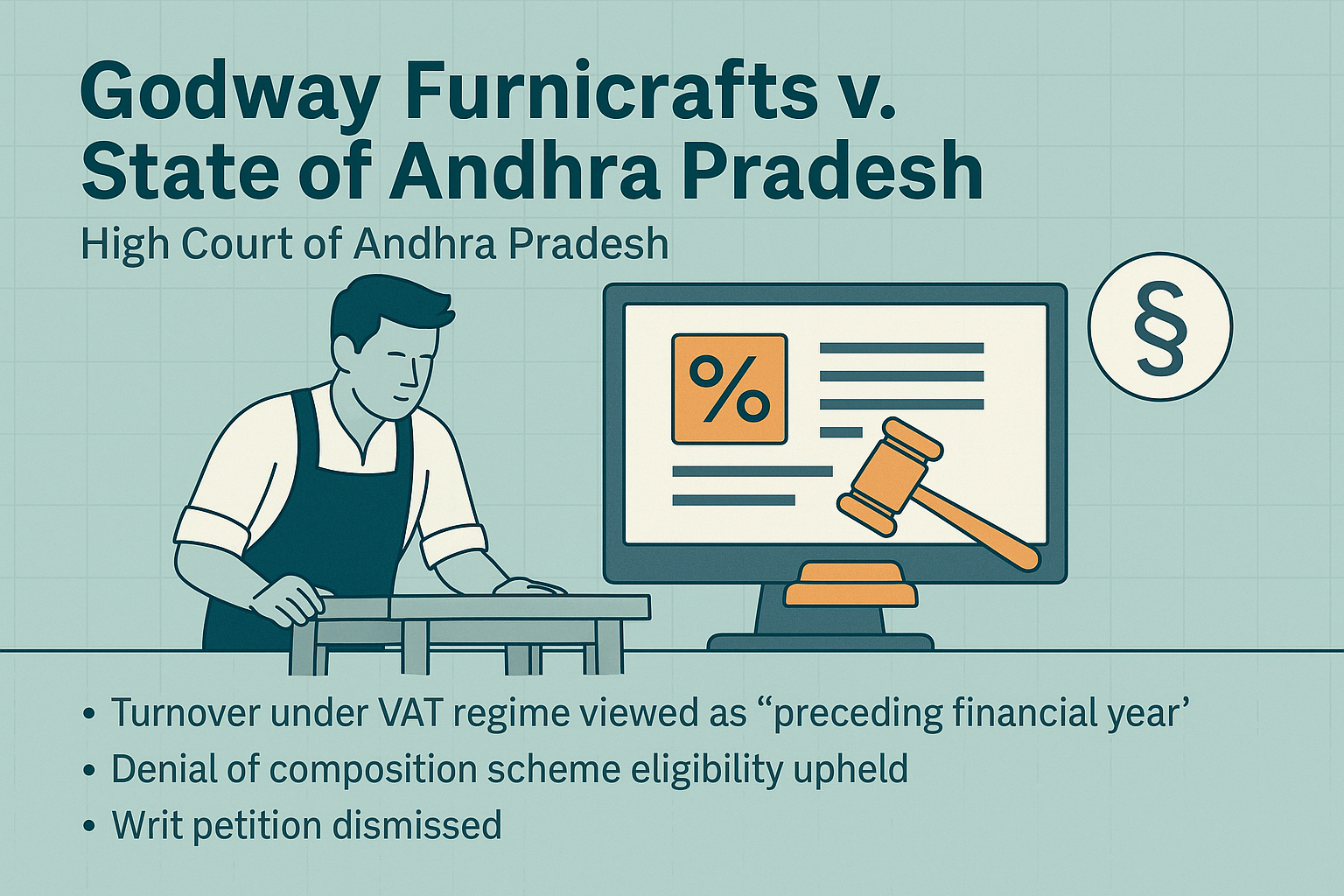
Godway Furnicrafts v. State of Andhra Pradesh
High Court of Andhra Pradesh
Writ Petition No. 10350 of 2020
Category: Composition Scheme under Section 10 of CGST Act
Date of Judgement: 11 November 2020
Relevant Sections: Section 10(1), 10(5), 74 of CGST/State GST Act; Rule 3(4) of CGST Rules
Facts of the Case
- The petitioner, a proprietorship firm engaged in furniture business, obtained GST registration effective from 01.07.2017 and opted for the composition scheme under Section 10(1) of the CGST Act. [Para 1]
- The petitioner filed GSTR-IV returns and paid 1% GST as per the scheme. However, the department issued a show-cause notice on 14.02.2018 stating that her turnover under the VAT regime for the preceding year (2016-17) exceeded ₹2.09 crores, disqualifying her from the composition scheme. [Para 1]
- Despite the petitioner’s response, the option was cancelled through Form CMP-07 on 26.07.2018, and a fresh SCN was issued under Sections 74 and 10(5), demanding GST @28% from 01.07.2017. [Para 1]
- The demand was confirmed on 19.09.2018 and upheld in appeal on 12.02.2020, prompting the petitioner to file the present writ petition. [Para 1]
Questions in Consideration
- Whether the term “preceding financial year” under Section 10(1) of the CGST/State GST Act refers to the pre-GST (VAT) period? [Para 4]
- Whether the department is estopped from denying composition levy when returns under the scheme were accepted for four quarters without objection? [Para 2]
Observations of the Court
- The GST regime replaced earlier indirect taxes including VAT, and its transitional provisions aim to provide continuity while avoiding double taxation. [Paras 5–6]
- Section 10(1) allows composition levy if turnover in the “preceding financial year” does not exceed ₹50 lakh (as amended by notification). The legislature’s intent was to include turnover under the earlier regime (VAT) to determine eligibility for the scheme. [Paras 8–11, 13–15]
- Self-declaration of composition option is subject to verification. Acceptance of returns does not estop the department from acting on later verification results. [Paras 12, 16]
- Excluding the turnover under the VAT regime for FY 2016–17 would defeat the purpose of Section 10(1) and allow ineligible assessees to avail lower tax rates under false declarations. [Paras 13–15]
Judgement of the Court
The Court upheld the department’s view that turnover under the VAT regime (FY 2016–17) qualifies as the “preceding financial year” under Section 10(1). The writ petition was dismissed. [Paras 16–17]
Between Fine Lines
- The court confirmed that the term “preceding financial year” in Section 10(1) includes the VAT-era turnover.
- Self-declared composition scheme options are not binding until verified by the department.
- Acceptance of returns does not prevent the department from correcting ineligible composition claims.
- The purpose of the GST Act was seen as a continuation—not detachment—from previous tax regimes.
- The decision limits wrongful access to lower GST rates through selective interpretation of “preceding financial year”.
Summary of Referred Cases
| Name | Citation | Summary | Verdict |
| Mc Dowell & Co. Ltd. v. CTO | [1985] 22 Taxman 1 (SC) | Tax laws must be interpreted strictly; nothing is to be read in or implied. | Quoted to support strict interpretation of “preceding financial year”. |