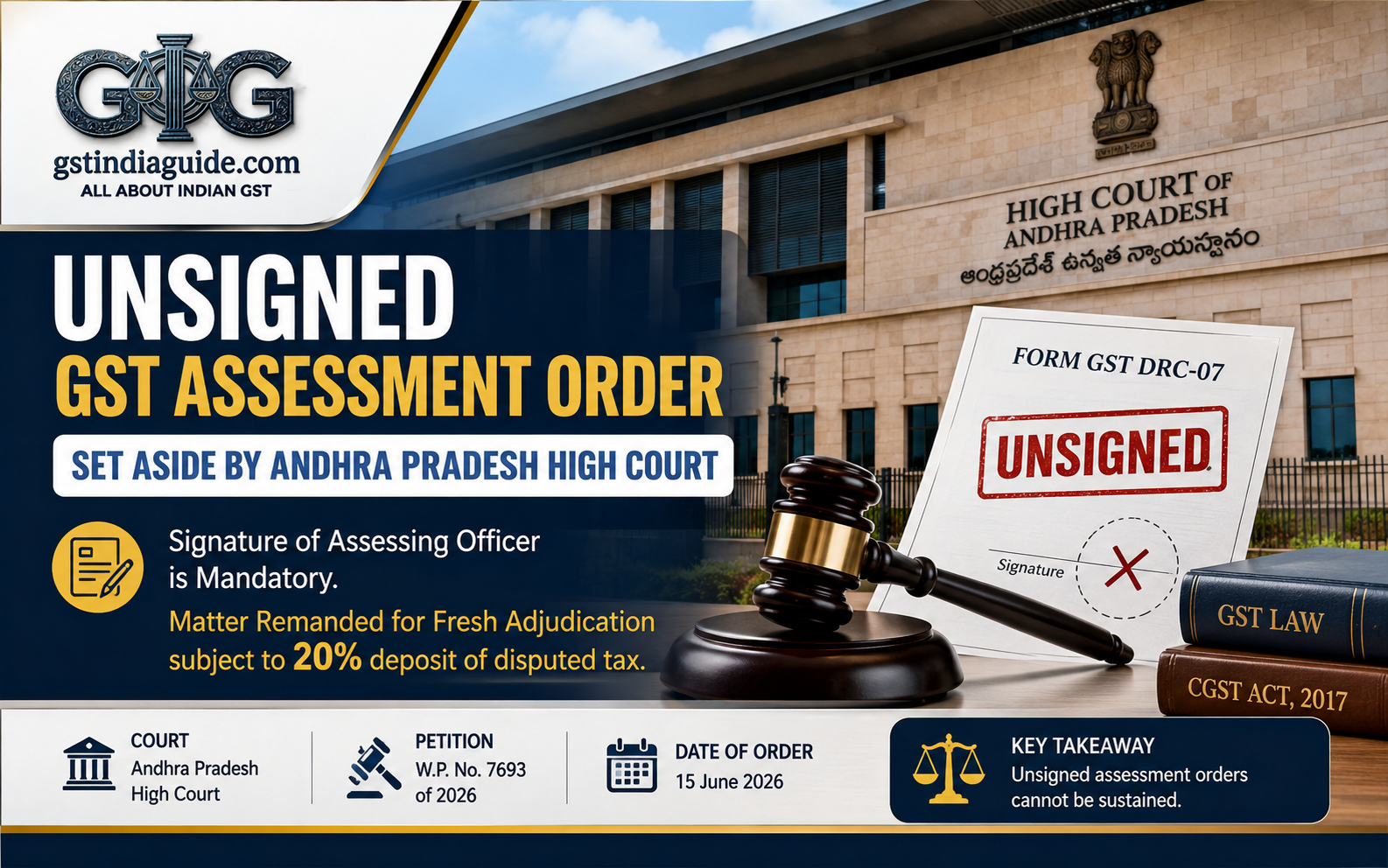
The Andhra Pradesh High Court, in Nominee Works Committee Kalavalla, represented by its Proprietor Pachava Mahesh v. Deputy Assistant Commissioner, ST-II, Kavali Circle & Others, has set aside a GST assessment order issued in FORM GST DRC-07 because it did not contain the signature of the assessing officer.
The judgment was delivered on 15 June 2026 by a Division Bench comprising Justice R. Raghunandan Rao and Justice T.C.D. Sekhar in Writ Petition No. 7693 of 2026.
Background of the Dispute
The petitioner challenged the assessment order dated 25 July 2023 issued in FORM GST DRC-07 and the subsequent proceedings in FORM GST DRC-16 dated 17 February 2026.
The petitioner contended, among other grounds, that the assessment order was invalid because it did not bear the signature of the assessing officer. The petitioner had also raised issues concerning the GST rate applicable to works contracts executed for the State Government, the levy of interest and penalty, and the adjustment of tax deducted at source.
The High Court, however, principally examined the inherent defect arising from the absence of the assessing officer’s signature on the assessment order.
Signature on GST Assessment Order Is Mandatory
The Court referred to its earlier decision in A.V. Bhanoji Row v. Assistant Commissioner (ST), in which it had held that the signature of the assessing officer on an assessment order cannot be dispensed with.
It reiterated that Sections 160 and 169 of the Central Goods and Services Tax Act, 2017 do not cure or validate the absence of a signature on an assessment order.
The Court also relied upon its subsequent decisions in M/s SRK Enterprises v. Assistant Commissioner and M/s SRS Traders v. Assistant Commissioner ST, where unsigned assessment orders had been treated as invalid and set aside.
Accordingly, the High Court held that the assessment order challenged by the petitioner suffered from an inherent and patent defect.
Delay in Filing the Writ Petition
The State opposed the writ petition on the ground that the petitioner had approached the Court after an inordinate and unexplained delay.
The petitioner submitted that the order had not been served through conventional means and that the authorities were relying upon its uploading on the GST portal as valid service.
The Court noted that Section 169(1)(d) of the GST Act recognises uploading an order on the common portal as a mode of service. It also observed that it had previously taken the view that uploading an order on the portal could constitute valid service.
At the same time, the Court acknowledged the practical difficulties faced by registered persons under the online GST administration system. It observed that many taxpayers had approached the Court claiming that they were unaware of orders uploaded on the portal or had not been informed by persons authorised to handle their GST compliance.
Although ignorance of law or inability to access the portal would ordinarily not justify delay, the Court considered it appropriate to grant relief where the impugned order suffered from a patent irregularity.
Relief Subject to 20% Deposit
To balance the difficulties faced by registered taxpayers with the State’s interest in tax administration, the High Court held that delayed writ petitions involving patently defective orders could be considered subject to payment of a portion of the disputed tax.
The Court therefore set aside the unsigned assessment order and remanded the matter to the assessing officer, subject to the petitioner depositing 20% of the disputed tax within six weeks.
Any payments made by the petitioner after the date of the assessment order were directed to be taken into account while calculating the required deposit.
Fresh Assessment After Hearing
The assessing officer was directed to pass fresh orders after providing the petitioner with a proper opportunity of hearing under the GST law.
The Court further directed that the period from the filing of the writ petition until the assessing officer received the High Court’s order would be excluded while computing limitation.
All substantive issues, including those relating to the applicable GST rate, interest, penalty and adjustment of tax deducted at source, were left open for the petitioner to raise before the assessing officer.
Conclusion
The judgment reinforces that authentication of a GST assessment order through the signature of the competent officer is a fundamental procedural requirement. An unsigned assessment order cannot be validated merely by relying upon the provisions governing service of orders or correction of procedural defects.
The decision also demonstrates that a High Court may grant relief against a patently defective GST order despite delay, while imposing suitable conditions such as a pre-deposit to protect the interests of the revenue.