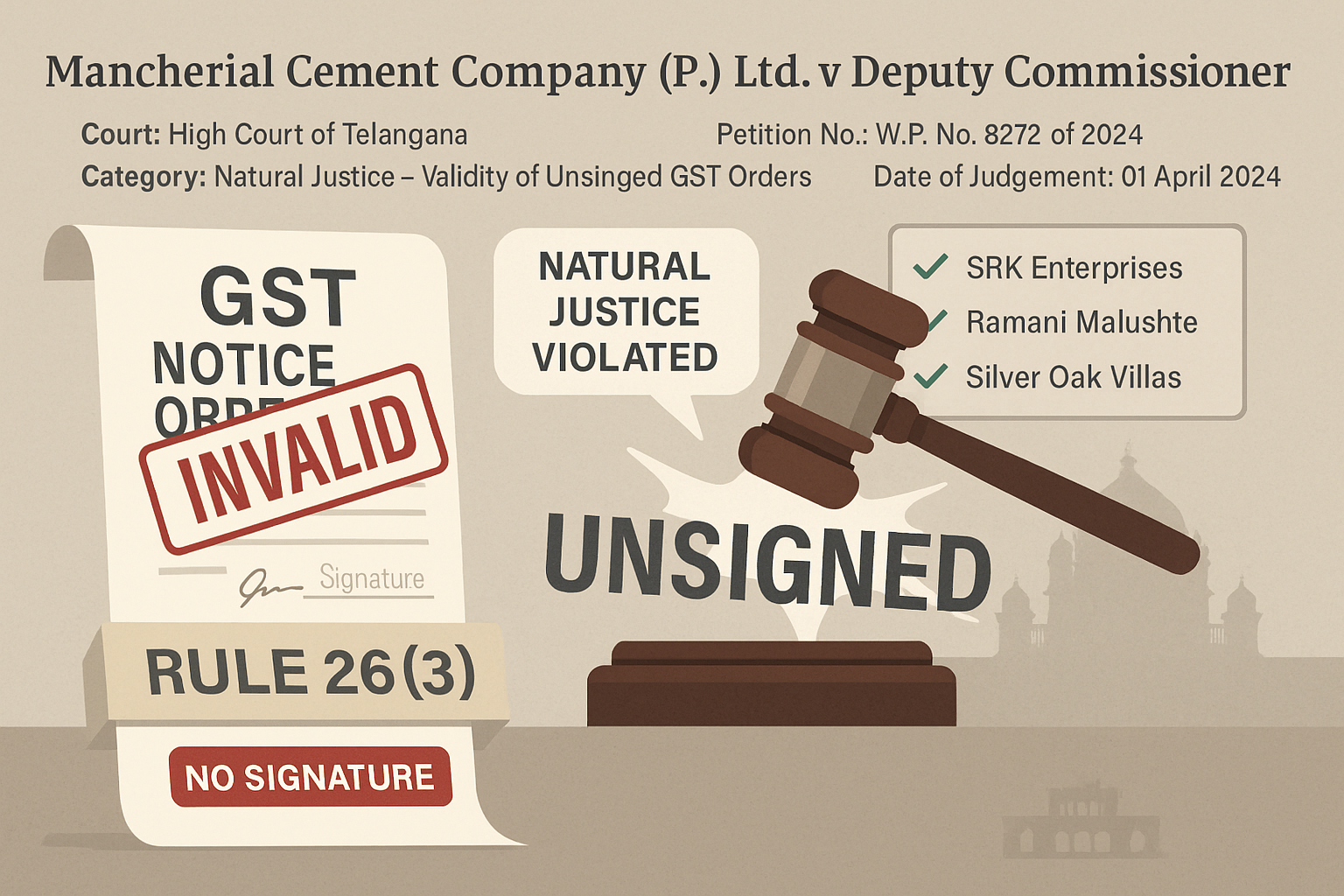
Case Title: Mancherial Cement Company (P.) Ltd. v. Deputy Commissioner
Court: High Court of Telangana
Petition No.: Writ Petition No. 8272 of 2024
Date of Judgement: 01 April 2024
Relevant Sections: Rule 26(3) of the Telangana Goods and Services Tax Rules, 2017 (analogous to CGST Rules)
Category of Dispute: Natural Justice – Validity of Unsigned GST Orders
Facts of the Case (Para 1-3)
- The petitioner, Mancherial Cement Company (P.) Ltd., challenged the validity of certain GST proceedings initiated by the department.
- The primary grievance was that the notices dated 10-02-2022 and 12-02-2021, and the final order dated 15-11-2023 were issued without any physical or digital signature.
- The petitioner contended that this omission violated Rule 26(3) of the CGST Rules, 2017, which mandates that every communication must bear the proper signature (manual or digital) of the competent authority.
- The absence of such a signature, according to the petitioner, rendered the orders void and violative of principles of natural justice.
Question(s) in Consideration (Para 2 & 3)
- Whether a notice or order issued without the manual or digital signature of the competent authority is legally sustainable under GST laws, particularly in view of Rule 26(3) of the CGST Rules, 2017?
Observation of the Court (Para 3-4)
- The Court acknowledged that the issue raised was purely legal and not in dispute factually—the impugned notices and order were indeed unsigned.
- The Court took note of consistent precedents from various High Courts including:
- SRK Enterprises v. Asst. Commissioner (ST) – A.P. HC
- Ramani Suchit Malushte v. Union of India – Bombay HC
- Railsys Engineers (P.) Ltd. v. Addl. Commissioner CGST (Appeals-II) – Delhi HC
- Silver Oak Villas LLP v. Asst. Commissioner (ST) – Telangana HC
- These rulings unanimously held that any unsigned order or notice cannot be sustained in law and violates Rule 26(3).
Judgement of the Court (Para 5-6)
- The Telangana High Court set aside the impugned notices and order for want of proper authentication (signature).
- However, it granted liberty to the department to reinitiate proceedings in accordance with law.
- The writ petition was allowed without costs.
Between Fine Lines
- The Court confirmed that orders without signatures—physical or digital—are not valid under GST law.
- Such unsigned documents violate Rule 26(3) of the CGST Rules and principles of natural justice.
- Relief was granted on procedural grounds without barring future action by the department.
- Affected taxpayers can rely on this case to challenge similar unsigned orders.
- Authorities must ensure proper authentication of notices to withstand judicial scrutiny.
Summary of Referred Cases
| Name of Case | Citation | Summary | Verdict |
| SRK Enterprises v. Asst. Commissioner (ST) | [2023] 157 taxmann.com 93 | Held that unsigned orders are invalid under GST | Order set aside |
| Ramani Suchit Malushte v. Union of India | [2022] (9) TMI 1263 | Emphasized need for digital/physical signature in GST orders | Order quashed |
| Railsys Engineers (P.) Ltd. v. Addl. Commissioner | [2022] 141 taxmann.com 527 | Lack of signature renders the order void | Order invalidated |
| Silver Oak Villas LLP v. Asst. Commissioner (ST) | [2024] 161 taxmann.com 103 | Reaffirmed Rule 26(3) compliance as mandatory | Order set aside |
Takeaway for the Case
“Unsigned Orders, Unenforceable Consequences: Mandate of Rule 26(3) Reaffirmed”