
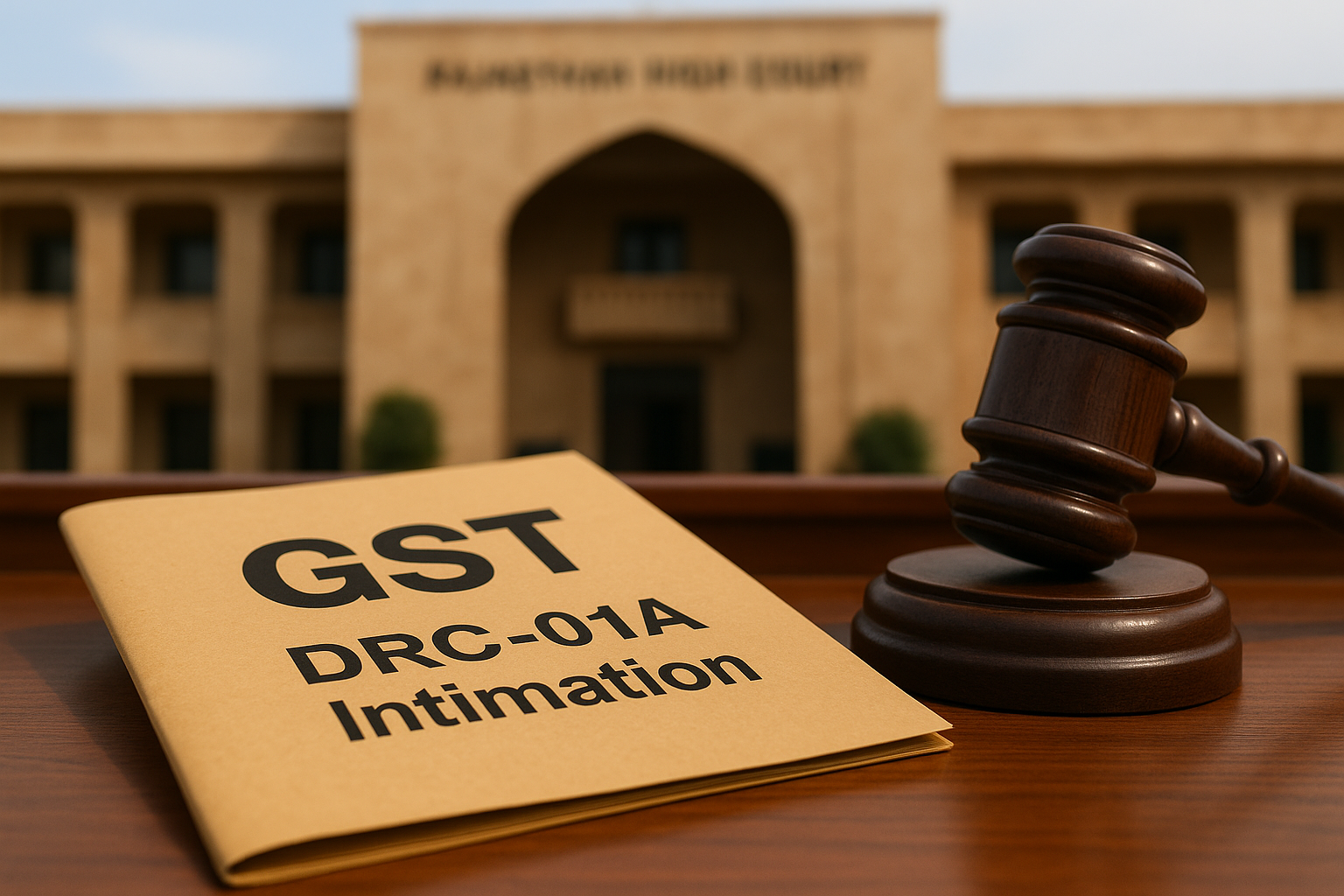
Case Summary
Case Title: M/s Shri Sharma Steeltech India Pvt. Ltd. v. State of Rajasthan & Ors.
Court: High Court of Judicature for Rajasthan, Bench at Jaipur
Petition No.: D.B. Civil Writ Petition No. 13167/2024
Judgment Date: 13.08.2024
Coram: Justice Pankaj Bhandari & Justice Praveer Bhatnagar
Category of Dispute: Procedural validity – Pre-SCN reply under GST Rules
Relevant Provisions: Rule 142(1A) & 142(2A) of CGST/RGST Rules, 2017; Section 74 of CGST Act (contextually); Article 226 of Constitution
Facts (Paras 1–4)
The petitioner, a registered company, challenged the non-consideration of its reply filed in response to a pre-show cause intimation issued under Form GST DRC-01A. Relying on Rule 142(1A) & (2A), the petitioner contended that the authorities were obliged to consider its reply before issuing a formal show cause notice. To support this, it cited Calcutta High Court rulings in Eden Real Estate Pvt. Ltd. (2024) and Diamond Beverages Pvt. Ltd. (2023), where it was held that even at the intimation stage, taxpayers must be afforded an opportunity of hearing.
Questions Before Court
-
Whether the reply submitted to a DRC-01A pre-show cause communication obliges the authority to consider and adjudicate upon it before proceeding to issue a show cause notice under Rule 142(1)(a)?
-
Whether denial of hearing at the pre-SCN stage violates principles of natural justice?
Observations (Paras 5–12)
The State argued that Rule 142(1A) merely provides that the proper officer “may” issue communication, which is discretionary and not mandatory. Rule 142(2A) permits filing of submissions against proposed liability, but no adjudicatory mechanism is prescribed at that stage. Hearing is only statutorily mandated after issuance of a show cause notice, not before.
The Court agreed, relying on Supreme Court’s ruling in CCE v. Krishna Wax Pvt. Ltd. (2020) 12 SCC 572, which emphasized that writ petitions ordinarily should not be entertained against pre-SCN intimations since the assessee’s rights fully arise only after issuance of SCN. Further, Ajmera Housing Corporation v. CIT (2010 INSC 535) was invoked to stress that tax statutes must be construed strictly and courts cannot read rights into provisions that do not expressly exist.
The Court expressly disagreed with the Calcutta High Court view, observing that the RGST/CGST Rules do not envisage hearing at the intimation stage, and expanding such right would amount to judicial legislation.
Judgment (Paras 13–15)
The High Court dismissed the writ petition, holding that:
-
Rule 142(1A) communication is merely discretionary and informational, not determinative.
-
No vested right of hearing or adjudication exists at pre-SCN stage.
-
Remedy lies only after SCN is issued, where opportunity of hearing is explicitly provided.
-
The writ petition was premature and an attempt to stall proceedings.
Table of Cases Referred
| Case | Court | Verdict |
|---|---|---|
| Eden Real Estate Pvt. Ltd. v. Senior Joint Commissioner, WBGST (2024) | Calcutta HC | Held that opportunity of hearing should be given even at pre-SCN intimation stage under Rule 142(1A). |
| Diamond Beverages Pvt. Ltd. v. Assistant Commissioner, CGST (2023) | Calcutta HC | Reinforced requirement of hearing at pre-SCN intimation stage. |
| CCE, Haldia v. Krishna Wax Pvt. Ltd. (2020) 12 SCC 572 | Supreme Court | Clarified writs should not be entertained at pre-SCN stage; SCN only reflects prima facie view. |
| Ajmera Housing Corporation v. CIT (2010 INSC 535) | Supreme Court | Taxing statutes must be strictly interpreted; no rights can be implied into provisions. |
Between Fine Lines
For taxpayers, this ruling clarifies that replies to pre-SCN intimation (DRC-01A) carry no binding effect on authorities. Relief cannot be sought from courts at this stage, as rights to hearing and adjudication only arise after receipt of formal SCN. Businesses must thus be prepared to make their strongest representations during the SCN and adjudication stage, rather than expecting early relief at the intimation stage.
Disclaimer – “The above summary is for academic purpose only; not formal legal opinion. Seek professional opinion before application. Author or publisher or website shall not be responsible for any usage in any form.”

 and 142(2A) of GST Rules. Writ petition dismissed as premature.)