Case Details
-
Case Title: Mukesh Kumar Garg v. Union of India & Ors.
-
Court: Delhi High Court
-
Petition No.: W.P.(C) 5737/2025 & CM APPL. 26171/2025
-
Date of Judgement: 09 May 2025
-
Category of Dispute: Input Tax Credit (Fake ITC), Penalty, Jurisdiction
-
Relevant Sections: Sections 16, 74, 122(1), 122(3), 107, and 75(13) of the CGST Act, 2017
Facts of the Case
(Refer: ¶2–5)
-
The petitioner, Mr. Mukesh Kumar Garg, challenged an Order-in-Original dated 30.01.2025 passed by Additional Commissioner of CGST (Delhi West), arising from a SCN dated 31.07.2024.
-
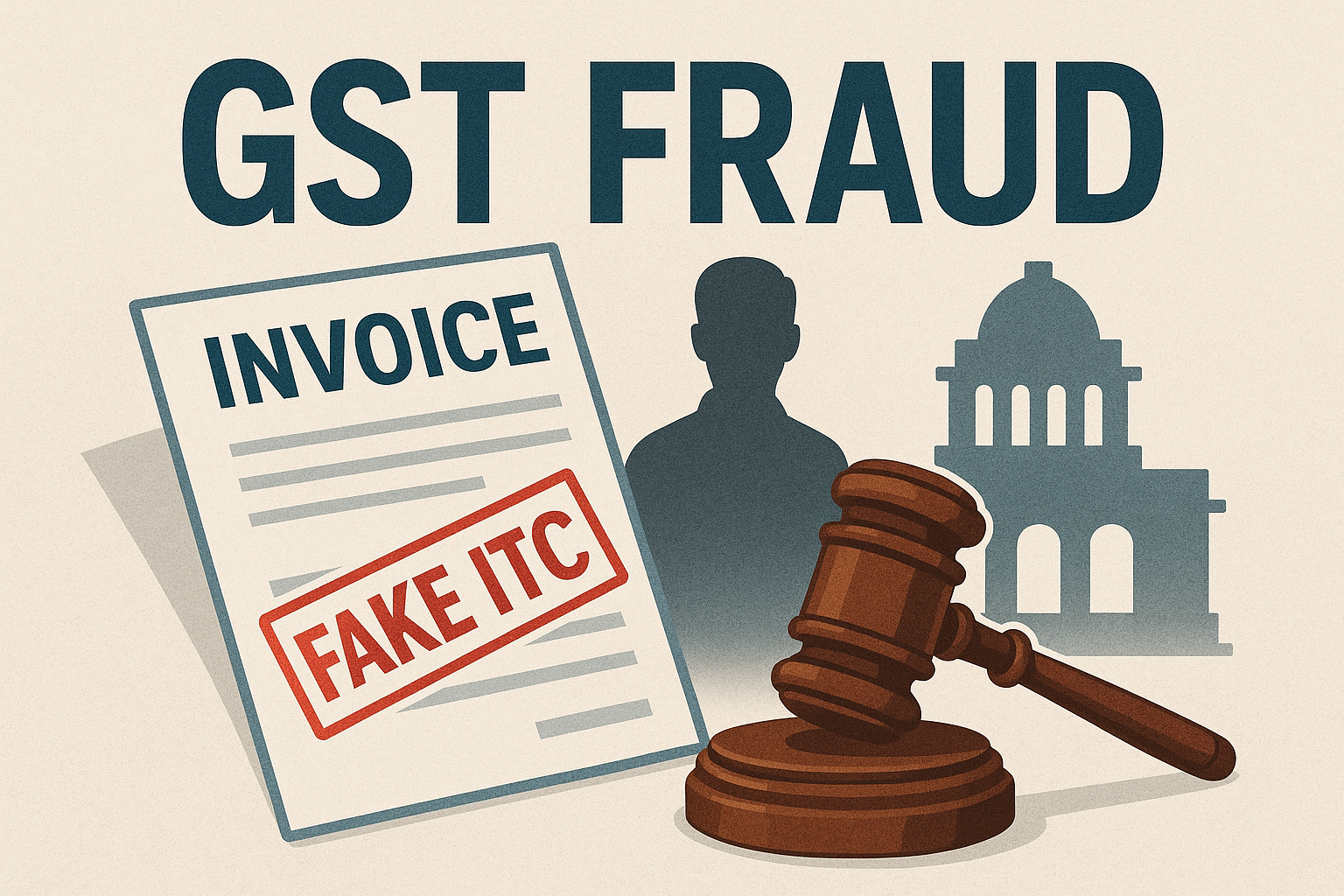
The department alleged that Mr. Mukesh Kumar Garg and his son Mr. Anuj Garg established 28 firms and availed fake ITC worth ₹115.73 crores without actual supply of goods/services.
-
The petitioner was penalized under Sections 74 and 122 of CGST Act. Personal hearing was granted, and a detailed reply was filed.
-
One of the firms involved—M/s Bhagwati Trading Company—was a sole proprietorship of the petitioner but did not receive a separate SCN due to jurisdictional issues (¶8).
-
Petitioner contended he was not a taxable person or authorized signatory of the main firm and hence should not be penalized beyond ₹25,000 under Section 122(3) (¶6–7).
Questions in Consideration
(Refer: ¶6, ¶9, ¶15, ¶17)
-
Whether the penalty imposed on the petitioner under Section 122 is legally sustainable, especially when he is not the main taxable person?
-
Whether writ jurisdiction under Article 226 is maintainable when the order is appealable under Section 107 of CGST Act?
-
Whether the petitioner is entitled to proportional penalty limited to his proprietary concern only?
-
Whether principles of natural justice and jurisdiction were violated in issuing the impugned order?
Observations of the Court
(Refer: ¶11–24)
-
The High Court emphasized that the case involved serious allegations of orchestrated fake ITC claims across multiple shell firms (¶11, ¶14).
-
It noted the misuse of ITC mechanism under Section 16 by non-existent firms, which threatens the credibility of GST regime (¶12–13).
-
The Court held that disputed factual issues like proportionality of penalty or the petitioner’s exact role require evidence and adjudication by appellate authorities, not by writ court (¶17).
-
It observed that entertaining writ petition would encourage forum shopping and multiplicity of proceedings, especially when co-noticee (son) has already filed appeal (¶18).
-
Citing Supreme Court decisions (K.D. Sharma, Ramjas Foundation, Prestige Lights), the Court reiterated the doctrine that writ jurisdiction is equitable and not for litigants who withhold facts or misuse process (¶24).
Judgement of the Court
(Refer: ¶25–26)
-
The writ petition was dismissed with ₹50,000 cost, holding that appropriate remedy for the petitioner lies in appeal under Section 107.
-
The Court found no violation of jurisdiction or natural justice as the petitioner was served notice and granted hearing.
Between Fine Lines
-
The Delhi High Court refused to quash the penalty under CGST Act imposed on a person alleged to have floated shell firms for availing fake ITC.
-
It held that complex factual issues and role attribution must be assessed in appeal, not via writ.
-
The Court emphasized that writ is an extraordinary remedy, not a substitute for statutory appeal.
-
The judgment underscores the importance of transparency when invoking writ jurisdiction.
-
Litigants must exhaust available appeal channels unless there’s clear arbitrariness or violation of natural justice.
Summary of Referred Cases
| Name | Citation | Summary | Verdict/Use in Case |
|---|---|---|---|
| Union of India v. Hindalco | 2023 (153) ELT 481 (SC) | Clarifies scope of writ jurisdiction when alternate remedy exists | Cited to assert that writ is not barred, but discretionary |
| Paradise Foodcourt v. Telangana | 2018 (61) GSTL 361 | Emphasized procedural fairness in tax investigations | Cited by petitioner, but found not applicable |
| K.D. Sharma v. SAIL | (2008) 12 SCC 481 | Litigants must approach writ court with clean hands | Cited by court to justify dismissal |
| Ramjas Foundation v. UOI | (2010) 14 SCC 38 | Misrepresentation is a bar to equitable relief under writ | Used to deny writ relief due to suppressed facts |
| Prestige Lights Ltd. v. SBI | (2007) 8 SCC 449 | Disclosure of material facts essential for writ remedy | Cited to reinforce writ jurisdiction must not be misused |
Disclaimer – “The above summary is for academic purpose only; not formal legal opinion. Seek professional opinion before application. Author or publisher or website shall not be responsible for any usage in any form.”