
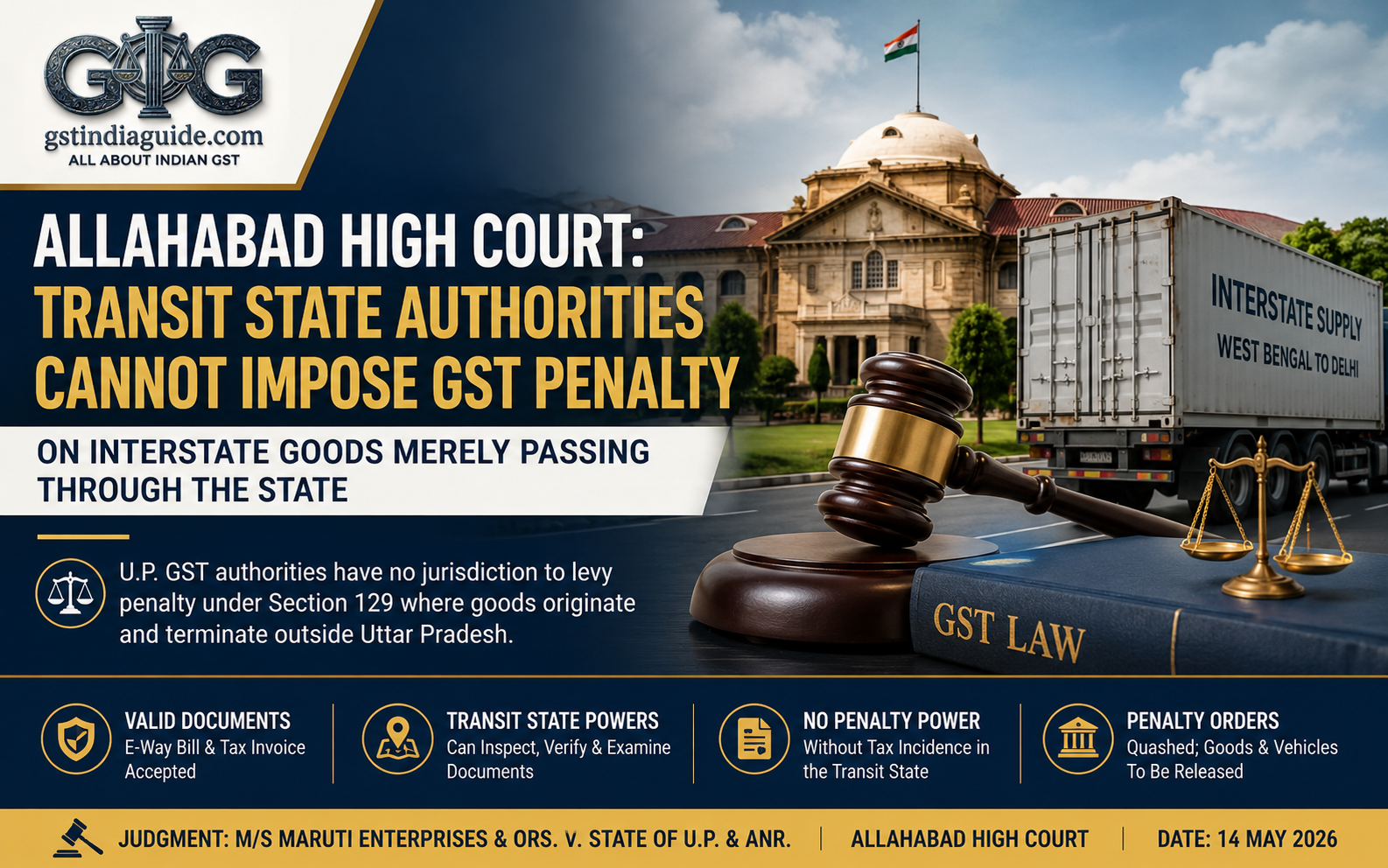
The Allahabad High Court, in M/s Maruti Enterprises v. State of U.P. and Another, has examined an important jurisdictional question concerning the power of GST authorities of a transit State to detain goods and impose penalty under Section 129 of the GST law when an interstate supply originates in one State and terminates in another State, with no tax incidence arising in the transit State. The judgment was delivered on 14 May 2026 by Justice Saumitra Dayal Singh and Justice Swarupama Chaturvedi in Writ Tax No. 1423 of 2026 along with connected writ petitions.
The lead petitioner, M/s Maruti Enterprises, had purchased 30,100 kg of dried Areca nuts from a registered supplier in West Bengal. The goods were being transported from West Bengal to New Delhi under a tax invoice and a valid e-way bill. When the vehicle reached Gautam Buddh Nagar in Uttar Pradesh, it was intercepted by the U.P. GST authorities. An objection was subsequently raised that the supplier had not issued an e-Tax Invoice as required under Rule 48 of the CGST Rules. A penalty of ₹33,18,525 was imposed in the case of M/s Maruti Enterprises. Similar penalties were imposed in the connected petitions.
Jurisdiction of a Transit State under GST
The principal issue before the High Court was whether the GST authorities of Uttar Pradesh had jurisdiction to impose a penalty where the goods merely passed through Uttar Pradesh and both the origin and destination of the supply were situated outside the State.
The Court recognised that GST authorities of a transit State are empowered to stop a conveyance, inspect the goods, physically verify them and examine the prescribed documents while the goods are passing through the State. Such regulatory powers are available even where no tax incidence arises in the transit State.
However, the Court drew a distinction between the power to inspect goods and the power to impose a substantive penalty. It held that the statutory concept of cross-empowerment does not create cross-empowerment between the GST authorities of different States. Rather, cross-empowerment operates between the Central GST authorities and the GST authorities of the concerned State in relation to transactions falling within their jurisdiction.
No Penalty Where U.P. Was Merely a Transit State
In the present case, there was no allegation that the goods were different from those mentioned in the tax invoice and e-way bill. There was also no allegation that the goods originated in Uttar Pradesh, were intended for supply within Uttar Pradesh, or that the documents produced were bogus.
Accordingly, where the transaction admittedly originated in West Bengal and was destined for Delhi, no tax became payable in Uttar Pradesh merely because the vehicle travelled through the State.
The High Court therefore held that the U.P. GST authorities could not invoke Section 129 to impose penalty in respect of such a transaction when Uttar Pradesh was only a transit State and there was no foundation for any tax levy in Uttar Pradesh.
Absence of E-Invoice Could Be Reported to Competent Authorities
The Court also dealt specifically with the absence of an e-Tax Invoice. It observed that the discrepancy could legitimately be noticed by the U.P. authorities during verification.
However, the proper course was to communicate the discrepancy to the competent GST authorities in West Bengal and Delhi, rather than detain the goods and impose penalty in Uttar Pradesh.
The Court further observed that issuance of an e-invoice depends upon the turnover of the supplier, a fact particularly within the supplier’s knowledge. Where the physical tax invoice was not alleged to be bogus, the recipient could not automatically be penalised for the supplier’s failure to generate an e-invoice.
Cross-Empowerment Does Not Extend From One State GST Authority to Another
A significant principle emerging from the judgment is that the cross-empowerment contemplated under Section 6 of the CGST/SGST framework and Section 4 of the IGST Act operates between the Centre and the concerned State, rather than creating unrestricted jurisdiction for the GST authorities of one State over taxpayers and transactions belonging entirely to other States.
The Court distinguished the Supreme Court decision in M/s ASP Traders v. State of U.P., observing that the facts and issue considered there were materially different. It also noted the similar view taken by the Andhra Pradesh High Court in Golden Traders and Ors. v. Deputy Asst. State Tax and Ors., 2026 SCC OnLine AP 803.
Final Decision
The Allahabad High Court allowed all the writ petitions. It held that where the goods admittedly originated outside Uttar Pradesh and were destined outside Uttar Pradesh, were supported by a valid e-way bill and physical tax invoice, and there was no allegation that the goods or documents were bogus or connected with any supply within Uttar Pradesh, the U.P. GST authorities had no jurisdiction to impose penalty merely because the goods were transiting through the State.
The individual penalty orders were consequently quashed, and the Court directed that the goods and vehicles be released forthwith.
[…] Click to view […]