
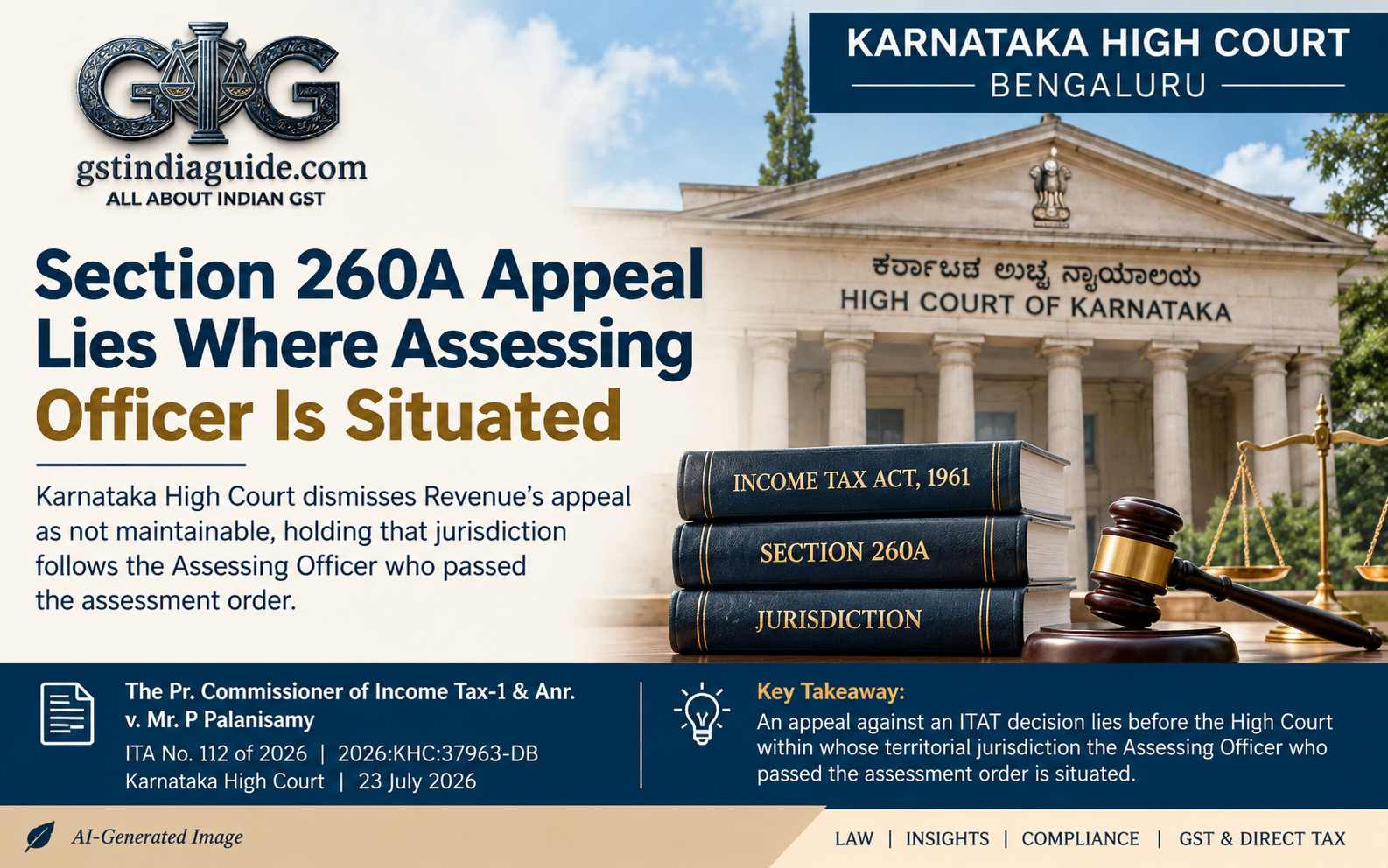
Case: The Pr. Commissioner of Income Tax-1 & Anr. v. Mr. P Palanisamy
Court: Karnataka High Court, Bengaluru — Division Bench
Case No.: Income Tax Appeal No. 112 of 2026
Neutral Citation: 2026:KHC:37963-DB
Date: 23 July 2026
Coram: Justice S.G. Pandit and Justice K. Manmadha Rao
Assessment Year: 2010-11
Impugned ITAT Order: ITA No. 209/CHNY/2025 dated 09.02.2026, ITAT Chennai, ‘C’ Bench.
Key Issue
Whether an appeal under Section 260A of the Income Tax Act, 1961 could be maintained before the Karnataka High Court merely because the assessee was situated in Bengaluru, when the assessment order had been passed by the Assessing Officer at Coimbatore.
Brief Facts
The Revenue filed an appeal under Section 260A challenging the order of the ITAT, Chennai ‘C’ Bench. The Registry raised an objection regarding the maintainability of the appeal before the Karnataka High Court. The Revenue submitted that the appeal was filed in Karnataka because the assessee was situated in Bengaluru and that assessment had taken place at Coimbatore following centralisation consequent to a search. The Court noted that the assessment order was passed by the Assistant Commissioner of Income Tax, Central Circle-3, Coimbatore, while the ITAT order was passed by the Chennai Bench.
Karnataka High Court’s Ruling
The Division Bench held that the Karnataka High Court did not have jurisdiction to entertain the appeal.
The Court relied upon the Supreme Court’s decision in Principal Commissioner of Income-Tax v. ABC Papers Ltd., wherein it was held that an appeal against an ITAT decision lies before the High Court within whose territorial jurisdiction the Assessing Officer who passed the assessment order is situated. The principle continues to apply even where the assessee’s case has been transferred under Section 127 of the Income Tax Act.
Since the assessment order in the present case was passed by the Assistant Commissioner of Income Tax, Central Circle-3, Coimbatore, the Karnataka High Court held that it lacked jurisdiction.
Accordingly, the appeal was dismissed as not maintainable, with liberty to the Revenue to file an appeal before the appropriate jurisdictional High Court.
Key Takeaway
For determining the jurisdiction of the High Court in an appeal under Section 260A, the relevant factor is the location of the Assessing Officer who passed the assessment order, and not merely the location of the assessee. A transfer or centralisation of the assessee’s case does not alter this jurisdictional principle.