
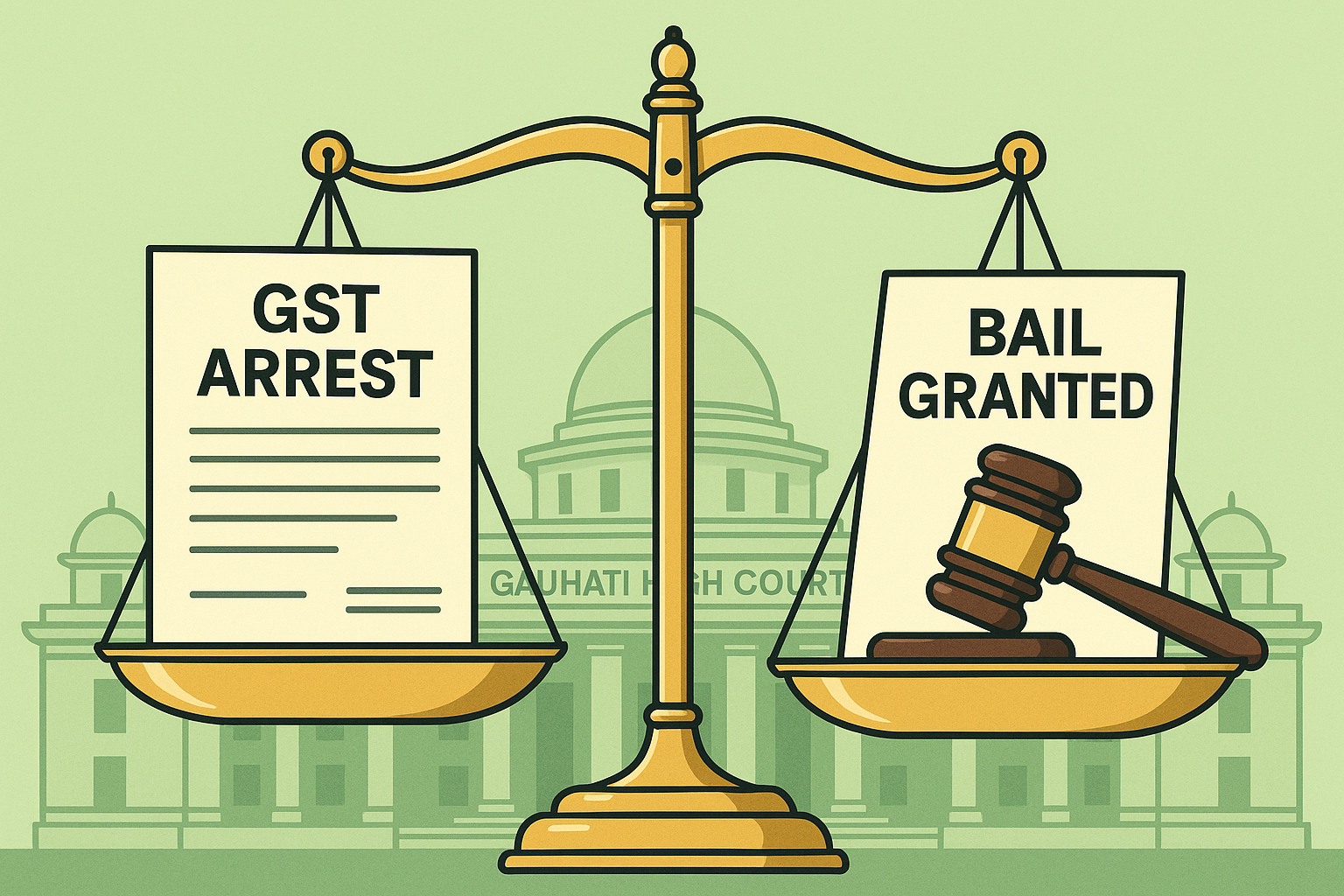
Case Summary
Case Title: Prabin Jha v. Union of India
Court: Gauhati High Court
Petition No.: Bail Appln./963/2025
Date of Judgment: 03.04.2025
Relevant Sections:
-
Section 132(5), Section 69, Section 70 of the CGST Act, 2017
-
Section 41, 41A, 50 of Cr.P.C. (now Sections 35(3), 47, 48 under BNSS, 2023)
-
Circular No. 122/41/2019-GST dated 05.11.2019 (DIN requirement)
Category of Dispute: Bail under GST arrest provisions (economic offence involving ITC fraud)
Facts (Paras 2–6, 9–14)
The petitioner, proprietor of M/s Goodwill Traders, was arrested by the Directorate General of GST Intelligence on 07.03.2025 for alleged issuance of fake invoices and wrongful ITC availment of ₹30.89 crores. He had appeared on summons but was taken into custody without police remand being sought. The defence argued that his arrest was mechanical, without prior assessment of tax dues, and violated Cr.P.C. safeguards. The documents such as authorization letter and grounds of arrest lacked a Document Identification Number (DIN), contrary to mandatory circulars. Crucially, the “reasons to believe” authorizing arrest under Section 69 CGST Act were not furnished to him, preventing him from challenging the arrest’s legality.
Questions/Issues (Paras 6–11, 16–19, 22–24)
-
Whether the absence of DIN in arrest-related documents invalidated the arrest.
-
Whether “reasons to believe” must be communicated to the arrestee.
-
Whether non-compliance with Sections 41/41A Cr.P.C. and BNSS equivalents vitiated the arrest.
-
Whether further custody was necessary after 30 days of incarceration when investigation was largely documentary.
Observations (Paras 22–25)
The Court noted that although Section 69 CGST Act empowers arrest, it is not a complete code, and Cr.P.C. safeguards apply unless expressly excluded. The arrest suffered from two fatal defects: (i) missing DIN in authorization and grounds of arrest (mandated under Circular 122/41/2019), and (ii) failure to communicate “reasons to believe” to the petitioner, which Supreme Court rulings (Radhika Agarwal, Arvind Kejriwal) held essential for upholding personal liberty. The Court emphasized that non-compliance with Sections 41/41A Cr.P.C. and BNSS equivalents amounted to violation of Articles 21 and 22 of the Constitution. Having been in custody for nearly 30 days with no further need for interrogation, denial of bail was unjustified.
Judgment (Paras 26–28)
The Court granted bail to the petitioner on furnishing a bond of ₹50,000 with one surety. Conditions imposed included cooperation with investigation, no inducement or intimidation of witnesses, and restriction on travel outside Kamrup (M) without prior permission.
Table of Precedents Referred
| Case | Court & Citation | Verdict/Ratio |
|---|---|---|
| Radhika Agarwal v. UOI (2025 SCC OnLine SC 449) | Supreme Court | GST Act not a complete code; Cr.P.C. applies; “reasons to believe” must be furnished to arrestee. |
| Arnesh Kumar v. State of Bihar | Supreme Court | Arrest must comply with Section 41/41A Cr.P.C.; notice mandatory. |
| Satender Kumar Antil v. CBI (2022 SCC OnLine SC 825) | Supreme Court | Reiterated safeguards for arrest and bail. |
| Vihaan Kumar v. State of Haryana (2025 SCC OnLine SC 269) | Supreme Court | Arrest without informing grounds violates Article 21. |
| Prabir Purkayastha v. State (NCT of Delhi) (2024) 8 SCC 254 | Supreme Court | Procedural safeguards under Articles 21–22 must be strictly observed. |
| P.V. Ramana Reddy v. UOI (WP 4764/2019, Telangana HC; upheld by SC) | High Court/Supreme Court | CGST Act is a complete code for prosecution and punishment. |
| Y.S. Jagan Mohan Reddy v. CBI (Cr.A. 730/2013) | Supreme Court | Economic offences must be treated with stricter bail scrutiny. |
Between Fine Lines
This case underscores that GST arrests cannot bypass Cr.P.C. safeguards. Even in economic offences, missing DIN numbers and failure to furnish “reasons to believe” can invalidate arrest procedures and strengthen bail claims. For businesses, the ruling reiterates that procedural lapses by GST officers create enforceable rights for taxpayers.
Disclaimer – “The above summary is for academic purpose only; not formal legal opinion. Seek professional opinion before application. Author or publisher or website shall not be responsible for any usage in any form.”