
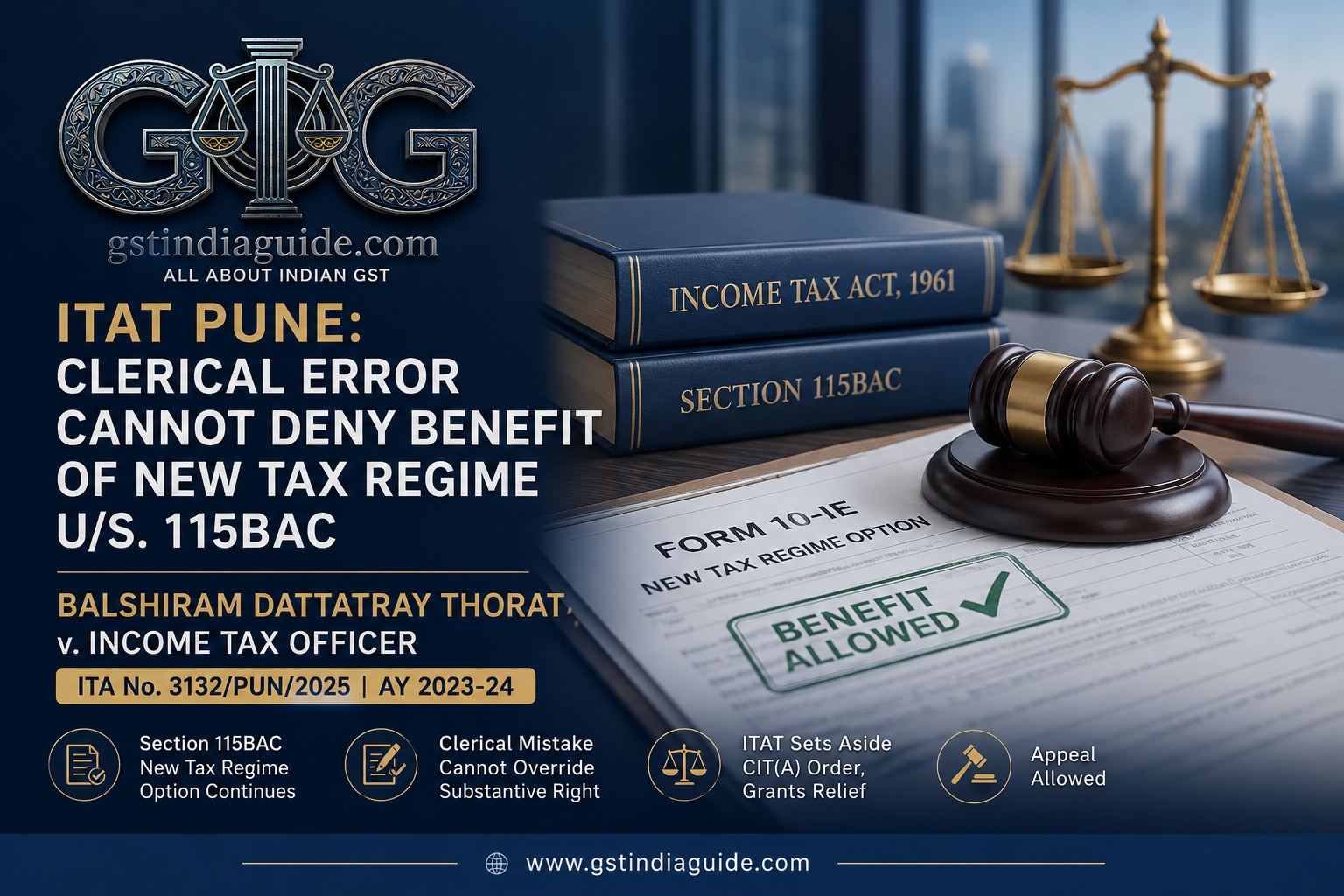
The Pune Bench of the Income Tax Appellate Tribunal (ITAT) has delivered an important ruling in Balshiram Dattatray Thorat v. Income Tax Officer, clarifying the operation of Section 115BAC of the Income-tax Act, 1961. The Tribunal held that where an assessee had already validly exercised the option to be taxed under the new tax regime by filing Form 10-IE and had never withdrawn that option, a clerical mistake in mentioning the first year of opting for the regime in the income tax return cannot deprive the assessee of the statutory benefit.
The dispute arose because, while filing the return for Assessment Year 2023-24, the assessee inadvertently mentioned Assessment Year 2022-23 instead of Assessment Year 2021-22 as the first year of opting for the new tax regime. Based on this mismatch, the Central Processing Centre (CPC) denied the benefit under Section 115BAC and computed the tax liability under the old tax regime. Although the assessee filed rectification applications explaining the clerical error, the CPC as well as the Commissioner (Appeals) refused to grant relief.
The Tribunal examined Section 115BAC(5) and observed that, for taxpayers having business or professional income, once the option is validly exercised by filing Form 10-IE, it automatically continues for subsequent assessment years unless the assessee withdraws it in accordance with law. Since the assessee had originally exercised the option in Assessment Year 2021-22, continued under the new regime in subsequent years, and had never opted out, there was no statutory requirement to file a fresh Form 10-IE for Assessment Year 2023-24.
The Bench further held that income-tax authorities should not deny substantive statutory benefits merely because of an inadvertent clerical mistake in the return, particularly where the factual record clearly establishes the assessee’s continued eligibility. The Tribunal relied upon the decision of the Surat Bench in Meenaben Maheshchandra Patel v. ITO, reiterating that procedural or technical errors should not defeat the legislative intent of granting the benefit of the new tax regime where all substantive conditions stand satisfied.
Accordingly, the ITAT set aside the order of the Commissioner (Appeals) and directed the Assessing Officer/CPC to grant the benefit of taxation under Section 115BAC by modifying the assessment. The assessee’s appeal was allowed.
Key Takeaways
This decision reinforces several important legal principles:
- Once the option under Section 115BAC is validly exercised through Form 10-IE, it continues for subsequent assessment years unless lawfully withdrawn.
- A clerical or inadvertent mistake in the income tax return should not override the substantive statutory right available to the taxpayer.
- CPC processing based solely on automated system validation cannot defeat genuine claims supported by statutory records.
- Tax authorities should facilitate the grant of legitimate tax benefits rather than deny them on purely technical grounds.
- The ruling strengthens taxpayer protection against denial of the new tax regime because of procedural mistakes.
Why This Judgment Matters
The decision provides significant relief to taxpayers and tax professionals dealing with processing errors under the new tax regime. It emphasizes that the objective of Section 115BAC is to provide a beneficial taxation option and that genuine clerical mistakes should not result in denial of that benefit where the statutory conditions are otherwise fulfilled. The ruling will be particularly useful in disputes involving CPC processing, Form 10-IE compliance, rectification proceedings, and automated return validations.