
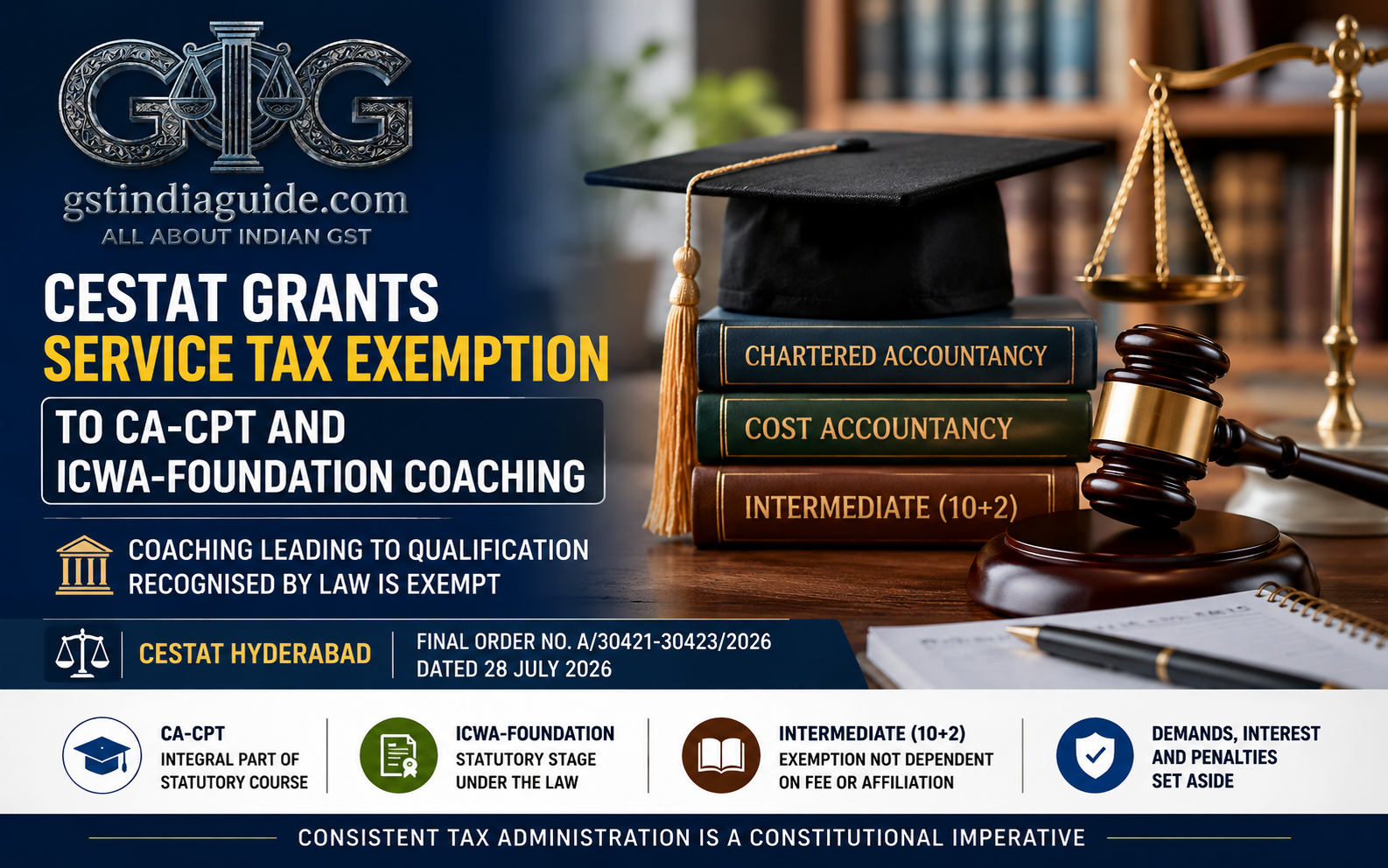
The Customs, Excise and Service Tax Appellate Tribunal, Hyderabad, has held that coaching provided for CA-CPT, ICWA-Foundation and Intermediate (10+2) examinations is eligible for exemption from service tax under Notification No. 33/2011-ST dated 25 April 2011.
The ruling was delivered in M/s Master Minds v. Commissioner of Central Excise & Service Tax, Guntur, in a group of three service tax appeals. The Division Bench comprised Mr. P. Anjani Kumar, Member (Technical), and Mr. Angad Prasad, Member (Judicial). The appeals were decided through Final Order Nos. A/30421-30423/2026 dated 28 July 2026.
Background of the Dispute
M/s Master Minds was engaged in providing coaching to students preparing for Chartered Accountancy, Cost Accountancy and Intermediate examinations. The institution was registered with the Service Tax Department under the category of “Commercial Training or Coaching Centre”.
The Department initiated proceedings on the ground that coaching provided for CA-CPT, ICWA-Foundation and Intermediate examinations did not satisfy the conditions of Notification No. 33/2011-ST. The adjudicating authority accepted the exemption for CA-IPCC, CA-Final and ICWA-Final coaching but confirmed service tax demand in respect of CA-CPT, ICWA-Foundation and Intermediate coaching.
The impugned orders collectively confirmed service tax of ₹35,40,895, apart from applicable interest and penalties.
Issue Before the Tribunal
The principal issue before the Tribunal was whether coaching provided for CA-CPT, ICWA-Foundation and Intermediate examinations could be regarded as coaching leading to the grant of an educational qualification recognised by law within the meaning of Notification No. 33/2011-ST.
The Department treated CA-CPT and ICWA-Foundation as merely qualifying or entrance examinations rather than recognised educational qualifications. The appellant contended that these examinations formed mandatory and inseparable stages of professional courses governed by statutory enactments and regulations.
CA-CPT Is an Integral Part of Statutory Education
The Tribunal observed that Chartered Accountancy education is governed by the Chartered Accountants Act, 1949 and the regulations framed under it. CA-CPT constituted the mandatory first stage of the statutory course, and a candidate could not proceed to the next stage without successfully completing it.
Accordingly, CA-CPT could not be treated as an independent, optional or merely preliminary examination. It formed an integral component of the educational programme leading to a qualification recognised by law.
The Tribunal applied the same reasoning to ICWA-Foundation, which was a statutory stage prescribed under the applicable Cost Accountancy regulations.
The fact that successful completion of a foundation-level examination enabled a student to progress to a higher stage did not deprive that examination of its character as part of an educational qualification recognised by law.
Exemption Not Restricted to Final Qualification
Notification No. 33/2011-ST exempted coaching or training leading to the grant of a certificate, diploma, degree or educational qualification recognised by law.
The Tribunal noted that the notification did not restrict the exemption only to coaching for the final stage of a degree or professional qualification. It also did not use the expression “final qualification”.
Therefore, denying the exemption merely because CA-CPT or ICWA-Foundation was a qualifying stage would amount to introducing an additional condition that was absent from the notification.
The Tribunal held that an exemption notification must be interpreted according to its actual language. Neither the Department nor the adjudicating authority could rewrite the notification by imposing conditions that the Central Government had not prescribed.
Intermediate Coaching Also Covered
The exemption relating to Intermediate (10+2) coaching had been denied on grounds including the amount of fees collected and the alleged absence of proof of affiliation.
The Tribunal found that Notification No. 33/2011-ST did not impose any condition concerning the quantum of fees charged by the institution. It also did not prescribe the additional affiliation requirement relied upon in the impugned orders.
Consequently, the denial of exemption on these grounds was held to be beyond the scope of the notification.
Inconsistent Stand of the Department
The appellant produced an earlier adjudication order showing that, for subsequent periods, the Department had accepted the exemption in respect of similar coaching services. Excess tax paid by the appellant had also been refunded.
The Tribunal held that, in the absence of any change in the relevant facts or law, the Revenue could not adopt contradictory positions for different periods.
It observed that consistency in tax administration is an important facet of Article 14 of the Constitution. Once the Department had accepted the exemption for an identical activity during another period, a contrary stand could not ordinarily be maintained without a legally sustainable distinction.
Tribunal’s Decision
The Tribunal held that coaching provided for CA-CPT, ICWA-Foundation and Intermediate examinations qualified for exemption under Notification No. 33/2011-ST.
It consequently set aside the service tax demands, together with the associated interest and penalties. All three appeals filed by M/s Master Minds were allowed, including consequential refund, subject to its admissibility under law.
Significance of the Ruling
The decision clarifies that the service tax exemption available to coaching leading to a qualification recognised by law is not confined to coaching for the final examination or final stage of a professional course.
Where a foundation, entrance or qualifying examination is a compulsory statutory stage of an integrated educational programme, coaching for that stage cannot be excluded merely because the student receives the ultimate professional qualification only after completing subsequent stages.
The ruling is relevant to coaching institutions, professional education providers and taxpayers dealing with legacy service tax disputes concerning courses governed by statutory professional bodies. It also reinforces the principle that tax authorities cannot introduce additional eligibility conditions into an exemption notification when those conditions are not found in its text.