
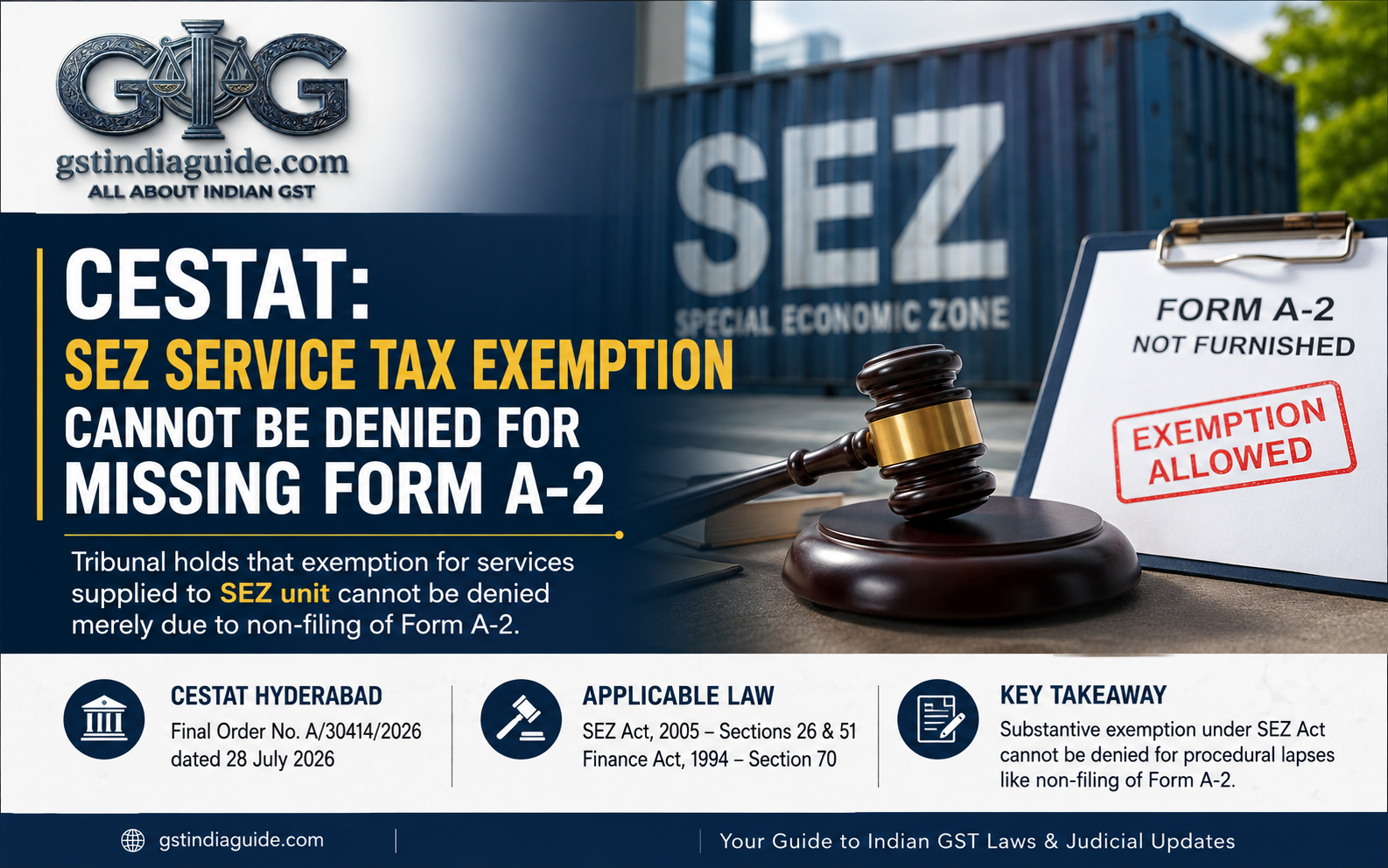
The Customs, Excise and Service Tax Appellate Tribunal, Hyderabad, has held that service tax exemption for services provided to a Special Economic Zone unit for authorised operations cannot be denied merely because the service provider failed to furnish Form A-2 for the relevant financial year.
The ruling was delivered in M/s Srisun Exim Services v. Commissioner of Central Tax, Medchal – GST, Service Tax Appeal No. 30747 of 2024. The Division Bench comprising P. Anjani Kumar, Member (Technical), and Angad Prasad, Member (Judicial), pronounced Final Order No. A/30414/2026 on 28 July 2026.
Background of the Dispute
M/s Srisun Exim Services was engaged in providing Business Auxiliary Service, Cargo Handling Service and Goods Transport Agency Service. A show cause notice was issued on the basis of differences between the turnover reflected in Form 26AS and the turnover declared in the appellant’s ST-3 returns.
After examining the invoices, books of account and supporting records, the adjudicating authority found that the differences represented non-taxable reimbursements, transportation expenses incurred on behalf of customers, freight-forwarding charges and services supplied to SEZ units. It also found that service tax had already been discharged on the taxable component and therefore dropped the proceedings.
The Department challenged that order. Although the Commissioner (Appeals) accepted the findings relating to reimbursements and taxable turnover, the authority denied exemption for services supplied to the SEZ unit because the appellant had not produced Form A-2 for the financial year 2016-17. Consequently, a service tax demand of ₹1,43,523, along with interest and penalty, was confirmed.
Issue Before the Tribunal
The principal question before the Tribunal was whether exemption available for taxable services provided to an SEZ unit could be denied solely on the ground that Form A-2 for the relevant financial year had not been furnished.
The Tribunal noted that there was no dispute that the services had been rendered to an SEZ unit and were used for its authorised operations. The nature of the services and their utilisation within the SEZ were also not questioned. The exemption had been denied only because Form A-2 was unavailable.
Statutory SEZ Exemption Cannot Be Curtailed by Procedure
The Tribunal relied on the decision of the Andhra Pradesh High Court in GMR Aerospace Engineering Ltd. v. Union of India, which had considered similar procedural conditions imposed through notifications issued under the Finance Act, 1994.
The Tribunal observed that Section 26 of the Special Economic Zones Act, 2005 grants a substantive statutory exemption. Conditions regulating that exemption must arise under the SEZ Act and the SEZ Rules. An executive notification issued under the Finance Act cannot curtail the substantive exemption by introducing additional procedural requirements.
The Tribunal further noted that the High Court had held that non-filing of Form A-1 or Form A-2 could not result in denial of an exemption otherwise available under the SEZ Act. Since the SEZ Act is a special enactment, it overrides inconsistent provisions by virtue of Section 51.
Applying this principle, the Tribunal held that once it was established that services had been supplied to an eligible SEZ unit and used for authorised operations, the exemption could not be denied merely because Form A-2 had not been produced or renewed.
Service Tax Demand, Interest and Penalty Set Aside
The Tribunal found that the Commissioner (Appeals) had wrongly treated Form A-2 as a mandatory substantive condition for claiming the exemption. It therefore set aside the service tax demand of ₹1,43,523, along with consequential interest and penalty.
Late Fee Restricted to Statutory Ceiling
The appellant had also challenged the levy of a late fee of ₹47,000 for delayed filing of ST-3 returns.
The Tribunal held that Section 70 of the Finance Act, 1994 prescribed the maximum late fee payable during the relevant period. Any amount exceeding the applicable statutory ceiling could not be sustained.
Accordingly, the matter was remanded only for the limited purpose of re-quantifying the late fee strictly in accordance with the ceiling prescribed under Section 70.
Significance of the Ruling
The decision reiterates that a substantive exemption granted by the SEZ Act cannot be denied solely because of non-compliance with a procedural documentation requirement. Where the supply of services to an SEZ unit and their use for authorised operations are undisputed, the absence of Form A-2 does not, by itself, make the exemption inadmissible.
The ruling is relevant for SEZ service providers, exporters, tax professionals and businesses dealing with legacy service tax disputes involving procedural conditions, exemption notifications and delayed filing of ST-3 returns.