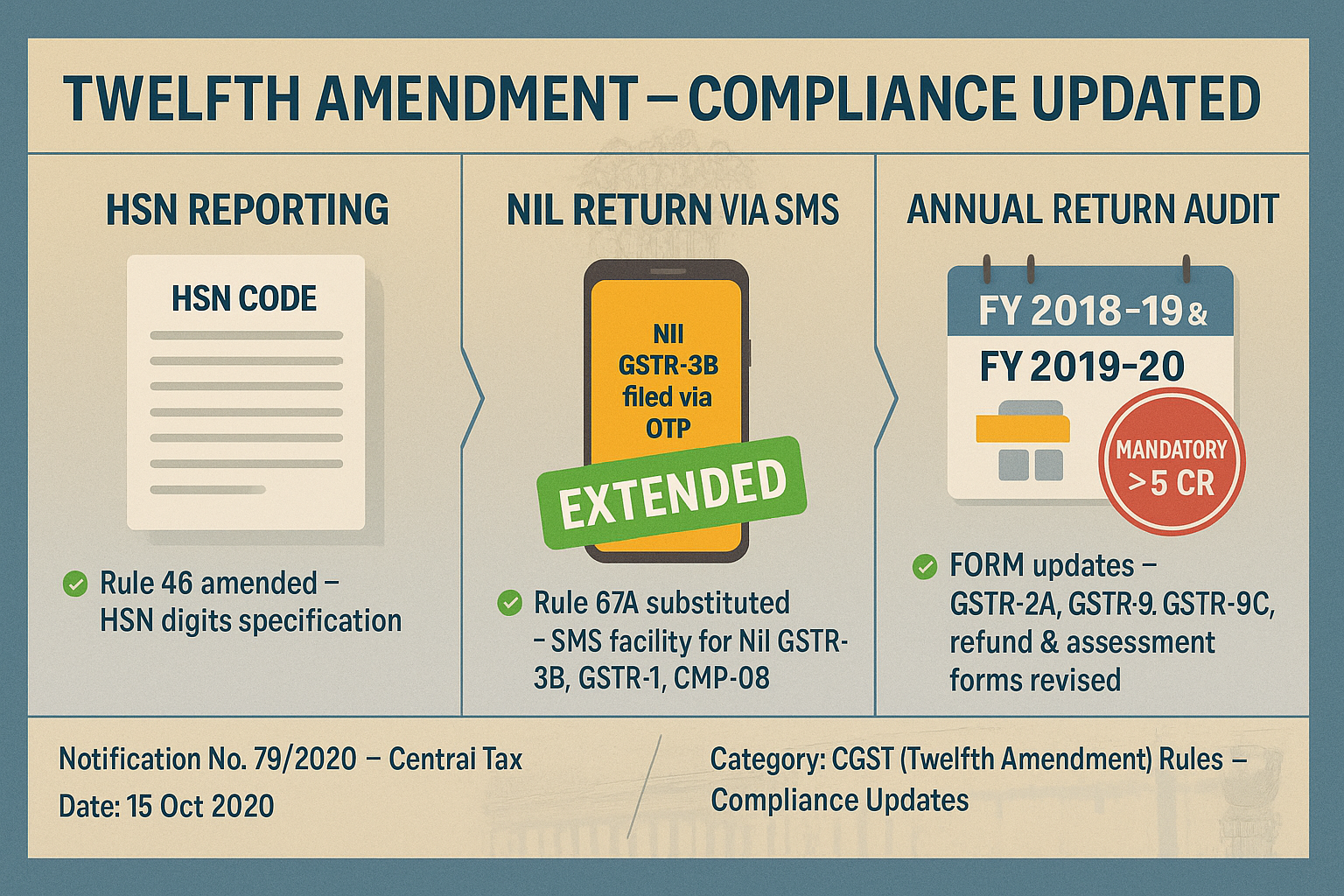
Notification No.: 79/2020 – Central Tax
Date of Notification: 15th October 2020
Relevant Sections and Rules:
Central GST Act, 2017:
- Section 164 – Power to make rules
CGST Rules, 2017 (Amended):
- Rule 46 – Tax invoice and HSN code usage
- Rule 67A – Filing Nil returns through SMS
- Rule 80(3) – Audit requirements for GSTR-9C
- Rule 138E – E-way bill generation restriction waiver
- Rule 142(1A) – Discretionary communication of tax liability
- Rule 60(1) – Form GSTR-2A
- Form amendments: GSTR-1, GSTR-2A, GSTR-5, GSTR-5A, GSTR-9, GSTR-9C, GSTR CMP-08, GST RFD-01, ASMT-16, DRC-01 to DRC-09, DRC-24, DRC-25
Summary of Notification
- Flexibility in Mentioning HSN Codes (Rule 46):
Amendment empowers the CBIC to notify:
(a) number of digits of HSN/SAC codes to be mentioned by different classes of registered persons,
(b) classes of supply for which specified HSN digits are mandatory, and
(c) persons exempted from mentioning HSN codes.
This grants dynamic flexibility in HSN/SAC reporting for different taxpayer classes. - Filing Nil GSTR-3B, GSTR-1, and CMP-08 via SMS (Rule 67A):
Registered persons can now file Nil returns (no entries in any table) using SMS verified by OTP linked to the registered mobile number.
Applies to GSTR-3B, GSTR-1, and GST CMP-08. - GSTR-9C Audit Relaxation for FY 2018–19 and 2019–20 (Rule 80):
Only taxpayers with turnover exceeding ₹5 crore need to file audited GSTR-9C for these financial years.
This aligns audit thresholds with Council’s recommendations and relieves smaller taxpayers. - Temporary Waiver on E-Way Bill Restrictions (Rule 138E):
From 20th March 2020 to 15th October 2020, E-Way Bill generation restriction is not applicable for non-filing of GSTR-3B, GSTR-1, or CMP-08 for February to August 2020.
This provided relief amid COVID-19 disruptions. - Discretionary Communication of Liability (Rule 142(1A)):
Language changed from “shall” to “may” to give discretion to proper officer regarding pre-SCN communication of liability. - Form Changes – GSTR-1 and GSTR-2A:
- GSTR-1: In column 6 of Sr. No. 12 table, heading changed from “Total value” to “Rate of Tax”.
- GSTR-2A: Entire format substituted; more detailed, dynamic, and structured auto-drafted input data, sourced from GSTR-1, 5, 6, 7, 8, imports, SEZ inward supplies.
- GSTR-5 and GSTR-5A Enhancements:
- GSTR-5: Introduced fields for ARN and date, explicit field for inward supplies attracting RCM, and clearer rate-wise reporting for B2B/B2C.
- GSTR-5A: New ARN fields, improved reporting of interest, other liabilities, and amounts paid.
- Detailed Updates to GSTR-9 and GSTR-9C for FY 2019–20:
- Clearer guidance on availing ITC, reporting timelines, SEZ services, and ITC eligibility.
- Specific instructions for reversal/reclaiming of ITC.
- Data auto-population clarified from GSTR-2A as on 1st Nov 2020.
- Revisions made to allow breakup of ITC into inputs, input services, and capital goods.
- Revisions in Refund and Assessment Forms:
- GST RFD-01: Heading for “accumulated ITC” removed from Annexure-1.
- ASMT-16: New format for assessment tables.
- GST DRC-01 to DRC-09, DRC-24, DRC-25: Standardized tabular formats for demand, recovery, arrears, and summaries, ensuring uniform presentation.