
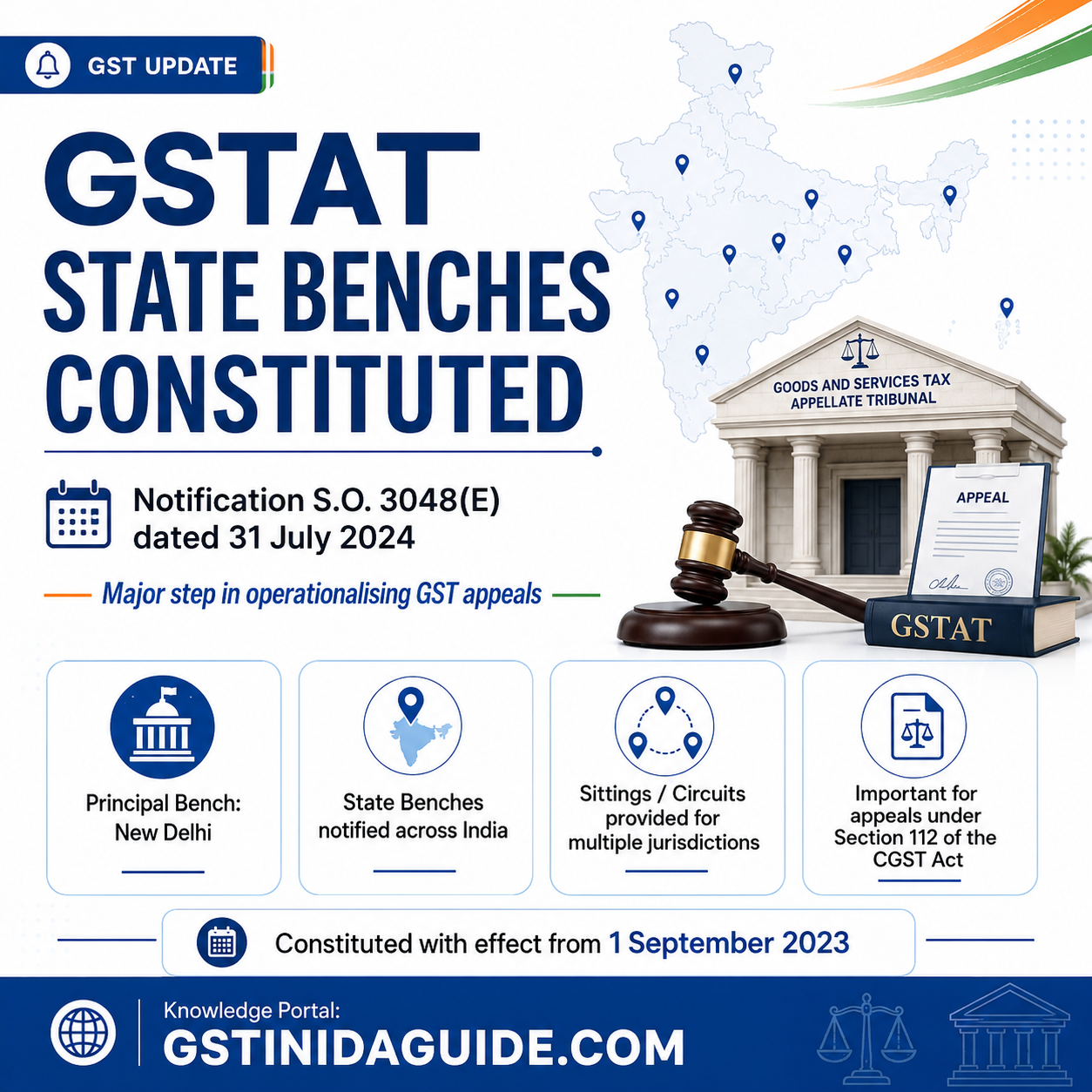
Summary of Notification S.O. 3048(E) dated 31 July 2024
The Central Government has issued Notification S.O. 3048(E) dated 31 July 2024 under sub-sections (1), (3) and (4) of section 109 of the CGST Act, 2017. By this notification, the Government has formally established the Goods and Services Tax Appellate Tribunal, with effect from 1 September 2023, constituted the Principal Bench of GSTAT at New Delhi, and notified the State Benches, their locations, and their sitting or circuit arrangements. The notification supersedes the earlier notifications S.O. 4073(E) dated 14 September 2023 and S.O. 1(E) dated 29 December 2023, except in respect of things already done or omitted to be done before such supersession.
The notification is significant because section 109 of the CGST Act provides the statutory foundation for constitution of the Appellate Tribunal. The definition clause also recognises “Appellate Tribunal” as the Goods and Services Tax Appellate Tribunal constituted under section 109. The Tribunal is the second appellate forum under the GST law, hearing appeals against orders passed by the Appellate Authority or Revisional Authority, and its operationalisation is central to the working of Chapter XVIII of the CGST Act dealing with appeals and revision.
Constitution of Principal Bench and State Benches
The Principal Bench has been constituted at New Delhi. Apart from the Principal Bench, State Benches have been notified across the country. The notification distributes Benches regionally, keeping in view the federal design of GST and the need for taxpayers to have reasonably proximate appellate access. Major allocations include one Bench each for Andhra Pradesh at Vijayawada, Bihar at Patna, Chhattisgarh at Raipur, Delhi at Delhi, Haryana at Gurugram, Himachal Pradesh at Shimla, Jharkhand at Ranchi, Madhya Pradesh at Bhopal, Odisha at Cuttack, Telangana at Hyderabad and Uttarakhand at Dehradun. Larger States or commercially significant jurisdictions have been given multiple Benches, such as Gujarat and Rajasthan with two Benches each, Karnataka and Tamil Nadu with two Benches each, Maharashtra and Goa together with three Benches, and Uttar Pradesh with three Benches.
The notification also provides sitting or circuit arrangements. For instance, Andhra Pradesh has a sitting at Visakhapatnam; Haryana has a sitting at Hisar; Jammu has a sitting at Srinagar; Kerala has a sitting at Thiruvananthapuram; Punjab has a sitting at Chandigarh; Uttar Pradesh has sittings at Prayagraj and Agra; Maharashtra has sittings at Thane and Chhatrapati Sambhajinagar; Tamil Nadu has a circuit at Puducherry and sitting at Coimbatore; and the North-Eastern States have Guwahati as the principal location with circuit benches at Aizawl, Agartala and Kohima.
Commentary under GST Statute
The notification is not merely administrative; it completes an essential part of the appellate mechanism contemplated under the CGST Act. Section 107 provides the first appellate remedy before the Appellate Authority, section 108 deals with revision, and section 112 provides the right of appeal to the Appellate Tribunal. Without constitution of the Tribunal and its benches, the statutory right of second appeal remains formally available but procedurally ineffective. This notification, therefore, gives institutional shape to the remedy contemplated by the Act.
The retrospective establishment of GSTAT with effect from 1 September 2023 is also relevant. It aligns the present notification with the earlier statutory and administrative steps taken for constitution of the Tribunal. However, the actual filing and hearing of appeals depends upon the functional readiness of the Benches, appointment of President, Members, Registrar-related process, and portal functionality. The statutory right to appeal must therefore be read along with the procedural machinery under the CGST Rules, particularly Rule 110, which provides for filing appeal to the Appellate Tribunal in FORM GST APL-05 and filing memorandum of cross-objections in FORM GST APL-06.
The circuit and sitting mechanism reflects a practical balance between access and caseload. A circuit bench is not a full-time bench in the ordinary sense. The notification expressly states that locations shown as “Circuit” shall operate in such manner as the President may order, depending upon the number of appeals filed by suppliers in the respective States or jurisdictions. It further provides that additional sittings associated with a Bench shall be operated by one Judicial Member and one Technical Member. This means that taxpayers cannot assume automatic day-to-day functioning of all circuit locations; their operation will depend upon administrative orders and appeal volume.
For taxpayers and practitioners, the notification is particularly important in pending matters where orders of the Appellate Authority have been passed but further statutory appeal could not be effectively filed earlier due to non-constitution or non-functionality of the Tribunal. CBIC had earlier clarified that the time limit for appeal to the Tribunal would be counted from the date on which the President or State President enters office, wherever applicable, and appellate authorities were advised to mention that appeals may be filed when the Tribunal is constituted within the prescribed period. This notification, therefore, should be read together with such transitional instructions while advising clients on limitation, pre-deposit, recovery protection and preservation of appellate rights.
Practical Impact
The immediate practical effect is that the GST appellate framework has moved from a partially incomplete structure to a formally constituted Tribunal framework. Once the Benches become operational, appeals against orders passed under section 107 or revision orders under section 108 will lie before GSTAT under section 112. The appeal will be required to be filed in FORM GST APL-05, and cross-objections, where necessary, will be filed in FORM GST APL-06.
For example, if M/s A Metals Pvt. Ltd., Jaipur receives an adverse appellate order dated 10 August 2024 confirming a demand of ₹75 lakh, its second appeal would ordinarily lie before the Rajasthan State Bench. Since Rajasthan has two notified locations, Jaipur and Jodhpur, the exact bench allocation would depend upon jurisdictional allocation and subsequent administrative orders. Similarly, a taxpayer in Noida or Ghaziabad would be concerned with the Uttar Pradesh Bench structure, where Lucknow, Varanasi and Ghaziabad have been notified with sittings at Prayagraj and Agra. The notification therefore has direct relevance in determining forum, convenience, representation strategy and future filing logistics.
In substance, S.O. 3048(E) is a foundational notification for operationalising GST litigation at the Tribunal level. It does not decide limitation, pre-deposit or appeal procedure by itself, but it provides the institutional forum before which those rights are to be exercised. Its importance lies in converting the statutory promise of a second appellate remedy into a notified appellate structure under section 109 of the CGST Act.
Source: Notification no. S.O. 3048(E)

 dated 31 July 2024, issued under Section 109 of the CGST Act. The notification is a significant step towards operationalising GST appeals before the Appellate Tribunal.)