
Summary of Notification S.O. 4220(E) — Time limit for filing appeals before GST Appellate Tribunal
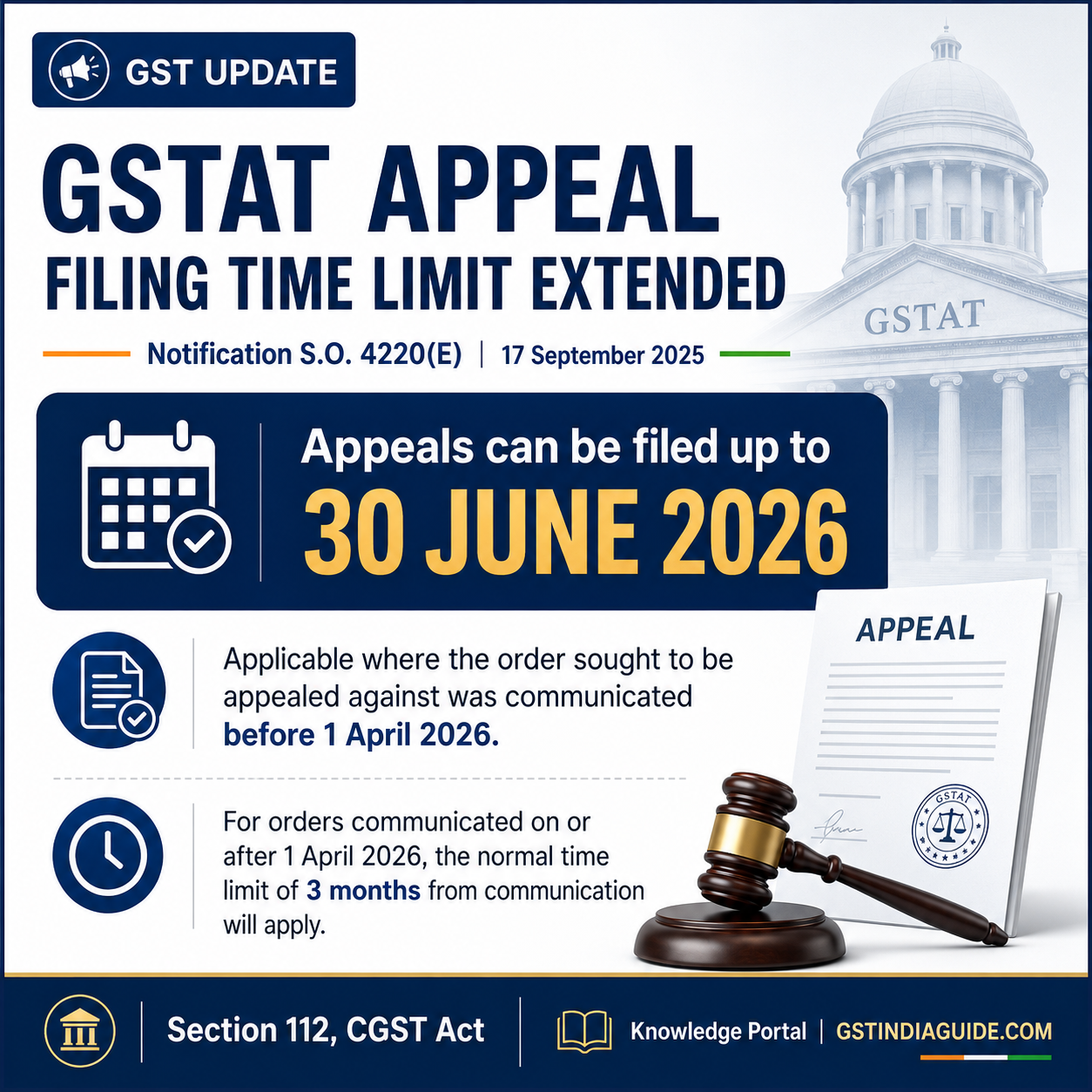
The Central Government, on the recommendations of the GST Council, has issued Notification S.O. 4220(E), dated 17 September 2025, in exercise of powers conferred under section 112(1) of the Central Goods and Services Tax Act, 2017. The notification prescribes the outer time limit for filing appeals before the Goods and Services Tax Appellate Tribunal in cases where the order proposed to be appealed against was communicated before 1 April 2026. For all such cases, appeal before the Appellate Tribunal may be filed up to 30 June 2026.
The notification further provides that where the order is communicated on or after 1 April 2026, the normal statutory period of three months shall apply, and appeal before the Tribunal may be filed within three months from the date on which such order is communicated to the person preferring the appeal.
In effect, the notification creates two separate limitation regimes for GSTAT appeals. First, for all appealable orders communicated before 1 April 2026, a uniform extended date of 30 June 2026 has been provided. Secondly, for orders communicated on or after 1 April 2026, limitation will run in the ordinary manner, namely three months from the date of communication of the order.
Statutory setting under section 112 of the CGST Act
Section 112 of the CGST Act governs appeals to the Appellate Tribunal. Under section 112(1), any person aggrieved by an order passed against him under section 107 or section 108 may appeal to the Appellate Tribunal against such order within three months from the date on which the order sought to be appealed against is communicated to such person. The words “communicated to such person” are significant because limitation does not run merely from the date of the order, but from the date when the order is made known to the person entitled to prefer the appeal.
The present notification has been issued under this statutory power and is intended to address the practical situation arising from delayed operationalisation of the GST Appellate Tribunal. Since a large number of orders-in-appeal had already been passed by Appellate Authorities across States before the Tribunal became functionally available, taxpayers could not effectively exercise the statutory right of second appeal. The notification therefore fixes 30 June 2026 as the date up to which appeals may be filed in respect of all orders communicated before 1 April 2026.
Practical effect of the notification
The notification is of immediate importance for all taxpayers whose first appellate orders, revisional orders, or other appealable orders under section 112 were communicated before 1 April 2026. In all such cases, the taxpayer need not compute three months from the original date of communication. The appeal can be filed before the GST Appellate Tribunal up to 30 June 2026.
For example, if M/s Arvind Components Pvt. Ltd. received an appellate order on 20 August 2024 confirming a demand of ₹48 lakh, the ordinary period of three months would have expired long before the Tribunal became operational. By virtue of this notification, the appeal against such order may still be filed before GSTAT up to 30 June 2026, subject to fulfilment of other statutory requirements such as pre-deposit and proper filing of appeal.
Similarly, if M/s Kavya Foods received an order-in-appeal on 15 March 2026, the appeal will also be governed by the special cut-off date of 30 June 2026, because the order was communicated before 1 April 2026. However, if an order is communicated on 10 April 2026, the special cut-off date will not apply. In that case, the taxpayer must file appeal within three months from 10 April 2026, namely within the normal limitation prescribed under section 112.
Importance of the date of communication
The notification is structured around the date of communication of the order and not merely the date on which the order was passed. This is consistent with section 112(1), which makes communication the starting point for limitation. Therefore, in applying the notification, practitioners must carefully verify the actual date on which the order was communicated through the GST portal, by e-mail, by physical service, or by any other mode recognised under section 169 of the CGST Act.
This distinction may be commercially material. An order dated 28 March 2026 but communicated on 2 April 2026 will fall under the normal three-month rule, because communication took place on or after 1 April 2026. Conversely, an order dated 31 March 2026 and communicated on the same date will be covered by the extended deadline of 30 June 2026.
Pre-deposit and filing compliance
The notification only extends or prescribes the time within which appeal may be filed. It does not dispense with the substantive and procedural conditions for institution of appeal before the Tribunal. Accordingly, the appellant must comply with section 112, including payment of admitted tax, statutory pre-deposit, and filing of appeal in the prescribed form and manner under the CGST Rules.
After the Finance Act, 2025 amendment, particular care is also required in penalty-only matters. Where the order demands only penalty and does not involve demand of tax, the appellate pre-deposit requirements must be examined in light of the amended provisions. The present notification deals with limitation; it does not dilute the statutory condition of pre-deposit.
Commentary on the legal effect
This notification is remedial in character. It recognises that the right of appeal under section 112, though statutory, had remained practically suspended in many cases because the Appellate Tribunal was not available as an effective forum. The notification therefore prevents the right of appeal from being defeated by administrative non-availability of the appellate forum.
The expression “all cases where the order sought to be appealed against is communicated to the person preferring the appeal before the 1st day of April, 2026” is wide. It is not confined to orders of a particular financial year or to demands of a particular nature. Therefore, every appealable order under the Act, if communicated before 1 April 2026, should fall within the extended filing window up to 30 June 2026, provided the appeal is otherwise maintainable before GSTAT.
The notification also brings certainty to pending litigation strategy. Earlier, taxpayers were required to preserve their appellate rights through representations, writ petitions, or reliance upon departmental circulars regarding recovery where GSTAT was not constituted. With this notification, the statutory route is clarified: appeals relating to pre-1 April 2026 communicated orders must be filed by 30 June 2026.
Key takeaway
All taxpayers having appealable orders communicated before 1 April 2026 should treat 30 June 2026 as the statutory last date for filing appeal before GSTAT. For orders communicated on or after 1 April 2026, the normal period of three months from the date of communication will apply. The date of communication, proof of service, pre-deposit, and correct filing particulars should therefore be verified immediately before preparing the appeal.
Source: Notification S.O. 4220(E)

 extends the time limit for filing GST Appellate Tribunal appeals up to 30 June 2026 for orders communicated before 1 April 2026.)