
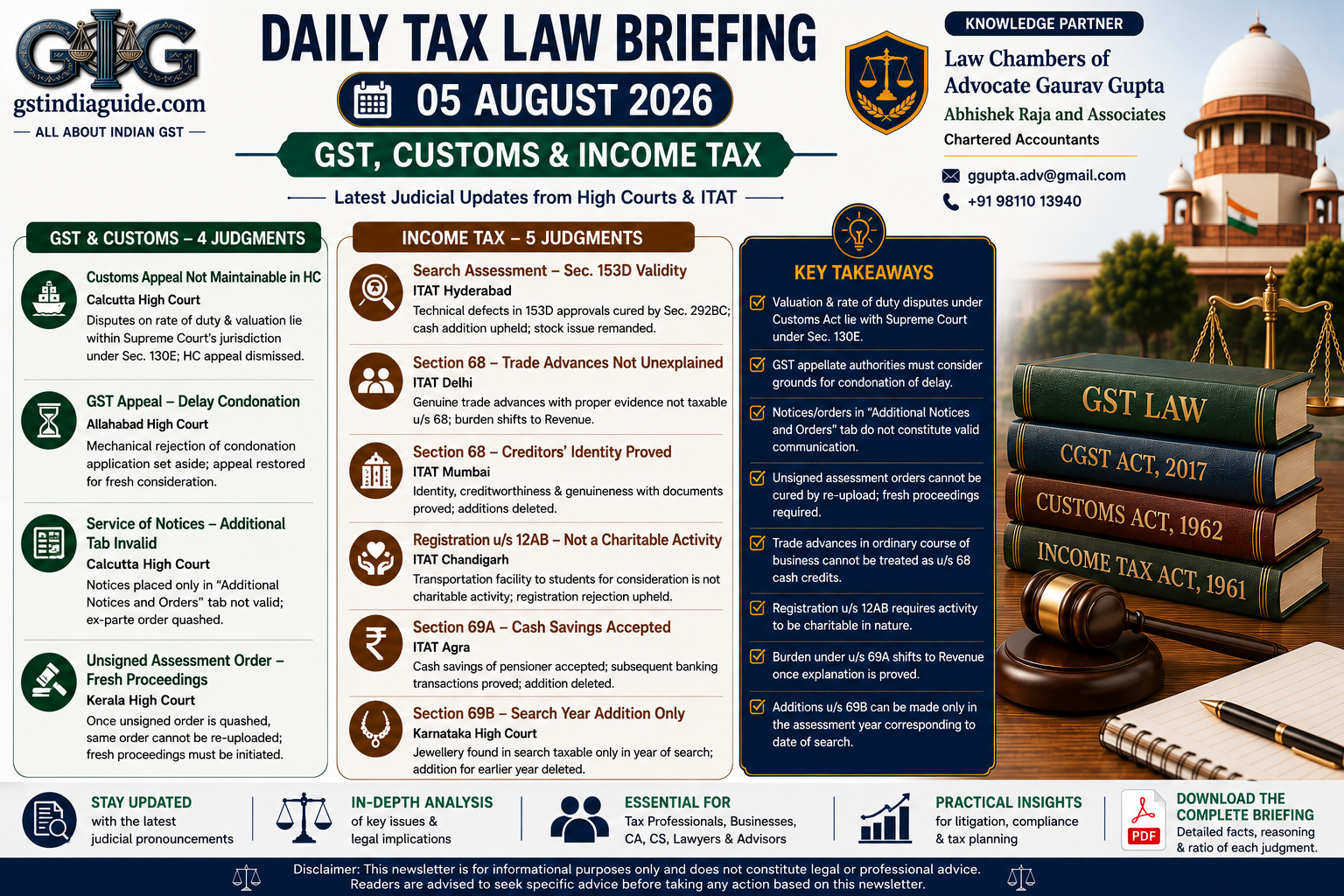
The Daily Tax Law Briefing – 05 August 2026 brings together the latest judicial developments under the Goods and Services Tax (GST), Customs Act, 1962, and the Income-tax Act, 1961. This edition analyses nine significant judicial pronouncements, comprising four GST/Customs judgments and five Income Tax decisions, delivered by the Calcutta High Court, Allahabad High Court, Kerala High Court, Karnataka High Court and various Benches of the Income Tax Appellate Tribunal. The judgments examine important issues concerning customs appellate jurisdiction, GST appeal limitation, validity of service of notices, unsigned assessment orders, search assessments, unexplained cash credits, charitable trust registration and unexplained investments.
The GST and Customs section is led by the Calcutta High Court’s decision in Commissioner of Customs (Port), Kolkata v. Enterprise International Limited, where the Court held that disputes involving the rate of duty and valuation of imported goods fall within the exclusive appellate jurisdiction of the Supreme Court under Section 130E of the Customs Act. Since the Revenue’s appeal primarily raised questions relating to valuation and duty, the High Court held that an appeal under Section 130 was not maintainable and dismissed it while granting liberty to approach the Supreme Court.
In another important ruling, the Allahabad High Court held that an appellate authority cannot reject an application for condonation of delay by passing a mechanical or cyclostyled order without examining the specific grounds raised by the taxpayer. Emphasising that the right of appeal is a valuable statutory right, the Court restored the delay condonation application and directed fresh consideration on merits.
The briefing also includes an important judgment of the Calcutta High Court, which reiterated that uploading notices and adjudication orders only under the “Additional Notices and Orders” tab on the GST portal does not constitute valid communication under the GST law. Since the taxpayer was also denied an effective opportunity of hearing, the ex parte adjudication order was quashed and the matter remanded for fresh adjudication. The Kerala High Court further clarified that once an unsigned assessment order is quashed, the Department cannot simply upload the same order after affixing a signature. Fresh proceedings must be initiated strictly in accordance with law after following due process and granting an effective hearing.
The Income Tax section analyses five significant judicial pronouncements concerning search assessments, unexplained cash credits, charitable trust registration, unexplained money and jewellery additions. The ITAT Delhi in Luv Bhardwaj v. DCIT delivered an important ruling on search assessments by holding that genuine trade advances arising in the ordinary course of business cannot be treated as unexplained cash credits under Section 68 merely because closing balances remain outstanding. The Tribunal further held that once the assessee establishes identity, genuineness and creditworthiness through documentary evidence, the burden shifts to the Revenue. It also ruled that additions based on GST portal mismatches, incorrect factual assumptions and assets belonging to third parties could not be sustained.
Another noteworthy decision comes from the ITAT Mumbai in Agility Consultancy Private Limited, where the Tribunal dismissed the Revenue’s appeal after holding that the assessee had successfully discharged the burden under Section 68 by producing PAN, audited financial statements, bank records and other supporting documents establishing the identity, creditworthiness and genuineness of the creditors. Mere reliance upon an Investigation Wing report without conducting an independent enquiry was held to be insufficient for making additions.
The briefing further includes the ITAT Chandigarh’s decision in International Will Trust, where the Tribunal held that providing transportation facilities to students for consideration does not amount to carrying on a charitable activity within the meaning of Section 2(15) and therefore upheld rejection of registration under Section 12AB. The ITAT Agra deleted additions under Section 69A after accepting the explanation of a family pensioner regarding accumulated cash savings and observing that the Department had failed to investigate the subsequent banking transactions. Finally, the Karnataka High Court held that additions under Section 69B relating to jewellery discovered during a search can be made only for the assessment year corresponding to the date of search and not for an earlier assessment year.
The Daily Tax Law Briefing – 05 August 2026 serves as a valuable resource for advocates, chartered accountants, company secretaries, tax consultants, businesses and corporate tax teams seeking concise updates on the latest judicial developments. It provides practical insights into GST litigation, customs appellate remedies, search assessments, charitable taxation and evidentiary principles while helping professionals stay informed of evolving judicial trends.
Download the complete Daily Tax Law Briefing (5 August 2026)