
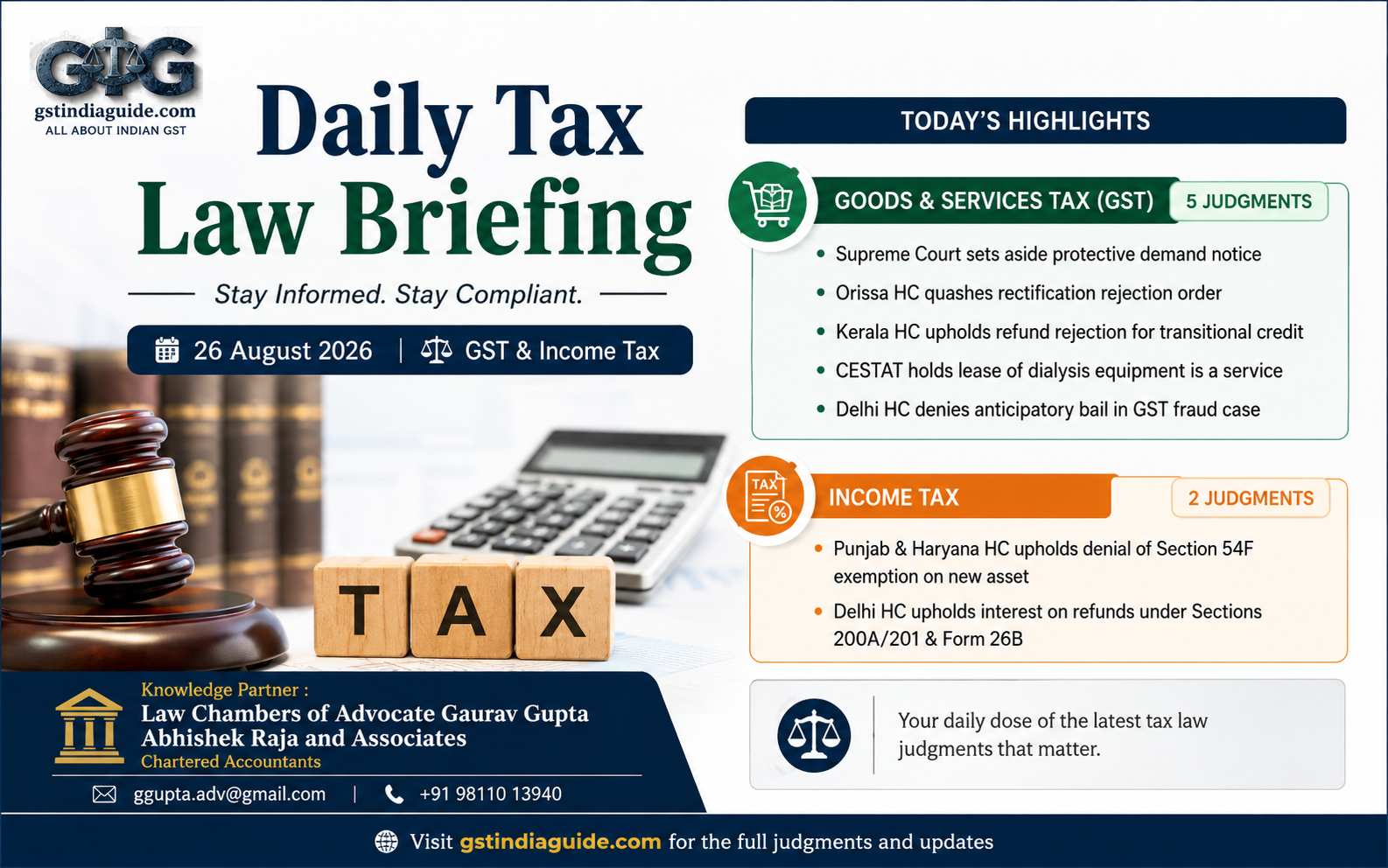
Daily Tax Law Briefing – GST & Income Tax | 26 August 2026
Goods & Services Tax (GST) (5 judgments)
| TITLE | BRIEF FACTS | RATIO |
| M/s Tata Steel Limited v. Union of India through the Secretary Ministry of Finance and Ors.
Arising out of SLP (C) No. 16859 of 2026)
Supreme Court
|
The appellant challenged proceedings concerning alleged input tax credit mismatch for financial years 2018-19 to 2020-21 and short payment of tax for 2019-20. Based on CAG audit objections, a show-cause notice dated 13 June 2025 was issued under Section 74 of the CGST Act. The notice was initially transferred to the “call book” and subsequently revived as a protective demand. The consequential Order-in-Original dated 26 December 2025 was also challenged. | The Supreme Court held that proceedings under Sections 73 or 74 must originate from the Proper Officer’s satisfaction. Invocation of Section 74 requires foundational facts showing fraud, wilful misstatement or suppression; merely reproducing these expressions cannot justify the extended limitation. The impugned notice lacked such facts, while protective assessment is not contemplated under the CGST Act. The show-cause notice and consequential order were set aside. The Department was granted liberty to initiate appropriate proceedings under Section 74 with the necessary foundational facts and pass an order before 28 February 2027. Appeal Allowed. |
| M/s. Asika Fintrade Pvt. Ltd., Barbil, Kendujhar v. Assistant Commissioner C.T. & G.S.T., Barbil Circle, Barbil, Keonjhar and Others
W.P.(C) No. 5276 of 2026
Orissa High Court
|
Pursuant to a show-cause notice dated 22 December 2023 under Section 73 of the GST Act, an order was passed against the petitioner on 29 April 2024. Its appeal was rejected on 17 July 2025 as time-barred. The petitioner’s rectification application dated 14 May 2024 was also rejected, but the rejection was not communicated because of a stated portal problem. The order-sheet recorded rejection on 30 May 2024, whereas the rejection order was signed on 30 May 2025. | The Court held that the rectification rejection could not be sustained because the record disclosed an unexplained inconsistency between the order-sheet dated 30 May 2024 and the rejection order signed on 30 May 2025, which had not been communicated to the petitioner. The rejection order was quashed and the matter remanded. The petitioner was directed to appear within fifteen working days, and the authority was directed to consider its explanation and supporting records, provide an opportunity of hearing, pass a reasoned order under Section 161 of the GST Act and communicate it forthwith. Writ Petition Disposed Of. |
| M/s. AVT McCormick Ingredients Pvt. Ltd. v. Union of India and Others
W.P.(C) No. 12964 of 2019
Kerala High Court
|
The petitioner, an exporter of spice extracts and oleoresins, transitioned unutilised VAT input tax credit into its Electronic Credit Ledger through Form GST TRAN-1. While claiming refund for November 2017, it included ₹49,54,739 as transitional SGST credit. By Order-in-Original dated 15 October 2018, the assessing authority excluded that amount from “Net ITC” under Rule 89(4), treating it as credit not earned during the relevant tax period. The petitioner challenged the disallowance after expiry of the statutory appeal period. | The Court held that transitional credit representing the closing balance as on 30 June 2017 could be carried forward as the opening balance in the Electronic Credit Ledger from 1 July 2017. However, the petitioner neither produced Form GST TRAN-1 nor satisfactory material proving that the disputed credit stood available in its ledger as on 1 July 2017; therefore, interference with the refund rejection was unwarranted. The Court further held that Article 226 cannot ordinarily revive a cause of action rendered unenforceable by expiry of the statutory appeal limitation, particularly where the petitioner failed to avail the prescribed remedy. Writ Petition Dismissed. |
| M/s. Fresenius Medical Care India Pvt. Ltd. v. Commissioner of CGST – Delhi East
Service Tax Appeal No. 52212 of 2022
CESTAT, New Delhi
|
The appellant leased dialysis equipment and paid VAT by treating the transactions as deemed sales. Following an audit covering 2012-13 to 30 June 2017, the Department alleged that the appellant had not transferred possession and effective control over the equipment and had consequently failed to pay service tax. A show-cause notice dated 20 July 2018 proposed service tax, cesses, interest and penalties, which were confirmed by the Commissioner through the order dated 26 July 2022. | The Tribunal held that the lease did not satisfy the essential conditions governing transfer of the right to use goods under Article 366(29A). Use of the equipment remained subject to the appellant’s approval, while maintenance and insurance obligations were also retained by it. Permission to enter the hospital premises for inspection and maintenance was insufficient to establish a deemed sale, and payment of VAT could not alter the nature of the transaction. The activity constituted a declared service under Section 66E of the Finance Act, 1994. Appeal Dismissed. |
| Raj Kumar v. The State (NCT of Delhi)
BAIL APPLN. 1632/2026
Delhi High Court
|
The applicant sought anticipatory bail in FIR No. 108/2025 registered at Police Station Cyber/Outer North under Sections 420, 419, 468, 471 and 120B IPC. The FIR arose from alleged misuse of the complainant’s PAN and Aadhaar credentials to obtain GST registrations for fictitious firms. Technical investigation allegedly connected the applicant’s mobile number and email IDs with fake GST returns, invoices, e-way bills and receipt of payments from clients. | The Court held that creating fictitious GST registrations and filing fake returns by misusing the credentials of innocent persons have serious consequences for the affected persons and the national economy. The allegations were supported by technical evidence and were not based merely upon a co-accused’s disclosure statement. As the applicant had not joined the investigation, further technical investigation remained pending and custodial interrogation was considered justified. His involvement in three other financial-fraud FIRs, including one under the Prevention of Money Laundering Act, was also noted. Anticipatory Bail Application Dismissed. |
Income Tax (2 judgments)
| TITLE | BRIEF FACTS | RATIO |
| Subh Karan Yadav v. Income Tax Officer, Rewari, Haryana
ITA-297-2026 (O&M)
Punjab and Haryana High Court
|
The appellant sold his residential house during Assessment Year 2011-12 for ₹22 lakh and purchased a residential plot in his wife’s name, where a house was constructed. He claimed exemption under Section 54F of the Income Tax Act. Following reassessment under Section 148, the Assessing Officer denied the exemption and added ₹22 lakh to his income. The CIT(A) and ITAT dismissed his appeals, leading to the appeal under Section 260A. | The Court held that Section 54F was inapplicable because both the original and new assets were residential properties; the applicable provision was Section 54. Exemption under Section 54 is available only where the same assessee sells the original residential asset and purchases or constructs the new residential asset within the prescribed period. A husband and wife are distinct individuals and legal entities; therefore, the husband’s sale and the wife’s purchase cannot be combined to claim exemption, even if the husband funded the investment. The questions raised stood concluded against the assessee by binding precedents of the Court. Appeal Dismissed. |
| Vodafone Idea Limited Successor of Vodafone Mobile Services Limited (VMSL) Which Merged with Idea Cellular Limited (ICL) and Is Now Known as Vodafone Idea Limited Represented Through Its Authorized Representative Aditya Aggarwal v. Assistant Commissioner of Income Tax Circle 78(1), New Delhi & Anr.
W.P.(C) 2729/2026, W.P.(C) 2733/2026 and W.P.(C) 3699/2026
Delhi High Court
|
The petitioner sought refunds with interest for Assessment Years 2003-04 and 2008-09 to 2013-14 pursuant to ITAT orders and appeal-effect orders. Although the Assessing Officer quantified a total refund of ₹53,09,56,470, it remained unpaid. The Department insisted upon Form 26B and cited outstanding demands against the petitioner’s PAN and sister TANs. The petitioner contended that Form 26B was inapplicable to refunds arising from assessment or appellate orders. | The Court held that Sections 200A and 201 operate in distinct fields. Once assessment under Section 201 is completed or an appellate order results in a refund, the assessee acquires a vested right to receive it with applicable interest. Rule 31A and Form 26B cannot govern such refund. Without an order under Section 245, the Department cannot withhold or adjust it against alleged demands. The respondents were directed to pay ₹53,09,56,470 with interest under Sections 244A and 244A(1A) by 30 September 2026, failing which additional interest at 1% per month would apply. Writ Petitions Allowed. |