(b) of the CGST Act.)
Case Reference:
Bipin Kumar Agrawal v. The Commissioner, CGST and Central Excise, Rourkela & Others
High Court of Orissa at Cuttack
W.P.(C) No. 20151 of 2024
Category: Dual Proceedings – Audit and Demand under GST
Date of Judgment: 24 February 2025
Relevant Sections: Sections 6(2)(b), 61, 65, 70, and 74 of the CGST/OGST Acts, 2017
Facts (Paras 1–5):
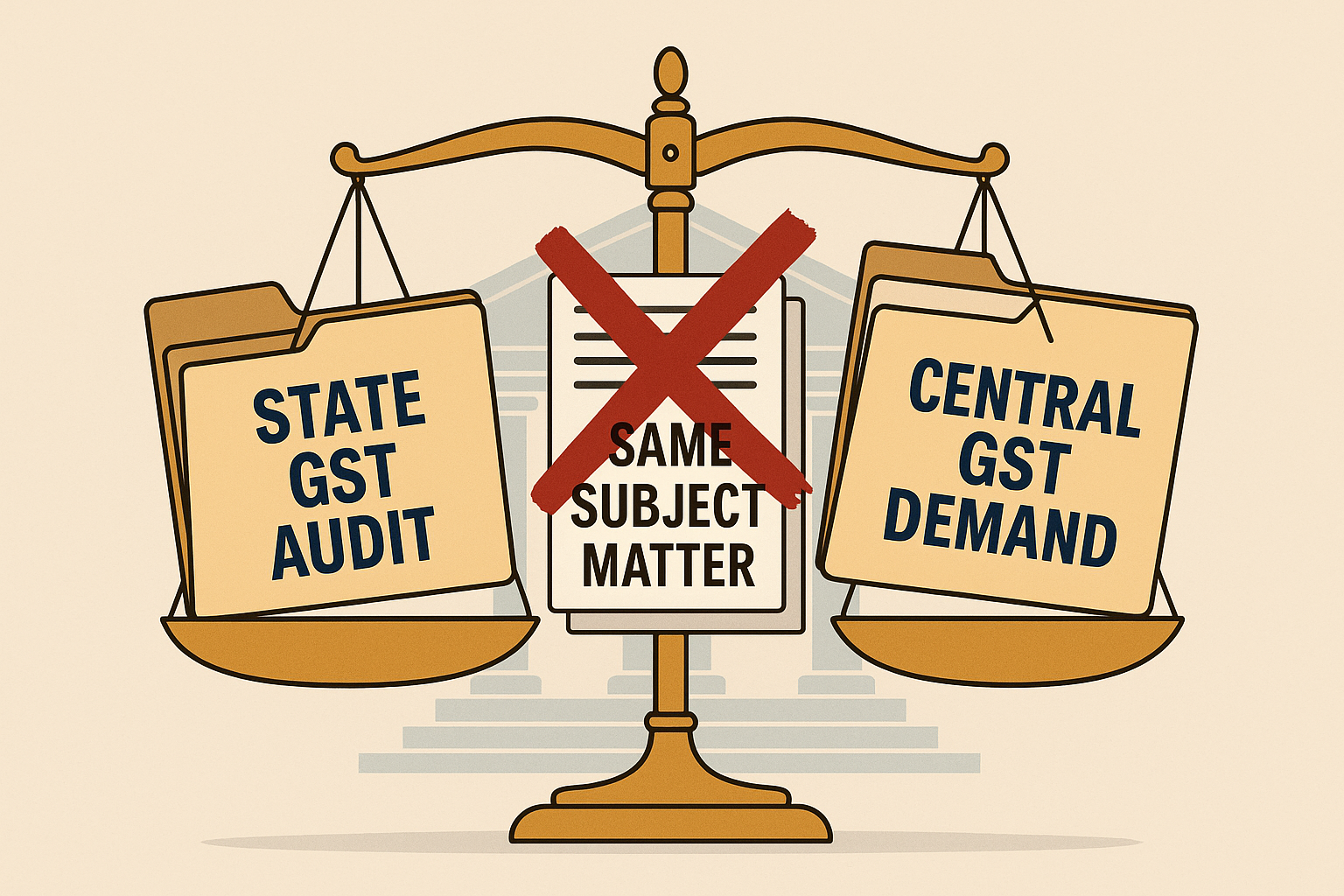
The petitioner, Bipin Kumar Agrawal, challenged the order dated 26 April 2024 passed by the Assistant Commissioner, GST and Central Excise, Rourkela. The impugned order raised a demand under Section 74 of the CGST Act following scrutiny under Section 61 for FY 2017–18 and 2018–19. However, the State GST authorities had already conducted an audit under Section 65 and issued a final audit report on 4 May 2023. The petitioner contended that once the State had concluded the audit proceedings, the Central GST authority could not initiate another proceeding on the same subject matter. Reliance was placed on G.K. Trading Company v. Union of India (Allahabad High Court, 2020), wherein it was held that once proceedings are initiated under one Act (State or Central), the other authority is barred from starting a parallel proceeding on the same issue under Section 6(2)(b).
Questions Before the Court:
Whether initiation of a proceeding by the Central GST authority under Section 74, after the State GST audit was concluded on the same subject matter, was permissible under Section 6(2)(b) of the CGST Act.
Court’s Observations (Paras 6–7):
The Bench, led by Acting Chief Justice Arindam Sinha, examined the interplay between Sections 6(2)(b), 65, and 74. It noted that both CGST and OGST Acts contain mirror provisions, establishing legislative intent to prevent overlapping jurisdiction and duplication of proceedings. The Court concurred with the reasoning of the G.K. Trading Company judgment, affirming that “audit” constitutes a proceeding for the purpose of Section 6(2)(b). Once such audit proceedings are initiated and concluded by the State authority, a separate proceeding by the Central authority on the same cause of action is barred.
The Court also clarified that issuance of a summons under Section 70 merely enables evidence collection and does not constitute initiation of adjudicatory proceedings under Section 74. Hence, the Central authority’s demand notice, issued post State audit, amounted to impermissible duplication.
Judgment (Paras 8–9):
The High Court held that since the State GST authority had already conducted an audit and the subject matter was identical, the subsequent proceeding by the Central GST authority was without jurisdiction. Accordingly, the impugned order dated 26 April 2024 was set aside and quashed. The writ petition was allowed, with a direction for recomputation wherever required, limiting interference to the impugned order alone.
Summary of Cases Referred:
| Case Name | Court | Issue | Verdict / Ratio |
|---|---|---|---|
| G.K. Trading Company v. Union of India (Civil Misc. Writ Tax No. 666/2020) | Allahabad High Court | Whether dual proceedings by State and Central GST authorities on the same subject matter are permissible | Held that once a proceeding is initiated under one Act (CGST/SGST), another parallel proceeding on the same issue is barred under Section 6(2)(b). |
| Liberty Oil Mills v. Union of India (1984) 3 SCC 465 | Supreme Court | Scope of “investigation” and “inquiry” | Defined “investigation” as process of evidence collection; distinguished inquiry from adjudicatory proceeding. |
Between Fine Lines (Trade Impact):
This ruling affirms that businesses cannot be subjected to parallel scrutiny, audit, or demand proceedings by both Central and State GST authorities for the same transactions. Once either authority has initiated and concluded a proceeding (such as an audit under Section 65), the other cannot reopen the same matter under Section 74. The judgment safeguards taxpayers from multiplicity of proceedings and ensures administrative harmony under the dual GST structure.
Disclaimer – “The above summary is for academic purpose only; not formal legal opinion. Seek professional opinion before application. Author or publisher or website shall not be responsible for any usage in any form.”