Summary of Circular No. 224/18/2024-GST dated 11 July 2024
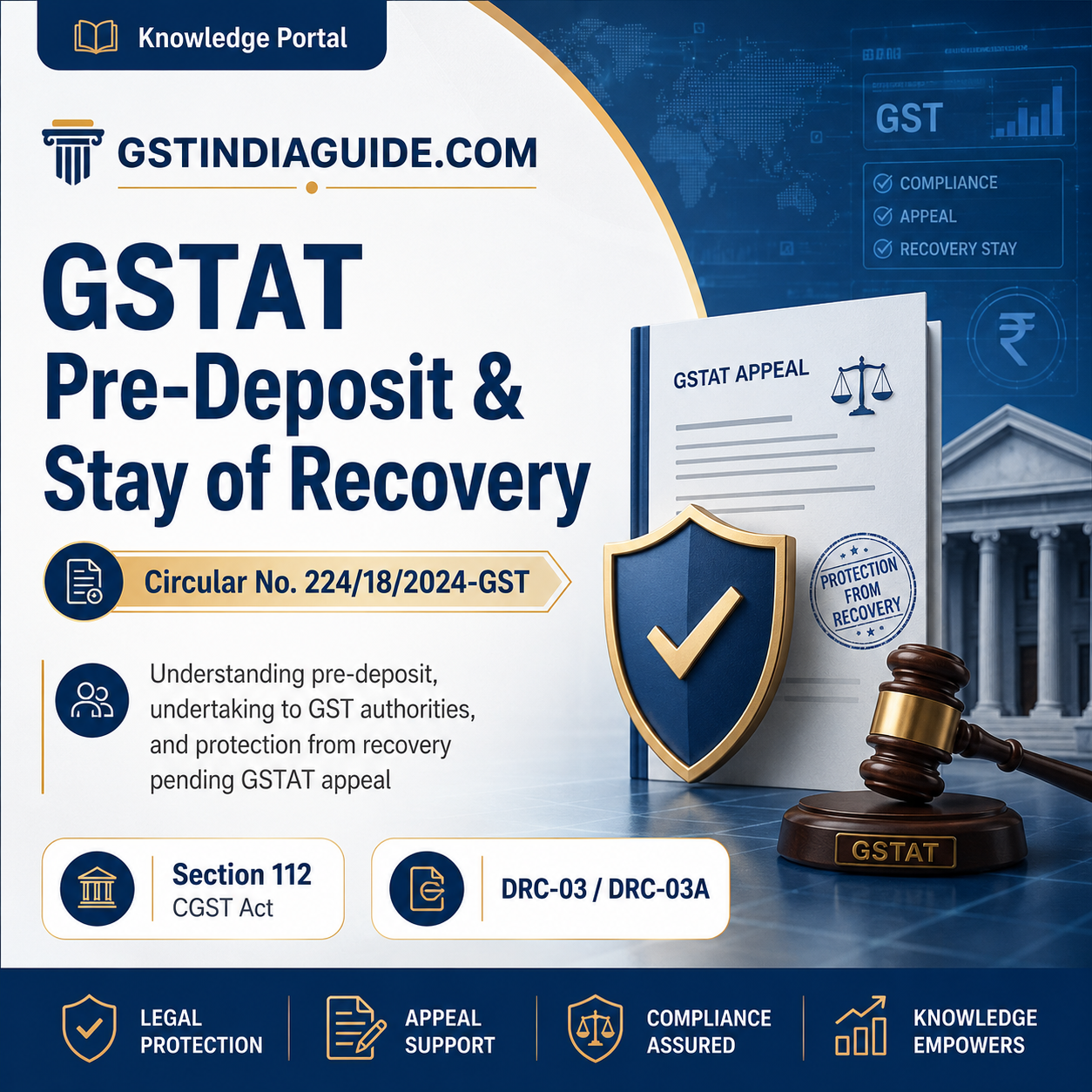
Circular No. 224/18/2024-GST deals with a very specific hardship which arose because first appeals under section 107 had been decided, demands had been confirmed either fully or partly, but the taxpayer could not file the second appeal under section 112 before the GST Appellate Tribunal due to non-operation of the Tribunal at that stage. In ordinary statutory design, once the appeal is filed before the Tribunal with the prescribed pre-deposit under section 112(8), recovery of the balance amount is deemed to be stayed under section 112(9). The difficulty was that the taxpayer was willing to avail the statutory appellate remedy, but the mechanism for filing the appeal was not available. The Circular therefore gives an administrative mechanism to preserve the statutory right of appeal and prevent coercive recovery, subject to payment of an amount equivalent to the pre-deposit and filing of an undertaking.
The Circular clarifies that where the taxpayer intends to file an appeal before the Tribunal against the order of the first appellate authority, he may pay an amount equal to the pre-deposit required under section 112(8) by using the portal path Services → Ledgers → Payment towards demand. Such payment is to be mapped against the specific outstanding demand order in Electronic Liability Register Part-II, and the amount so paid will later be adjusted against the pre-deposit payable at the time of filing appeal before the Tribunal.
The taxpayer must also file an undertaking or declaration before the jurisdictional proper officer stating that he will file the appeal before the Tribunal as and when the Tribunal becomes operational and within the period prescribed under section 112 read with the Central Goods and Services Tax (Ninth Removal of Difficulties) Order, 2019. Upon such payment and undertaking, recovery of the remaining confirmed demand shall stand stayed in terms of section 112(9). Conversely, if the taxpayer neither pays the equivalent pre-deposit nor furnishes the undertaking, it may be presumed that he is not willing to file the appeal, and recovery may proceed in accordance with law.
The Circular also addresses cases where taxpayers had already paid amounts through FORM GST DRC-03, often under “voluntary” or “others”, though the payment was actually intended to be towards a demand or towards pre-deposit. By referring to Notification No. 12/2024-Central Tax dated 10 July 2024, which inserted Rule 142(2B) and FORM GST DRC-03A, the Circular clarifies that such amounts may be adjusted against the demand and may also be treated towards the pre-deposit under section 107 or section 112, provided the taxpayer files FORM GST DRC-03A. However, this benefit is not available where proceedings have already been concluded by issuance of FORM GST DRC-05 under Rule 142(3).
Statutory Setting
The Circular is founded upon the combined operation of sections 78, 79, 107, 112, 168 and Rule 142 of the CGST Rules. Section 78 provides that any amount payable pursuant to an order passed under the Act must be paid within three months from the date of service of the order, failing which recovery proceedings are to be initiated, the proviso permits earlier recovery only where the proper officer records reasons in the interest of revenue. Section 79 then provides the machinery for recovery, including deduction from monies payable, detention and sale of goods, garnishee proceedings, distraint of movable or immovable property and other statutory modes.
Section 107(6) governs the pre-deposit for first appeal. The appellant must pay the admitted amount in full and 10% of the remaining amount of tax in dispute, subject to the statutory monetary ceiling, after payment, recovery of the balance amount is deemed to be stayed under section 107(7). In penalty-only cases, after the Finance Act, 2025 amendment made effective from 1 October 2025, the first appeal requires payment of 10% of the penalty where the order demands penalty without involving demand of tax.
Section 112(8) similarly governs appeal before the Appellate Tribunal. The appellant must pay the admitted amount in full and a further amount equal to 10% of the remaining amount of tax in dispute, in addition to the amount paid under section 107(6), subject to the maximum ceiling. Upon such payment, section 112(9) creates a statutory fiction that recovery proceedings for the balance amount shall be deemed to be stayed till disposal of the appeal. For penalty-only Tribunal appeals, the Finance Act, 2025 amendment provides that 10% of the penalty is payable in addition to the amount payable under the penalty-only proviso to section 107(6).
Commentary
The Circular protects the appellate remedy from becoming illusory
The right of appeal under section 112 is a statutory remedy against an order passed by the first appellate authority or revisional authority. The scheme of the Act contemplates that once the taxpayer complies with the pre-deposit condition, the law itself grants stay of the balance demand. The stay is not discretionary; it is a statutory consequence flowing from payment of pre-deposit. The Circular recognises that where the Tribunal was not operational, the taxpayer could not be denied the substance of section 112 merely because the institutional forum was not available.
The Circular therefore does not create a new right of stay. It gives working effect to section 112(9) in an interregnum situation. Its legal foundation lies in section 168(1), under which the Board may issue instructions or directions for uniform implementation of the Act. The Circular is thus administrative in form but statutory in purpose: it ensures that officers do not invoke section 78 and section 79 mechanically against taxpayers who have demonstrated their intention to file the second appeal and have deposited the amount equivalent to the statutory pre-deposit.
Payment against demand is treated as a functional substitute for pre-deposit
The mechanism prescribed in the Circular is practical. Since the appeal could not be filed before the Tribunal, the pre-deposit could not technically be made through the appellate filing process. The Circular therefore permits payment through the taxpayer’s dashboard by selecting the relevant demand order in Electronic Liability Register Part-II. This is significant because a general payment not mapped to the demand may create reconciliation disputes, whereas a mapped payment reduces the outstanding demand in the ledger and evidences that the payment relates to the very appellate order proposed to be challenged.
For instance, if M/s A Pvt. Ltd. receives an appellate order dated 20 August 2024 confirming tax of ₹50,00,000, interest of ₹18,00,000 and penalty of ₹5,00,000, and it had already deposited 10% of disputed tax at the first appeal stage, then for the proposed Tribunal appeal it would be required to deposit the amount prescribed under section 112(8), as applicable to the remaining disputed tax. If the Tribunal appeal filing facility is unavailable, the company may pay the equivalent amount through “Payment towards demand”, select the appellate order in ELL Part-II, and file an undertaking before the jurisdictional proper officer. On doing so, recovery of the balance confirmed demand should not be pursued.
Undertaking is not a mere formality
The undertaking required by the Circular performs an important legal function. It separates a taxpayer who genuinely intends to pursue the statutory appeal from a taxpayer who merely seeks postponement of recovery. The undertaking must state that the taxpayer will file appeal before the Tribunal as and when it comes into operation and within the limitation prescribed under section 112 read with the Removal of Difficulties Order. Once this undertaking is furnished along with the equivalent pre-deposit, the officer is expected to treat the balance recovery as stayed.
The undertaking should therefore be drafted with precision. It should refer to the order-in-appeal number, date, demand reference, amount confirmed, amount already deposited under section 107, amount now deposited towards section 112 pre-deposit, challan or ledger reference, and a clear statement that the taxpayer disputes the order and undertakes to file the statutory appeal within the prescribed time once the Tribunal filing mechanism is available.
DRC-03 payments are regularised through DRC-03A
A major practical difficulty under GST has been the use of FORM GST DRC-03 for payments which were not truly voluntary but were intended either towards a demand or towards pre-deposit. Before insertion of Rule 142(2B) and FORM GST DRC-03A, such payments often remained outside the demand ledger and could not be automatically recognised as payment against a specific order. The Circular resolves this by permitting the taxpayer to file FORM GST DRC-03A so that the amount paid through DRC-03 is adjusted as if it had been paid towards the relevant demand on the date of DRC-03 intimation.
This is commercially important. A taxpayer who had paid ₹8,00,000 through DRC-03 under “others” after receiving an appellate order may now seek adjustment against the demand by filing DRC-03A. Once adjusted, the amount can also be considered towards the pre-deposit required under section 107 or section 112, as the case may be. However, if the earlier DRC-03 payment had already resulted in conclusion of proceedings through FORM GST DRC-05, the Circular specifically denies the DRC-03A adjustment route.
Recovery can revive if the appeal is not filed within limitation
The protection under the Circular is conditional. It is not a permanent stay independent of appeal. If the taxpayer, after giving the undertaking, does not file the appeal before the Tribunal within the prescribed time once the statutory facility is available, the balance demand becomes recoverable. The Circular therefore preserves both sides of the statutory balance: the taxpayer is protected from coercive recovery during institutional non-availability of the Tribunal, while the revenue is protected against indefinite suspension of recovery where the taxpayer ultimately does not pursue the appeal.
Effect after Finance Act, 2025 amendments
The Circular was issued on 11 July 2024. At that time, the Tribunal pre-deposit under section 112(8) was worded differently from the position reflected after subsequent amendments. The bare law updated up to 31 October 2025 records that the pre-deposit under section 112(8) is now 10% of the remaining amount of tax in dispute, in addition to the amount paid under section 107(6), subject to the specified monetary ceiling, and that penalty-only appeals now require a separate 10% penalty pre-deposit at both the first appeal and Tribunal appeal stages as per the amended provisos.
Accordingly, while applying the Circular now, the amount to be deposited should be computed with reference to the current text of section 112(8), not merely the language or quantum prevailing when the Circular was issued. In tax-demand appeals, the deposit is to be computed on the disputed tax component. In penalty-only matters, the amended proviso must be separately kept in view.
Practical Position
Where first appeal has been decided against the taxpayer and the taxpayer proposes to challenge the order before GSTAT, the correct course is to pay the amount equivalent to the applicable section 112 pre-deposit against the specific demand through ELL Part-II, file a written undertaking before the jurisdictional proper officer, and preserve proof of payment, undertaking acknowledgement and order details. If payment has already been made through DRC-03, DRC-03A should be filed wherever the functionality is available; till such functionality is available, intimation should be given to the proper officer and recovery should not be insisted upon for the remaining amount in terms of the Circular.
The Circular is therefore beneficial, but not unconditional. Its protection operates only where the taxpayer demonstrates appellate intent, pays the statutory equivalent of pre-deposit, maps or regularises the payment against the demand, and ultimately files the appeal within the statutory time once the Tribunal remedy becomes available.
Form for Intimation for payment of pre-deposit as per Circular
FORMAT OF INTIMATION UNDERTAKING FOR PAYMENT OF PRE-DEPOSIT UNDER CIRCULAR
Source : Circular No. 224/18/2024-GST