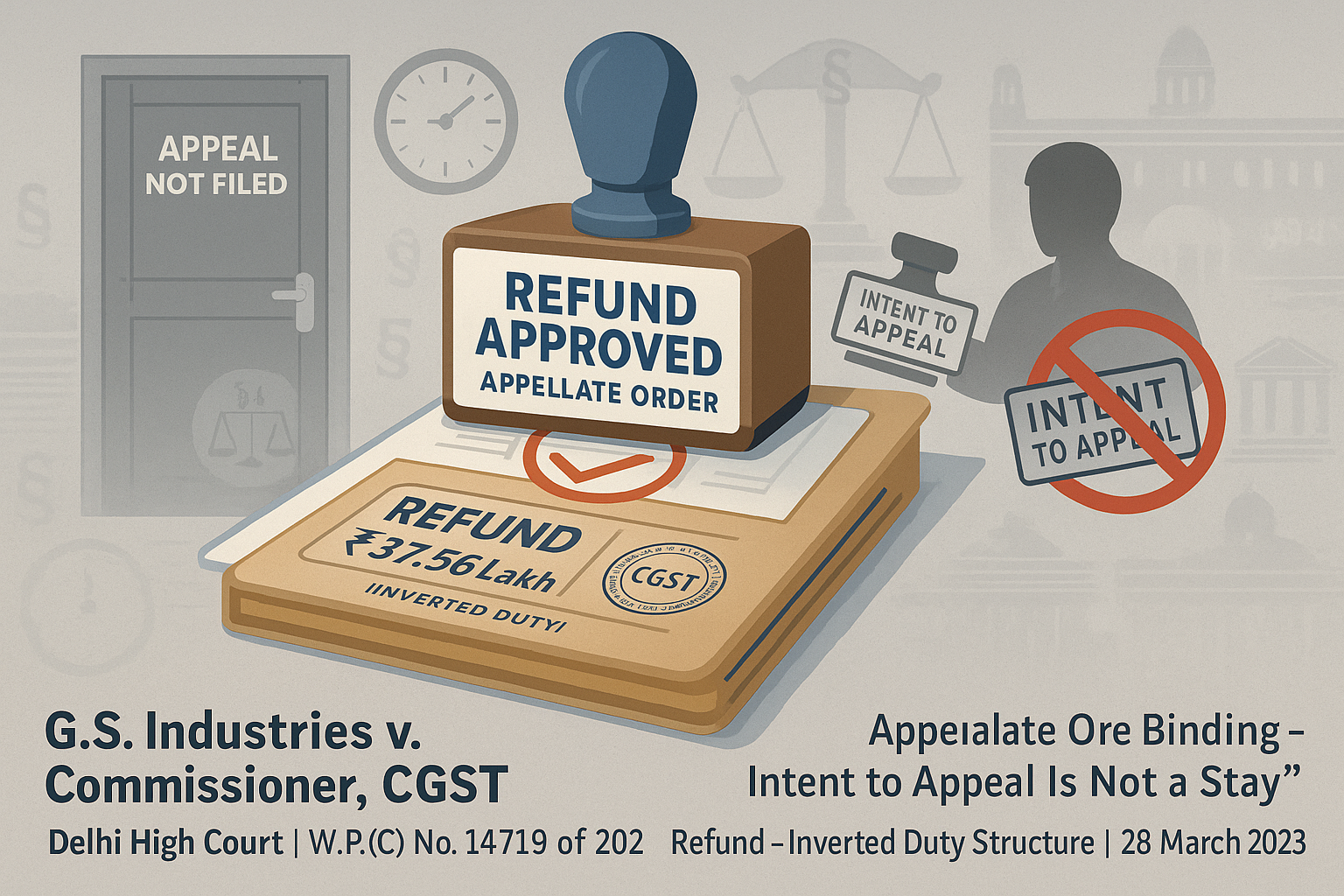
Case Title: G.S. Industries v. Commissioner, Central Goods and Services Tax
Court: High Court of Delhi
Petition No.: W.P.(C) No. 14719 of 2022
Date of Judgment: March 28, 2023
Relevant Sections: Section 54 and Section 67(1) of the CGST Act, 2017
Category of Dispute: Refund – Inverted Duty Structure
Facts of the Case
[¶1–4] G.S. Industries, engaged in manufacturing hand pump parts (HSN 8413/9140, GST @5%), claimed a refund of accumulated Input Tax Credit (ITC) due to an inverted duty structure for two periods:
- ₹23,10,333/- for September 2017 to March 2018
- ₹14,46,417/- for April 2018 to March 2019
[¶5] The refund applications filed in July 2019 were acknowledged, but deficiency memos dated 29.11.2019 were issued, seeking clarification and a Chartered Accountant’s certificate under the doctrine of unjust enrichment.
[¶6] Petitioner responded on 27.01.2020, but Show Cause Notices dated 23.11.2020 were issued alleging:
- Use of high-value input (Brass @18%) whereas manufactured product required minimal brass
- Inconsistencies in stock register and use of business premises by another entity as per Section 67(1) inspection
[¶7] Refund was rejected by orders-in-original dated 14.12.2020.
[¶8] Appeals were allowed by common Order-in-Appeal dated 03.01.2022. Appellate Authority held that:
- Petitioner’s business existence was proved by electricity bills, tax returns, etc.
- No proper basis was given for alleging that little brass was required in production
[¶9–10] Despite appellate victory, refund was not processed. Respondent argued that they had decided to challenge the appellate order (dated 19.05.2022), though no actual appeal was filed.
Question(s) in Consideration
[¶11] Whether the department is justified in withholding the refund merely on the basis that they intend to file an appeal against the Order-in-Appeal dated 03.01.2022, in the absence of a stay or actual challenge?
Observation of the Court
[¶12] The High Court held that:
- No appeal had been filed against the Order-in-Appeal
- No stay has been granted by any authority
- The Order-in-Appeal must be respected and cannot be ignored just because the department thinks it is erroneous
[¶13] The Court relied on its earlier decision in Brij Mohan Mangla v. Union of India, W.P.(C) 14234 of 2022 (decided on 23.02.2023), which supported the principle that an appellate order remains binding unless stayed.
Judgment of the Court
[¶14] The writ petition was allowed. The Court directed the department to immediately process the refund along with applicable interest.
[¶15] However, the department retains the right to challenge the Order-in-Appeal, and if successful, can initiate lawful recovery proceedings.
Between Fine Lines
- Refunds under inverted duty structure cannot be withheld solely based on departmental intent to appeal.
- Appellate orders are binding unless stayed.
- Delay without legal backing is impermissible and violates taxpayer rights.
- Procedural fairness requires that authorities act promptly on appellate decisions.
- Even if recovery is needed later, it must follow legal procedures post a valid appellate outcome.
Summary of Referred Cases
| Name of Case | Citation | Summary | Verdict |
| Brij Mohan Mangla v. Union of India | W.P.(C) 14234 of 2022, decided on 23-2-2023 | Held that appellate orders cannot be disregarded in the absence of a stay or higher court intervention | Appellate order must be implemented |
Takeaway
“Intent to Appeal is Not a Stay: Refund Cannot Be Delayed on Mere Anticipation”