
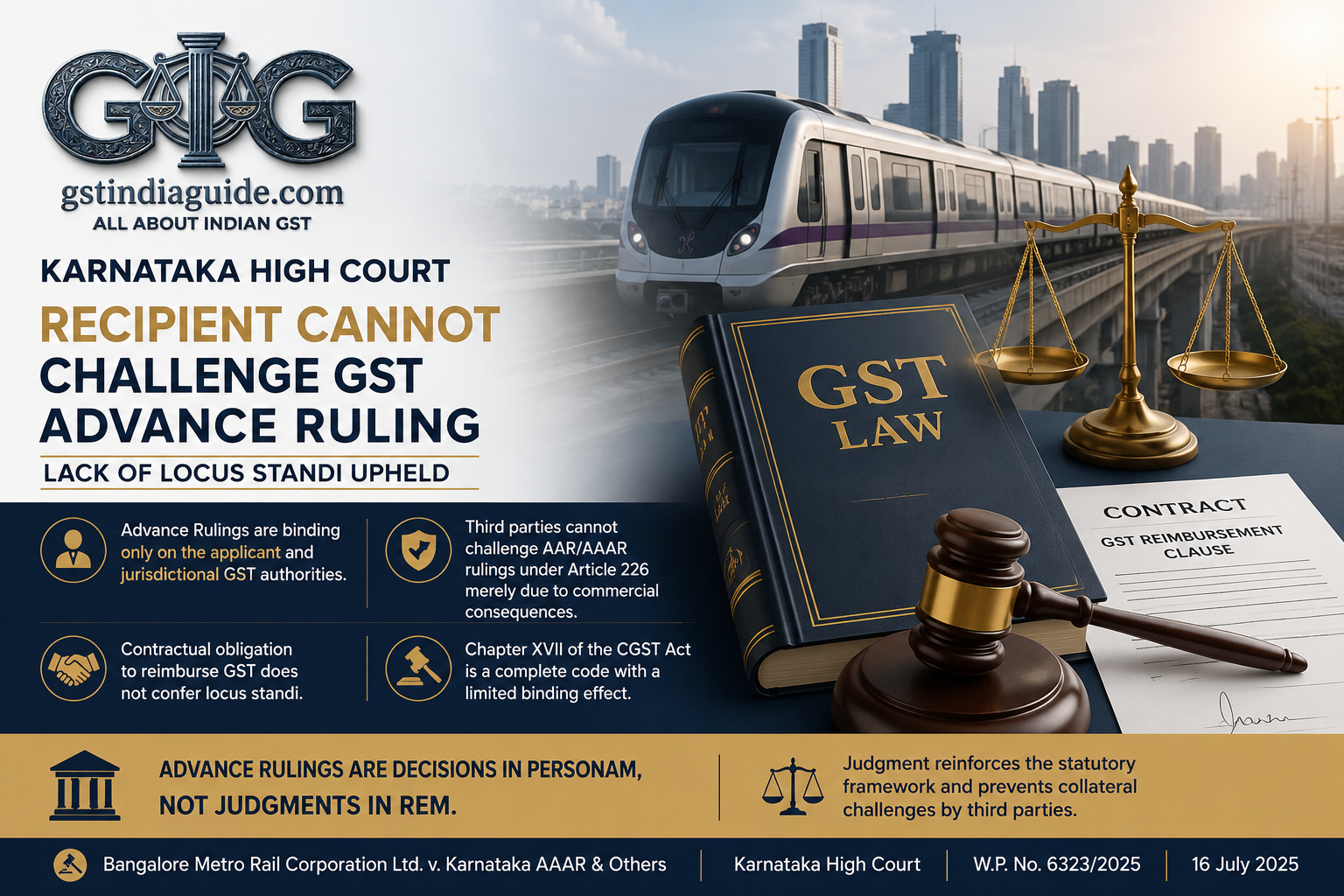
The Karnataka High Court, in Bangalore Metro Rail Corporation Ltd. (BMRCL) v. Karnataka Appellate Authority for Advance Ruling & Others, has delivered an important judgment on the scope and binding effect of Advance Rulings under the GST regime. The Court examined whether a recipient of goods or services, who was not an applicant before the Authority for Advance Ruling (AAR) or the Appellate Authority for Advance Ruling (AAAR), could challenge an adverse advance ruling merely because it resulted in a higher GST reimbursement obligation under a commercial contract.
The Court ultimately dismissed the writ petition, holding that the petitioner lacked locus standi since the statutory framework under Chapter XVII of the CGST Act confines the binding effect of advance rulings only to the applicant and the concerned jurisdictional tax authorities.
Background
BMRCL had entered into a contract with Bharat Earth Movers Limited (BEML) for the supply of metro rail intermediate cars. The contract required BMRCL to reimburse the “applicable GST” charged by BEML.
BEML sought an Advance Ruling regarding the classification of the supplies. While the Karnataka AAR initially treated the transaction as a composite supply, the Karnataka AAAR reclassified different portions of the contract into separate supplies attracting GST at varying rates ranging from 5% to 28%. Since BMRCL was contractually obligated to reimburse GST, it challenged the AAAR order before the Karnataka High Court despite not being a party to the Advance Ruling proceedings.
Key Issues Before the Court
The principal question before the Court was whether:
- A person who was neither the applicant before the AAR/AAAR nor the concerned jurisdictional officer could challenge an Advance Ruling under Article 226 of the Constitution.
- A contractual obligation to reimburse GST creates sufficient civil consequences to confer locus standi on such third party.
Key Findings of the Karnataka High Court
The High Court held that Chapter XVII of the CGST Act constitutes a complete code governing Advance Rulings.
The Court observed that Section 103 expressly provides that an Advance Ruling is binding only upon:
- the applicant who sought the ruling; and
- the concerned or jurisdictional GST officer in relation to that applicant.
Accordingly, a third party cannot either rely upon or challenge such a ruling merely because it may indirectly affect its commercial interests.
The Court further held that the concept of an “aggrieved person” applicable in ordinary litigation cannot be imported into the special statutory framework governing Advance Rulings.
Contractual Reimbursement Did Not Confer Locus
BMRCL argued that it would ultimately bear the increased GST burden because the contract required reimbursement of the applicable GST.
The Court rejected this contention, noting that the agreement did not prescribe any specific GST classification or tax rate. It merely obligated BMRCL to reimburse the GST “as applicable” under law. Since the contract itself left the applicable GST to be determined in accordance with law, the AAAR ruling did not alter the contractual terms or impose any new liability beyond what the parties had already agreed.
Reliance on Section 103 of the CGST Act
The judgment places significant emphasis on Section 103 of the CGST Act.
According to the Court, the legislature intentionally restricted the binding nature of Advance Rulings to the applicant and jurisdictional authorities. Extending the right to challenge such rulings to third parties would amount to rewriting the statutory framework and expanding the scope of Chapter XVII beyond legislative intent.
Important Legal Principles
The judgment reiterates several important principles under GST law:
- Advance Rulings are decisions in personam and not judgments in rem.
- Only the applicant and the concerned GST authorities are bound by an AAR or AAAR ruling.
- Third parties cannot invoke Article 226 merely because the ruling has indirect financial implications.
- A contractual obligation to reimburse GST does not automatically create locus standi to challenge an Advance Ruling.
- Courts cannot rewrite contractual provisions or import classification clauses that parties themselves never agreed upon.
Why This Judgment is Important
This ruling significantly clarifies the limited scope of GST Advance Rulings. Businesses entering supply contracts that contain GST reimbursement clauses should carefully appreciate that the recipient cannot ordinarily challenge an Advance Ruling obtained by the supplier.
The judgment also reinforces the statutory character of Chapter XVII of the CGST Act and limits collateral challenges by persons who are not parties to Advance Ruling proceedings.
Conclusion
The Karnataka High Court dismissed BMRCL’s writ petition, holding that it had no locus standi to challenge the AAAR order. The Court concluded that Advance Rulings under the GST law remain binding only upon the applicant and the concerned tax authorities, and cannot be challenged by third parties merely because they may suffer indirect commercial consequences.