
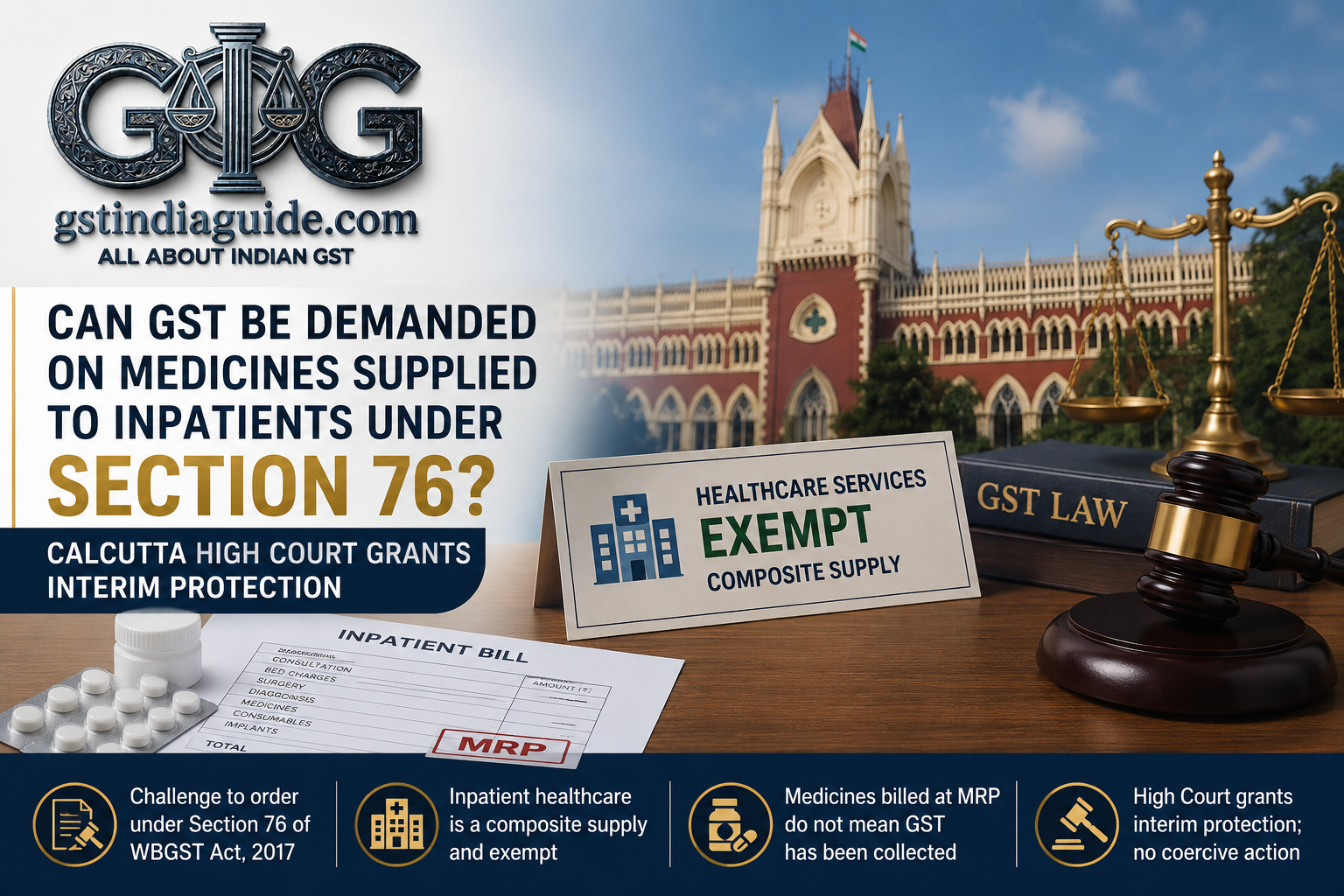
The Calcutta High Court, in M/s. Narayana Hrudayalaya Limited v. The Joint Commissioner of State Tax, Large Taxpayer Unit & Ors., has considered an important issue concerning the levy of GST on medicines and consumables supplied to hospital inpatients. The writ petition challenges an order passed under Section 76 of the West Bengal GST Act alleging that the hospital collected tax embedded in the Maximum Retail Price (MRP) of medicines without remitting it to the Government. The Court has granted interim protection while calling for affidavits from the parties.
The petitioner, a multi-specialty hospital providing exempt healthcare services, contended that treatment provided to admitted patients constitutes a composite supply in which healthcare is the principal supply. Medicines, consumables, implants, room charges and other ancillary supplies form part of the overall healthcare package and therefore enjoy the same exemption. Although medicines were shown separately in inpatient bills and charged at MRP, no GST was separately collected from patients. According to the petitioner, charging MRP as a matter of business policy cannot be equated with collection of GST so as to attract Section 76 of the GST law.
The State authorities, however, argued that medicines were separately billed at MRP and therefore represented an amount collected as tax. Relying upon Section 76, they maintained that the provision applies even where the underlying supply is exempt if any amount representing tax has been collected.
The petitioner relied upon the Supreme Court’s decision in Deputy Commissioner of Commercial Taxes v. Hindustan Lever Ltd. to contend that adopting a uniform MRP across the country is a legitimate business practice and does not by itself establish that tax has been collected. Reliance was also placed upon the Bombay High Court decision in Spanv Medisearch Lifesciences Pvt. Ltd. v. Union of India, which recognised that exempt healthcare services cannot be fragmented merely because medicines are supplied as part of inpatient treatment. The petitioner further referred to an order passed in its own case by the Mysore CGST Commissionerate dealing with similar issues relating to composite healthcare services.
After considering the rival submissions, the High Court observed that the dispute raises a significant conflict between the concept of an exempt composite healthcare supply and the allegation that medicines billed separately constitute taxable supplies attracting Section 76. Since the matter requires detailed consideration, the Court directed the respondents to file their affidavit and listed the matter for further hearing. Pending adjudication, the Court restrained the authorities from taking any coercive steps or giving effect to the impugned order dated 25 February 2026 until the next date of hearing.
Why This Judgment Is Important
This interim order is significant for hospitals, healthcare service providers, GST practitioners and tax professionals. It highlights the continuing controversy regarding the GST treatment of medicines supplied during inpatient treatment, the scope of composite supply under Section 2(30), and the circumstances in which Section 76 can be invoked. The final outcome is likely to have substantial implications for hospitals following the practice of billing medicines separately while providing exempt inpatient healthcare services.