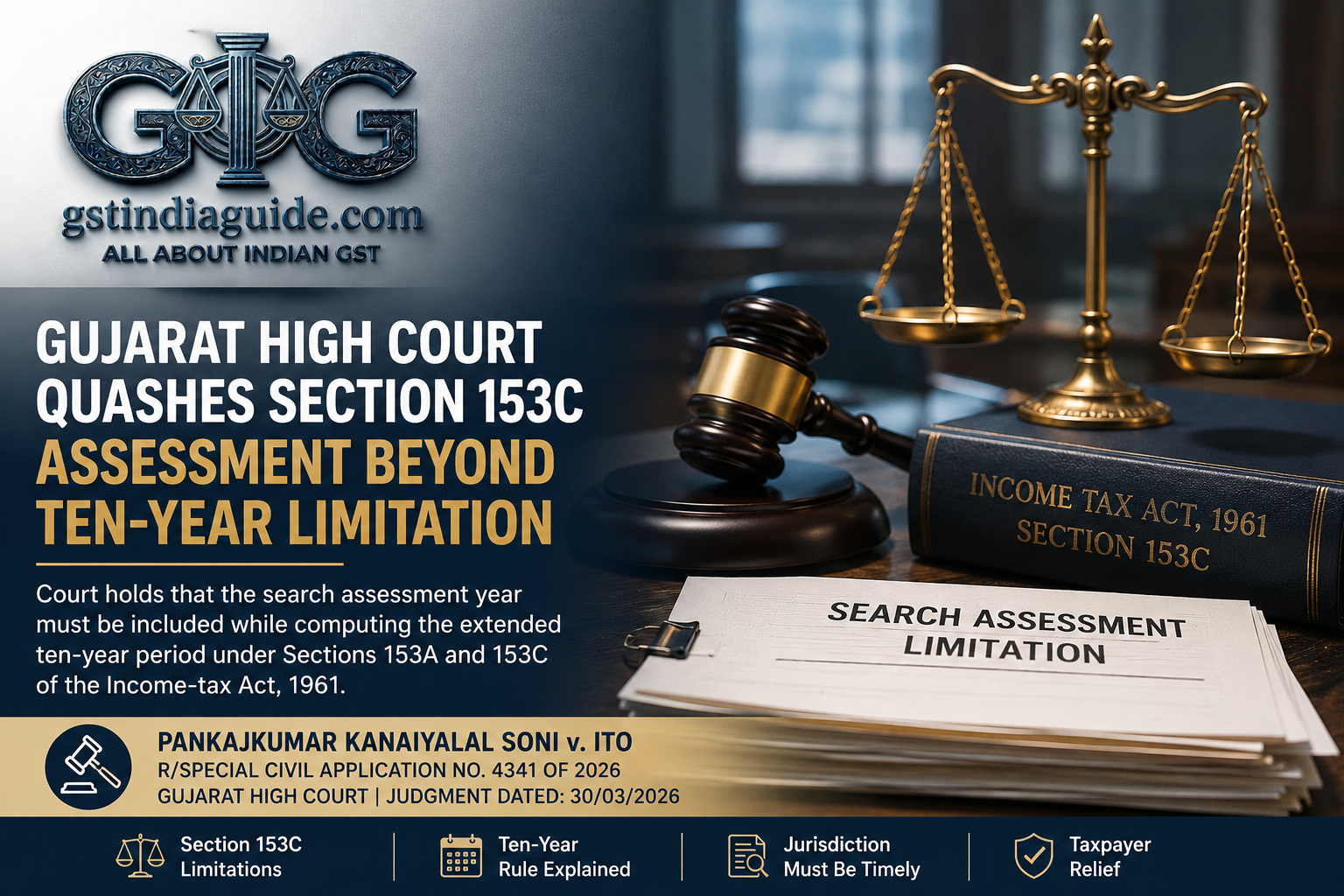
The Gujarat High Court, in Pankajkumar Kanaiyalal Soni v. Income Tax Officer, has delivered an important judgment on the computation of limitation under Sections 153A and 153C of the Income-tax Act, 1961. The Court examined whether proceedings initiated against a person other than the searched person could be sustained when the relevant assessment year fell beyond the statutory ten-year period prescribed under the law.
The dispute arose from a search conducted on third parties in March 2018, during which digital evidence allegedly relating to the petitioner was recovered. The seized material was subsequently transmitted to the petitioner’s Jurisdictional Assessing Officer in July 2021, following which proceedings under Section 153C were initiated for Assessment Year 2010-11. The petitioner challenged both the notice and the consequential assessment order primarily on the ground of limitation.
The principal issue before the High Court was the correct method of computing the extended ten-year assessment block under Explanation 1 to Section 153A, as applicable to Section 153C proceedings. The Revenue argued that the assessment year corresponding to the year in which the seized material was received should be excluded while computing the ten-year period. The petitioner, however, contended that the search assessment year itself must be included in the computation.
After an elaborate analysis of the statutory language, the Gujarat High Court held that Parliament has consciously adopted two different computational mechanisms under Section 153A. While the six-year block refers to assessment years “immediately preceding” the search assessment year, the extended ten-year block is to be reckoned “from the end of the assessment year” relevant to the previous year in which the search was conducted or the seized material was received. Consequently, the search assessment year forms the first year in the ten-year computation and cannot be excluded.
The Court also relied upon earlier decisions of the Delhi High Court, the Madras High Court and its own earlier judgments, reiterating that the statutory language governing the ten-year block is distinct from that applicable to the six-year block and must be interpreted independently. Applying this interpretation, Assessment Year 2010-11 fell outside the permissible ten-year period because the relevant computation commenced from Assessment Year 2022-23.
Accordingly, the Gujarat High Court quashed the notice issued under Section 153C, the consequential assessment order passed under Sections 144 read with 153C and 250, as well as the demand notice issued under Section 156, holding the entire proceedings to be barred by limitation. The judgment reinforces that jurisdiction under Section 153C is strictly circumscribed by the statutory limitation period and cannot be extended through an alternative method of computation.
Why This Judgment Matters
This decision is significant for taxpayers, Chartered Accountants, tax advocates and litigation professionals dealing with search assessments under Sections 153A and 153C. It provides authoritative guidance on the computation of the extended ten-year limitation period and reiterates that jurisdictional requirements under search assessment provisions must be strictly satisfied. The ruling is likely to have considerable impact in pending litigation involving notices issued beyond the permissible limitation period.