
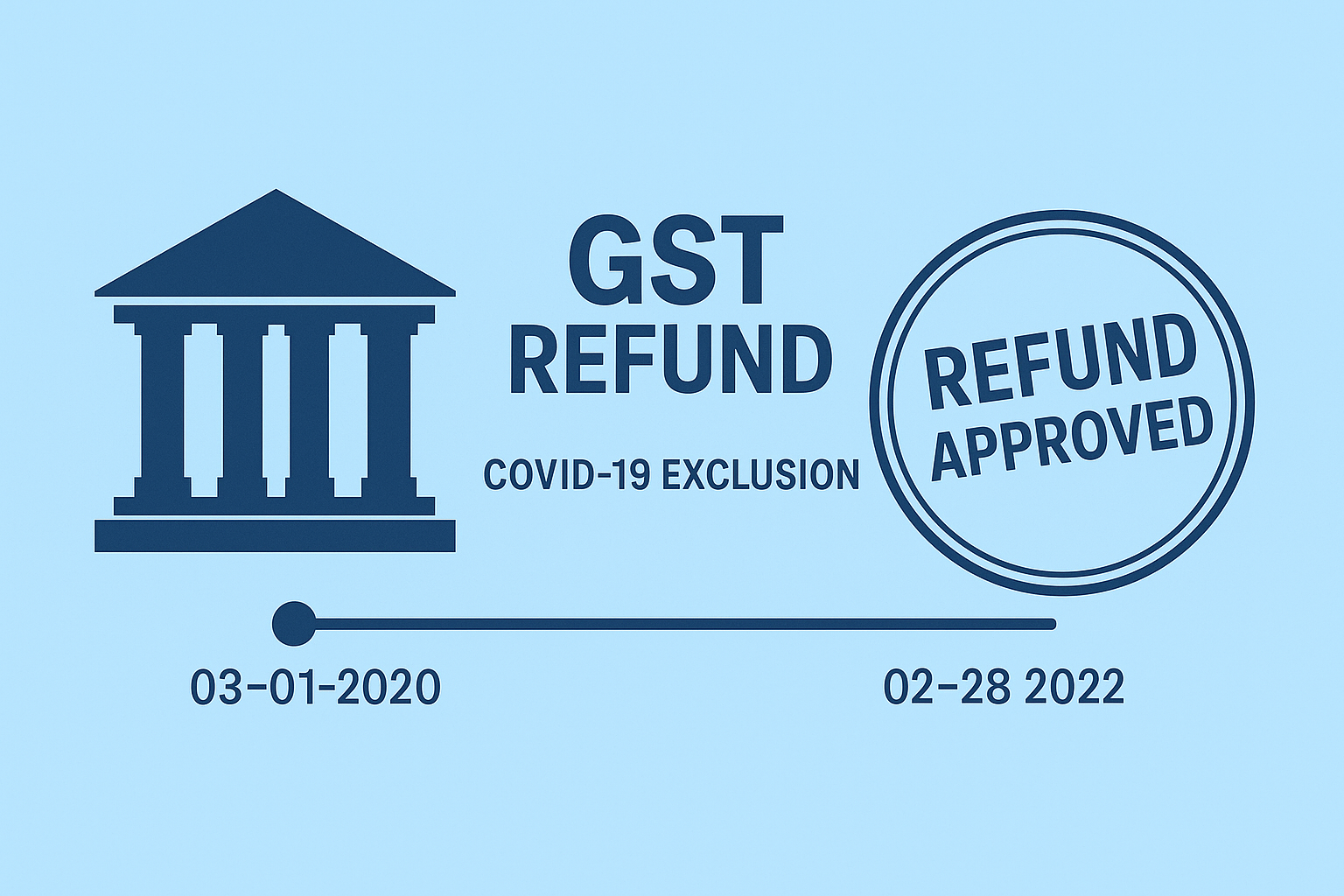
Case Summary: Mahalaxmi Exports v. Commissioner of Delhi GST
Delhi High Court | W.P.(C) 12697/2023 | Category: Refund – Limitation | Date of Judgment: 26 September 2023
Relevant Provisions: Section 54(1) CGST Act; Notification No. 13/2022-CT dated 05.07.2022; Suo Motu W.P.(C) No. 3/2020 (SC extension of limitation)
Facts (Paras 5–12)
The petitioner, Mahalaxmi Exports, challenged the orders dated 28.01.2022 (adjudication) and 11.08.2023 (appellate order), whereby the authorities denied refund of unutilised Input Tax Credit arising out of zero-rated supplies for the period 1 April 2019 to 30 September 2019. The refund application of ₹6,57,568 was filed on 28.11.2021 and duly acknowledged through Form GST RFD-02 on 30.12.2021. On the same day, a show-cause notice under GST RFD-08 was issued proposing rejection on the ground that the claim was filed beyond the two-year limitation under Section 54(1) of the CGST Act.
The petitioner replied on 13.01.2022, contending that the delay was attributable to the COVID-19 pandemic and that the Supreme Court’s extension-of-limitation orders safeguarded the filing period. Nevertheless, the adjudicating authority rejected the refund on 28.01.2022, and the appellate authority affirmed the rejection on 11.08.2023, solely citing limitation.
Questions / Issues (Paras 9–16)
-
Whether the refund claim was time-barred under Section 54(1) CGST Act, once the COVID-19 exclusion period notified by CBIC vide Notification No. 13/2022-CT dated 05.07.2022 and the Supreme Court’s suo motu extension were taken into account.
-
Whether the authorities erred by ignoring the mandatory exclusion of 01.03.2020–28.02.2022 for computing limitation for refund filings.
-
Whether the petitioner was entitled to a fresh adjudication and processing of refund along with statutory interest.
Court’s Observations (Paras 13–16)
The Court noted that the petitioner’s claim was covered by both (i) the Supreme Court orders issued in Suo Motu W.P.(C) No. 3/2020 granting universal extension of limitation due to the pandemic, and (ii) Notification No. 13/2022-CT, which expressly excluded 01.03.2020 to 28.02.2022 for the purpose of filing refund applications under Sections 54 and 55 of the CGST Act.
The Court further held that once this exclusion was applied, the petitioner’s refund application was unquestionably within time, and the authorities had committed an error in declining the benefit of the notification merely because it had been issued after the original refund rejection. The High Court clarified that the benefit of the exclusion applies retrospectively for computation of limitation, and refusal to extend such benefit defeats both the statutory mandate and the Supreme Court’s binding directions.
Judgment / Final Holding (Paras 17–19)
The High Court set aside the orders dated 28.01.2022 and 11.08.2023, holding that the refund rejection was unsustainable in law. The respondents were directed to process the refund claim along with applicable interest within two weeks. The writ petition was accordingly allowed.
Table: Cases / Legal Authorities Referred
| Sr. No. | Case / Notification / Authority | Citation / Number | Principle / Verdict |
|---|---|---|---|
| 1 | Suo Motu Writ Petition (Civil) No. 3 of 2020 – Supreme Court | Extension of Limitation Orders (COVID-19) | Supreme Court extended all periods of limitation; authorities must exclude the notified COVID period in computing limitation. |
| 2 | Notification No. 13/2022 – Central Tax dated 05.07.2022 | Issued by CBIC under Section 168 CGST Act | Mandated exclusion of 01.03.2020–28.02.2022 for filing refund claims under Sections 54 and 55. Application becomes within time once exclusion applied. |
Between Fine Lines (Practical Impact for Trade / Industry)
This ruling confirms that all refund claims filed during or after the COVID-19 interruption window must receive the benefit of the exclusion period, regardless of the date on which the refund order or appellate order was passed. Any rejection solely on limitation without applying Notification No. 13/2022-CT is legally untenable. Businesses with pending or rejected refund claims for procedural delay arising during the pandemic can rely on this judgment to seek restoration and processing of refunds with statutory interest.
Disclaimer – “The above summary is for academic purpose only; not formal legal opinion. Seek professional opinion before application. Author or publisher or website shall not be responsible for any usage in any form.”