The petitioner, proprietor of Ashapura Construction, was registered under the GST law since 1 July 2017. A show-cause notice dated 9 May 2023 proposed cancellation of his GST registration for failure to furnish returns for six consecutive months. The registration was simultaneously suspended.
As no reply was filed, the Proper Officer passed an order dated 3 August 2023 cancelling the GST registration with effect from 31 March 2023. The petitioner subsequently filed an appeal under Section 107 of the RGST Act, but the appeal was beyond both the normal period of limitation and the additional condonable period. The Appellate Authority accordingly dismissed the appeal on 10 June 2026 as time-barred.
Issue Before the High Court
The principal question was whether the High Court, in exercise of its extraordinary jurisdiction under Article 226 of the Constitution, could condone a delay beyond the maximum statutory period prescribed under Section 107 and direct the Appellate Authority to decide the GST appeal on merits.
The Court also examined the validity of cancellation from 31 March 2023 and whether a separate show-cause notice was required before giving effect to cancellation from an earlier date.
Rajasthan High Court on Limitation Under Section 107
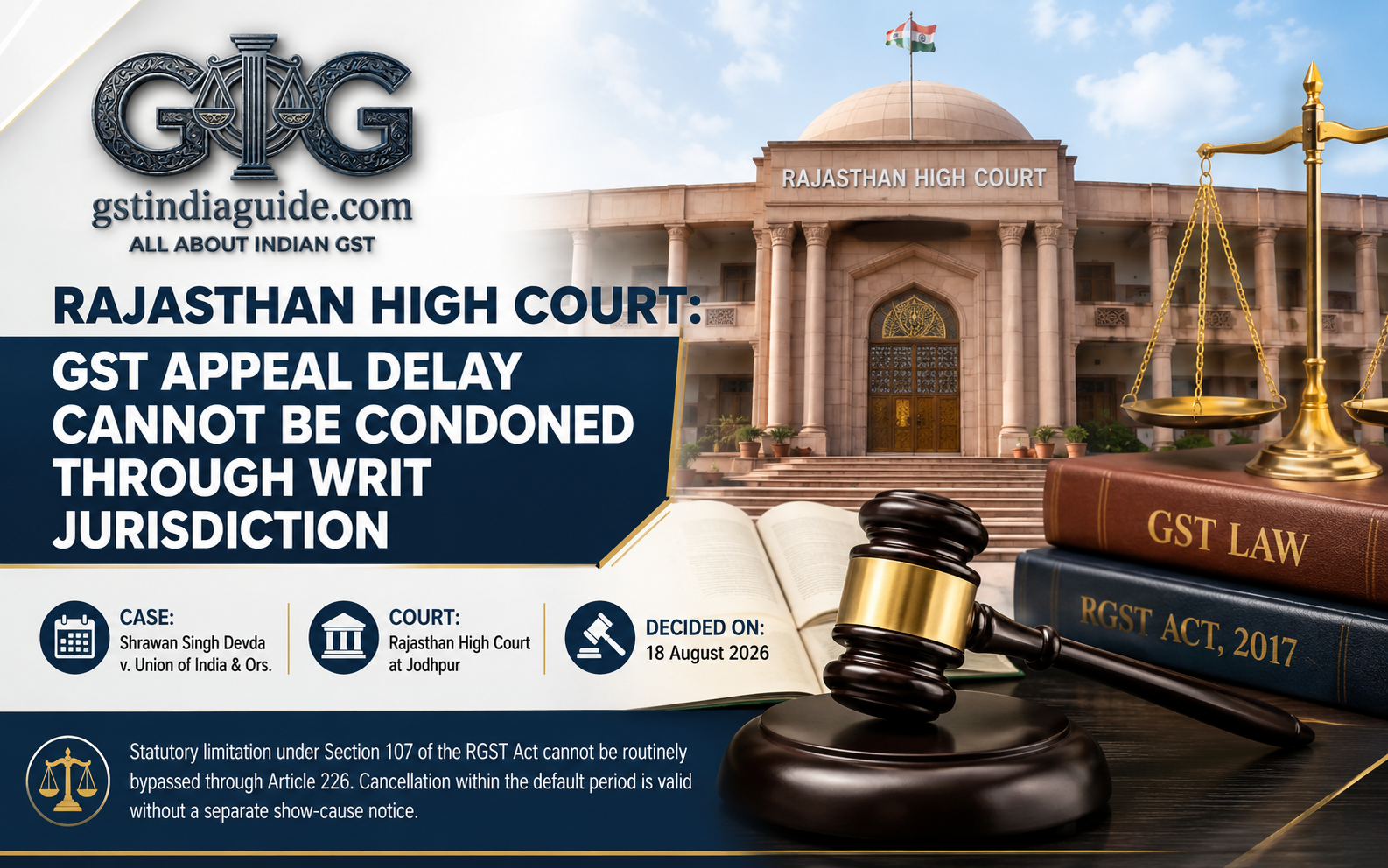
The Division Bench held that where the statutory appeal is filed beyond the maximum limitation period, including the period which the Appellate Authority is empowered to condone, the statutory scheme cannot ordinarily be circumvented by invoking Article 226.
The Court clarified that there is no absolute bar on exercise of writ jurisdiction merely because the period for statutory appeal has expired. However, such jurisdiction cannot be exercised as a matter of course to condone delay and remit the appeal for consideration on merits.
Interference after expiry of statutory limitation may be justified only in exceptional circumstances, including cases involving complete disregard of principles of natural justice or an inherent lack of jurisdiction. No such exceptional circumstance was established in the present case.
Cancellation From a Date Falling Within the Default Period
The Court observed that Section 29(2)(c) empowers the Proper Officer to cancel registration where returns have not been furnished for a continuous period of six months.
Although retrospective cancellation cannot be ordered mechanically and must ordinarily be supported by objective criteria and valid reasons, the Court distinguished a cancellation made effective from a date within the period of default from one extending to a date preceding the period of violation.
Since the petitioner’s registration was cancelled with effect from 31 March 2023, which fell within the period of default, the Court held that it was not a retrospective cancellation “in the strict sense”.
Separate Show-Cause Notice Not Required
The High Court rejected the contention that a separate show-cause notice was mandatory before cancellation could be given effect from an earlier date.
According to the Court, Section 29 requires issuance of a show-cause notice before cancellation of registration, informing the registered person about the alleged non-compliances forming the basis of the proposed action. The statute does not require a separate notice merely because the cancellation order may operate from an earlier date.
Earlier Rajasthan High Court Decisions Held Per Incuriam
An important aspect of the judgment concerns conflicting Rajasthan High Court decisions on condonation of delay.
The Bench held that the decision in M/s Molana Construction Company v. Central Goods & Service Tax Department & Ors., and subsequent decisions founded upon it, were rendered without considering the earlier Division Bench ruling in Ashok Verandani and relevant Supreme Court precedents.
The Court consequently held such decisions to be per incuriam insofar as they permitted condonation beyond the statutory limitation contrary to the binding legal position.
Final Decision
The Court found no exceptional circumstances warranting interference with the cancellation order or the appellate order dismissing the delayed appeal.
It also rejected the challenge based on Articles 14, 19(1)(g) and 21, observing that the petitioner was not rendered remediless because the statutory framework permitted him to apply for fresh registration in accordance with law.
Accordingly, the writ petition was dismissed, and pending interlocutory applications were disposed of.
Key Takeaway
The judgment reinforces that the limited condonation period prescribed under Section 107 of the GST law cannot ordinarily be enlarged through Article 226. While constitutional writ jurisdiction remains available in exceptional cases involving fundamental jurisdictional defects or serious violations of natural justice, it cannot routinely be used to bypass the statutory limitation framework.
It also clarifies that cancellation taking effect from a date falling within the taxpayer’s period of default is not necessarily a retrospective cancellation in the strict sense requiring separate justification applicable to periods preceding the default.