
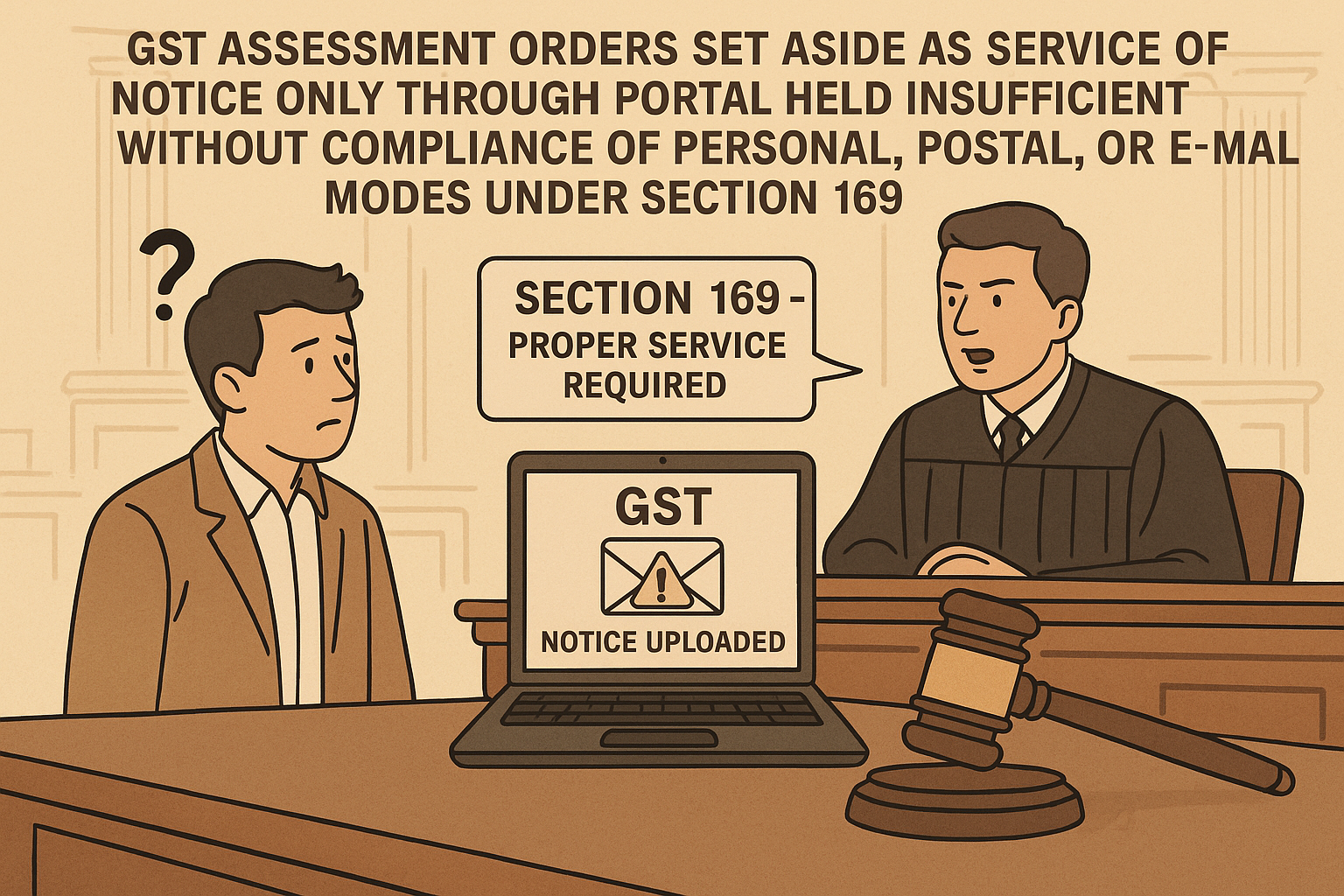
Case Title: Udumalpet Sarvodaya Sangham v. Deputy Commissioner of Labour & Ors.
Court: Madurai Bench of Madras High Court
Petition No.: W.P.(MD) Nos. 26481, 25801, 25855, 25979, 25773, 25952, 27362, 27363, 27357–27361, 27869 & 27190 of 2024 (and batch)
Date of Judgment: 06.01.2025
Category: Principles of Natural Justice / Service of Notice under GST
Relevant Sections: Section 169 of the CGST/TNGST Act, 2017; Rule 149 of CGST Rules
Facts (Paras 2–5)
The petitioners challenged assessment orders passed under the Tamil Nadu GST Act, 2017, contending that notices and orders were only uploaded on the departmental web portal without serving them through other prescribed modes under Section 169(1)(a)–(f).
Most petitioners were small traders unfamiliar with the portal, relying on tax practitioners who registered their own contact details. Consequently, they were unaware of notices issued and could not respond. Petitioners argued that all sub-clauses of Section 169(1) should be read conjunctively, ensuring effective communication to preserve natural justice.
Questions Before the Court
-
Whether uploading notices/orders on the GST portal alone constitutes valid service under Section 169 of the TNGST/CGST Act.
-
Whether failure to serve through other prescribed modes violates the principles of natural justice.
Observations (Paras 6–21)
-
The State contended that service through the portal suffices, citing Pandidorai Sethupathi Raja v. Superintendent of Central Tax (2022 SCC Online Mad 8986) and other decisions supporting electronic service as valid.
-
However, the Court compared Section 169 of the GST Act with Rule 52 of the TNGST Rules, 1959, observing that both use alternative but sequential modes of service.
-
Drawing from Singaravelar Spinning Mills (P) Ltd. v. State of Tamil Nadu (2010 SCC Online Mad 6454), the Court held that Clauses (a) to (c) (personal, postal, e-mail) are alternative modes, but if those are impracticable, only then may Clauses (d) to (f)** (portal publication, newspaper, affixture)** be invoked.
-
The judgment emphasizes that statutory rules cannot override legislative mandates; hence, Rule 149 allowing electronic service cannot dilute Section 169’s prescribed sequence.
-
The Court found that interpreting Section 169 disjunctively (allowing portal-only service) would defeat natural justice and the object of giving the assessee a fair opportunity to respond.
Judgment (Paras 22–25)
-
Section 169 mandates service in person, by post, or by e-mail alternatively; only if these are impracticable can service through the portal or publication be resorted to.
-
Therefore, assessment orders based solely on portal upload were quashed.
-
Petitioners were directed to submit replies to show cause notices by 31.01.2025, after which authorities must provide a personal hearing and pass fresh orders on merits.
-
The writ petitions were allowed; no costs imposed.
Table – Cases Referred
| Case Name | Court & Citation | Legal Issue | Verdict / Relevance |
|---|---|---|---|
| Pandidorai Sethupathi Raja v. Superintendent of Central Tax | Madras HC, 2022 SCC OnLine Mad 8986 | Validity of portal service | Held portal service sufficient under specific facts; distinguished in present case |
| Singaravelar Spinning Mills (P) Ltd. v. State of Tamil Nadu | Madras HC, 2010 SCC OnLine Mad 6454 | Modes of notice service | Clauses (a)-(c) are alternative, not cumulative; must be attempted before affixture |
| M. Satyanarayana v. State of Karnataka | SC, 1986 (2) SCC 512 | Disjunctive interpretation of service provisions | Clarified alternative modes under service laws; cited by State |
| Ram Prasad Sharma v. Chief Commissioner | MP HC, 2020 SCC OnLine MP 4650 | Rule 142 service validity | Not applicable—different facts |
| Pee Bee Enterprises v. AC, Kerala GST Dept. | Kerala HC, 2020 SCC OnLine Ker 3331 | Portal & email service | Factually different—service also made by email/post |
Between Fine Lines – Trade Takeaway
This ruling reaffirms that mere portal upload does not amount to valid service of notice under GST. Authorities must first attempt personal, postal, or e-mail communication before relying on electronic publication. Businesses unaware of portal notices can seek relief by invoking natural justice. The decision offers crucial procedural protection to small taxpayers dependent on consultants.
Disclaimer – “The above summary is for academic purpose only; not formal legal opinion. Seek professional opinion before application. Author or publisher or website shall not be responsible for any usage in any form.”