


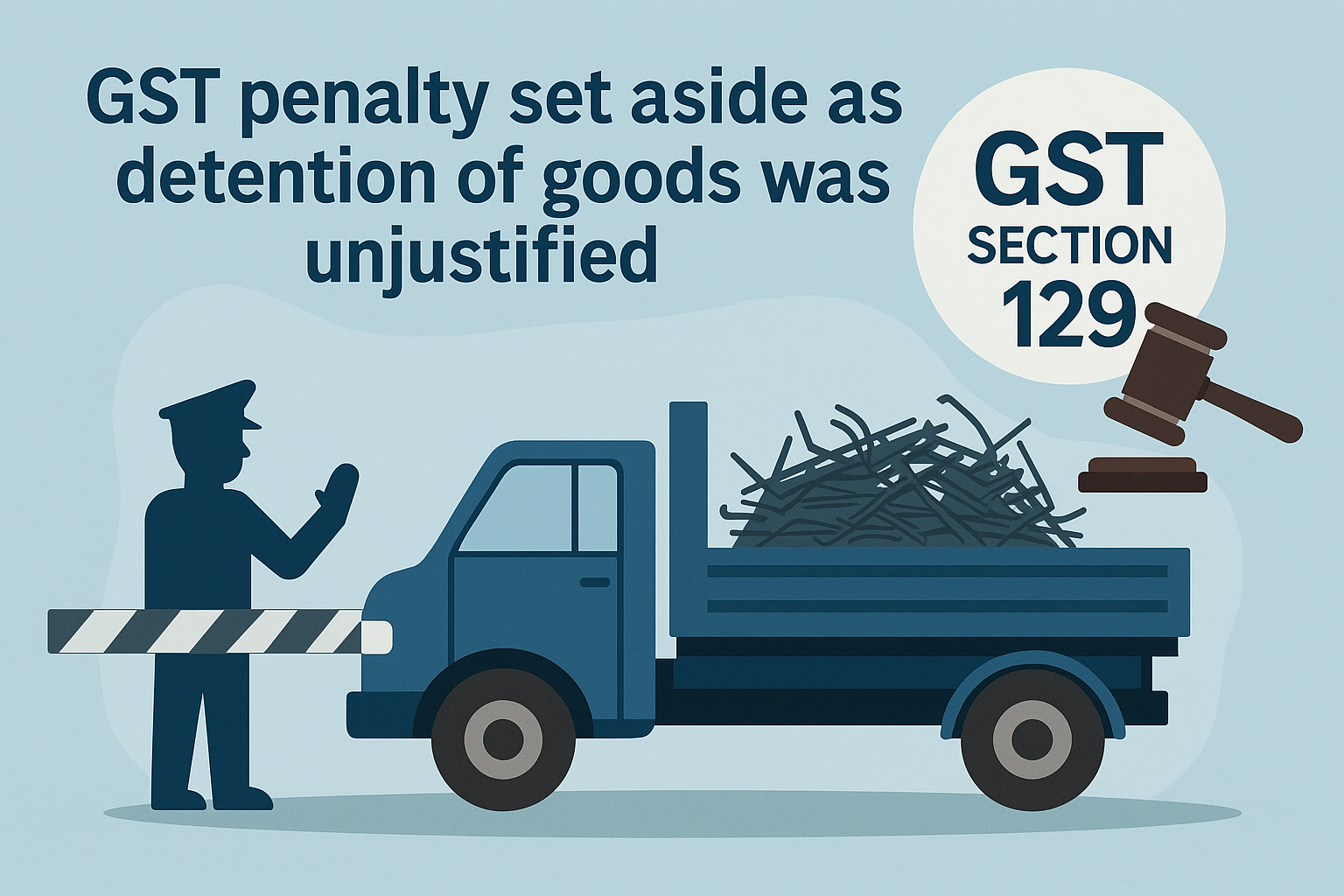
Case Title: RNYN Steel v. Assistant Commissioner (ST), Adjudication Intelligence – I, Chennai
Court: Madras High Court
Petition No.: W.P. No. 18398 of 2022
Date of Judgment: 19.12.2024
Category of Dispute: Detention of Goods / Penalty under Section 129 – E-way Bill Compliance
Relevant Sections: Section 129(1) & (3) of the Central Goods and Services Tax Act, 2017
Facts (Paras 2–6)
The petitioner, RNYN Steel, had purchased MS scrap from Tvl. Nav Durga Steel Zone, Chennai, with a valid e-way bill dated 20.04.2022, expiring on 21.04.2022. After delivery at its Ambattur godown, the same goods were re-supplied to Maa Mahamaya Industrial Ltd., Andhra Pradesh on the same day under a fresh e-way bill valid till 25.04.2022. During transport, the goods were intercepted at Redhills at 5.50 p.m. The driver produced all documents, yet the vehicle was detained, and the officer imposed a penalty of ₹5,11,928 under Section 129. The petitioner paid the amount for release and challenged the penalty order for being issued without notice or hearing, and not uploaded on the GST portal.
Questions for Consideration
Whether the detention of goods and levy of penalty under Section 129(1) r/w 129(3) of CGST Act, 2017 were legally sustainable when valid e-way bills were in place and no procedural opportunity was provided to the taxpayer.
Observations (Paras 10–11)
The Court examined the Physical Verification Report (Form MOV-04) signed by the driver and found no justification for seizure or detention. The Court observed that mere suspicion based on loading at Ambattur could not warrant penalty when valid e-way bills existed, and no evidence indicated evasion. The Court emphasized that Section 129 authorizes detention only upon clear contravention of provisions, which was absent in this case.
Judgment (Paras 12–13)
The Madras High Court quashed the penalty order dated 21.04.2022, holding it without merit or legal foundation. It directed that the penalty amount already paid be adjusted towards the regular tax liability of the petitioner. The Court thus reaffirmed that arbitrary detention without specific contravention under Section 129 violates the principles of legality and fairness in tax enforcement.
Summary of Cases Referred
| Case | Court | Principle / Verdict |
|---|---|---|
| No other precedents cited in the order | — | The case was decided on its own merits, emphasizing statutory compliance under Section 129. |
Between Fine Lines
This decision underscores that mere procedural doubts during transport cannot justify detention when all valid e-way bills are present. Tax authorities must ensure reasoned findings and adherence to Section 129 safeguards before imposing penalties. For trade, it reinforces that maintaining accurate and valid e-way documentation shields transport consignments from arbitrary enforcement.
Disclaimer – “The above summary is for academic purpose only; not formal legal opinion. Seek professional opinion before application. Author or publisher or website shall not be responsible for any usage in any form.”

