(b) of the CGST Act and holds prior CGST proceedings are not barred by subsequently initiated SGST proceedings.)
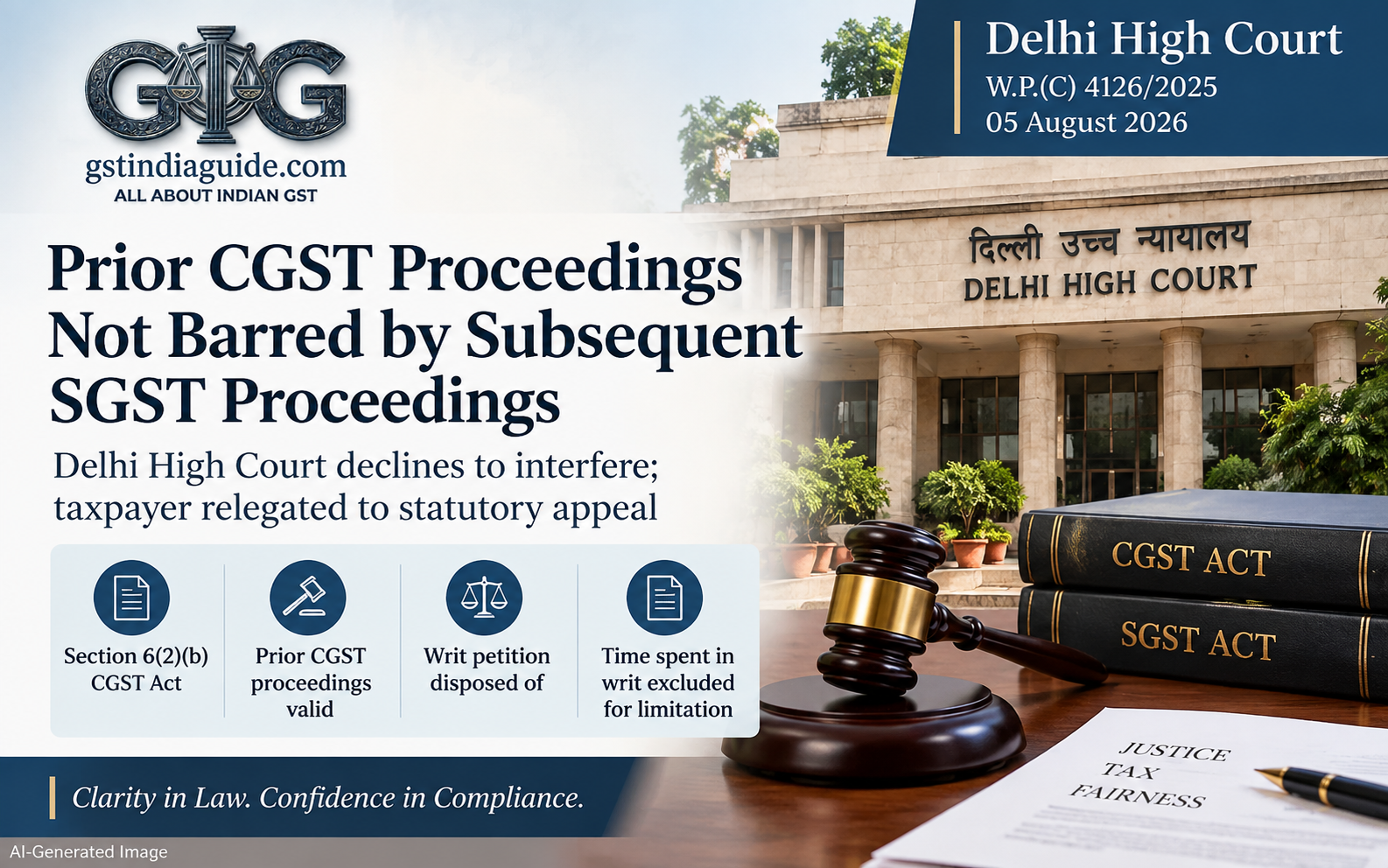
Case: Shub Conductors LLP and Ors. v. Joint Commissioner Central Tax GST Delhi East Delhi and Ors.
Court: Delhi High Court, Division Bench
Case No.: W.P.(C) 4126/2025 and CM APPL. 19123/2025
Date of Decision: 5 August 2026
Coram: Justice Anil Kshetrapal and Justice Shail Jain
Background
Shub Conductors LLP and others approached the Delhi High Court challenging an order dated 11 January 2025 passed pursuant to proceedings under Section 74 of the Central Goods and Services Tax Act, 2017.
The CGST authorities had issued a show-cause notice on 22 March 2023 covering financial years 2017-18 to 2021-22, alleging wrongful availment of input tax credit and evasion of tax. The petitioners contended, inter alia, that proceedings by the CGST authorities were barred under Section 6(2)(b) of the CGST Act because proceedings had also been undertaken by the SGST authorities.
Issue Before the Court
Whether the CGST proceedings were barred under Section 6(2)(b) of the CGST Act on account of proceedings initiated by the SGST authorities, and whether the High Court should exercise writ jurisdiction despite the statutory appellate remedy under Section 107.
Delhi High Court’s Findings
The Court observed that Section 6(2)(b) provides that where a proper officer under the State GST Act has initiated proceedings on a subject matter, no proceedings shall be initiated by the proper officer under the CGST Act on the same subject matter.
However, the chronology was crucial. The CGST show-cause notice under Section 74 was issued on 22 March 2023, whereas the first notice relied upon from the SGST authorities was issued subsequently on 25 September 2023.
Accordingly, the Court found no jurisdictional infirmity under Section 6(2)(b) that would justify bypassing the statutory appellate remedy.
The Court also distinguished the earlier proceedings relating to goods seized during the search from the subsequent Section 74 proceedings arising after investigation. Merely on that basis, the two could not be treated as parallel adjudication of the same subject matter.
Alternative Remedy and Writ Jurisdiction
The Court acknowledged the principle that availability of an alternative remedy does not make a writ petition inherently non-maintainable. However, whether the High Court should entertain such a petition remains a matter of judicial discretion.
Since no jurisdictional defect was established in the present proceedings, the Court declined to exercise writ jurisdiction in preference to the effective statutory remedy available under Section 107 of the CGST Act.
Decision
The Delhi High Court disposed of the writ petition and relegated the petitioners to the statutory appellate remedy under Section 107 of the CGST Act.
Importantly, the Court directed that the period spent by the petitioners prosecuting the writ petition before the High Court would be excluded while computing the limitation period for filing the statutory appeal.
Key Takeaway
Where CGST proceedings are initiated before the SGST authorities commence proceedings, Section 6(2)(b) cannot, merely because of the subsequent SGST proceedings, be invoked to establish a jurisdictional bar against the earlier CGST proceedings. In the absence of such jurisdictional infirmity, the taxpayer may be required to pursue the statutory appeal under Section 107 rather than invoke writ jurisdiction.